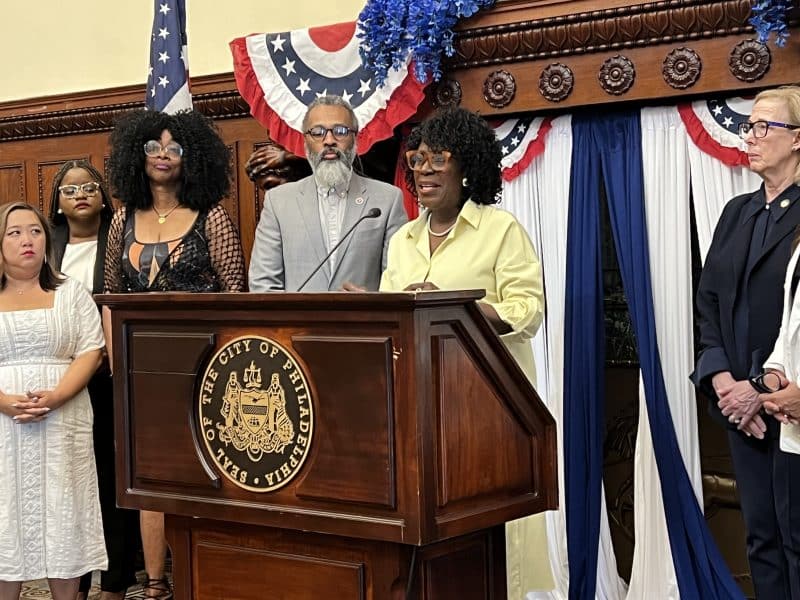
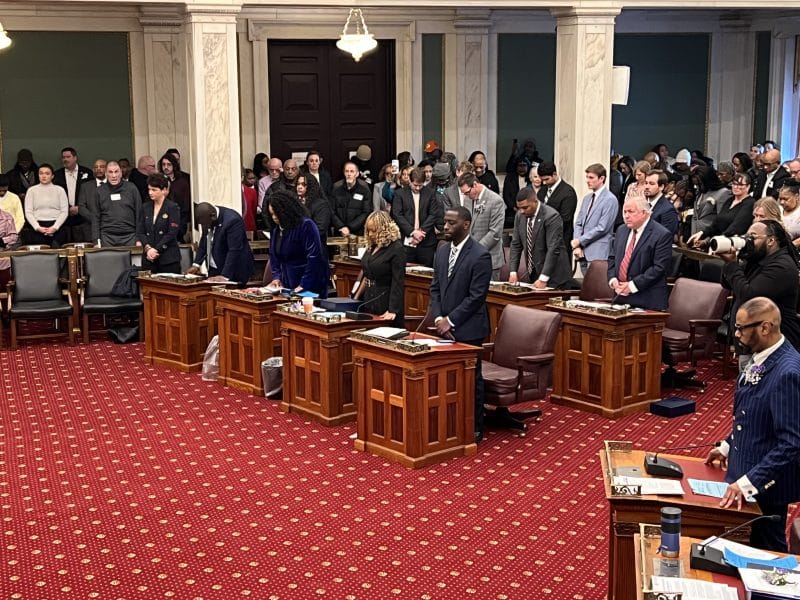
This was another busy week in Philadelphia City Council, as more testimony regarding the potential arena project was heard, and various committees held hearings on key legislation.
L&I Advances Restrictions on Kensington Service Providers
The Philadelphia City Council Committee on Licenses and Inspections heard testimony on Bill No. 240665, which, if passed, would regulate “vehicular mobile service providers and providing for penalties.”
Citing residents’ concerns involving “increasing occurrences” of vehicular mobile service providers “congregated in large numbers to distribute goods…contributing to litter, nuisance behavior, and safety concerns,” Councilmember Quetcy Lozada introduced the legislation at the behest of residents of the 7th Councilmanic District due to the following:
The accumulation of plastic waste, toxic waste, human waste, discarded drug paraphernalia, discarded pills, medical supplies, and various other items on their residential streets which poses a danger to children, the environment, public health, and the dignity of our communities;
Increased social conflict and confrontation, caused by some recipients of mobile services who engage in nuisance and criminal activity, including conduct carried out on nearby residents’ porches, front steps, or in their backyards and
Exposure of their children to traumatic and frequently unsafe conditions arising from the fentanyl crisis.
This legislation protects community safety and well-being and ensures that children, families, and residential communities in the Seventh Councilmanic District are treated with dignity and can enjoy clean, safe communities.
The legislation prohibits mobile providers in the following areas:
No vehicular mobile service provider shall operate within the Seventh Councilmanic District on any residential block.
No vehicular mobile service provider shall operate in any sensitive public area within 50 feet of the sidewalk.
Philadelphia Health Commissioner Frank Franklin offered restrained support for the bill, uncertain how it would be enforced due to ambiguity in the legislation’s definitions.
“I think the challenge comes into play where a lot of the definitional scope of some of the definitions with the current bill as it’s presented makes it difficult to execute,” Franklin said in response to a question from Councilmember O’Rourke. “And if it’s difficult to execute, it’s difficult to enforce.”
Lozada said the Parker Administration has begun conversations about possible locations where providers can offer services. She said concerns about several providers utilizing the same location and drawing large groups of people seeking the services were raised. Ideally, Lozada said, different providers could be stationed in other areas of the neighborhood.
However, providers who work in Kensington and offer needed services, such as wound care, believed the legislation would all but end their ability to work with their patients.
Kara Cohen, a registered nurse and member of the street medicine team at Project HOME, a Philadelphia organization working to break the cycle of homelessness in the city, explained her work in Kensington.
“The services I provide are primary care, low barrier primary care through a holistic and trauma-informed lens,” Cohen said. “We treat people’s blood pressure, diabetes, thyroid disease, untreated HIV, gender-affirming care, pregnancy care, and women’s health care.”
Cohen said she has worked with the city health department to ensure people who have been exposed to syphilis compte the shot regimen of pencils and that her team employs wound-care specialists, especially crucial due to the associated injuries caused by xylazine.
“I’ve been doing street medicine in Philadelphia for seven years,” Cohen said. “I think a lot of times it’s the difference between someone living and someone dying. (If this bill passes) my team would not be able to function.”
Arena Hearings Continue
Representatives from the Philadelphia 76ers and the Parker Administration testified to some unconvinced members of the Philadelphia City Council’s Committee of the Whole meeting on Tuesday, December 3rd, 2024.
A series of questions that remained unanswered from the last hearing attended by the administration and 76ers executives caused the frustration expressed by council members.
Councilmember Rue Landau, in particular, was exasperated by the lack of answers to key questions this late in the process.
” These bills, this timeline, is your timeline,” Landau said. “You want it so bad that we introduced the bills on October 22nd, and we only started hearings on November 12th. You were here testifying on November 14th. We’re following up on the same questions we asked, and still don’t have answers to the questions we need to decide if we can proceed with this.”
A common theme among the 76ers representatives has been the issue of “fairness” and being treated like other sports teams in the city. Councilmember Cindy Bass took umbrage with this statement, pointing out the differences between this arena proposal and those of the other teams.
“The other teams aren’t asking for an arena before we have a sustainable plan for SEPTA,” Bass said. “I continue to think this is an issue that has to be figured out before we give this a ‘yes.'”
Later in the hearing, Bass reemphasized her disappointment with the presentation, particularly with the CBA.
“I’m not particularly impressed,” Bass said. “What is your bottom line? What is the minimum that you’re willing to do? How much more would you be willing to do in the future beyond what you’re currently doing?”
Council’s goal was to have the legislation allowing for the arena to be passed before the end of the calendar year if the project was to go forward. Council President Kenyatta Johnson said the project needed more votes on Thursday. The legislation must be voted out of the Committee of the Whole before next Thursday’s Stated Meeting of Council if it is to be enacted according to that timeline, as all bills and resolutions must be heard twice in council before their final passage.
O’Rourke Calls For SEPTA Funding
Councilmember Nicholas O’Rourke introduced a resolution “urging Pennsylvania State Senate Republicans and Senate Democrats to draft and pass bipartisan legislation that will secure the necessary funding to prevent a fiscal cliff for SEPTA, which could lead to service closures, fare increases, and a decline in mobility and economic activity for the citizens of Philadelphia and neighboring counties.”
Acknowledging the significant funding gap SEPTA faces despite Governor Shapiro’s redirection of $153 million of federal funding, the resolution mentions that the Pennsylvania House of Representatives has passed bipartisan SEPTA funding legislation on three separate occasions, but the Senate has failed to act each time.
The funding provided by “flexing” federal funds is a stopgap measure; longer-term funding must be secured to maintain current service levels and avoid fair increases. The death-spiral scenario, in which SEPTA continuously cuts service due to a lack of funds, which then reduces the amount of rider-generated revenue the organization receives, necessitating more cuts, is still a very real possibility, although temporality has been forestalled.
More Council Legislation Aimed at Preparedness for Incoming Presidential Administration
Councilmember Curtis Jones introduced a resolution “authorizing the Committee on Law and Government to hold hearings to evaluate the financial impacts of the impending Trump Administration on the City of Philadelphia.”
This resolution comes on the heels of similar legislation passed by Councilmember Rue Landau, as the Philadelphia City Council begins to consider what a second Trump administration could mean for cities like Philadelphia and its inhabitants, some of whom, such as the immigrant and LGTBQ communities, have been directly targeted by Trump’s proposed policies.
Concerns regarding education, healthcare, and social safety-net funding are at the forefront of the council’s mind as the year closes out, making the end of 2024 particularly busy as the council works through the typical end-of-year legislation while deliberating on the potential 76ers arena plan. With the inauguration a mere six weeks away, much consideration must be given to the possible political and socioeconomic landscape ushered in by the results of the 2024 election.
This Week’s Committee Hearings
Committee on Licenses and Inspections
Bill No. 240340
An Ordinance amending various provisions of The Philadelphia Code to authorize revisions of various fees by regulation, including license and permit fees under Subcode “A” (The Philadelphia Administrative Code; license fees for food establishments under Title 6 (Health Code); license and permits under Title 9 (Regulation of Businesses, Trades and Professions); license under Section 10-722 (Use of Dumpsters); license under Section 11-610 (Construction Equipment); and license under Chapter 19-600 (Amusement Tax); all under certain terms and conditions.
Bill No. 240665
An Ordinance amending Title 10 of The Philadelphia Code, entitled “Regulation of Individual Conduct and Activity,” by adding a new chapter concerning vehicular mobile service providers, and providing for penalties, all under certain terms and conditions.
Committee on Appropriations
Bill No. 241084
An Ordinance authorizing transfers in appropriations for Fiscal Year 2024 from the General Fund from certain or all City offices, departments, boards and commissions, the Water Fund from certain or all City offices, departments, boards and commissions, the Grants Revenue Fund from certain or all City offices, departments, boards and commissions, and the Transportation Fund from certain or all City offices, departments, boards and commissions, to the General Fund to certain or all City offices, departments, boards and commissions, to the Water Fund to certain or all City offices, departments, boards and commissions and to the Transportation Fund to certain or all City offices, departments, boards and commissions.
Committee on Rules
Bill No. 240871
An Ordinance to amend the Philadelphia Zoning Maps by changing the zoning designations of certain areas of land located within an area bounded by Broad Street, Medary Avenue, Park Avenue and Godfrey Avenue.
Bill No. 241054
An Ordinance amending Section 14-520 of The Philadelphia Code, entitled “/NDO, Ninth District Overlay District,” by reorganizing existing requirements and requiring Special Exceptions for certain uses in designated areas, all under certain terms and conditions.
Bill No. 241044
An Ordinance to amend the Philadelphia Zoning Maps by changing the zoning designations of certain areas of land located within an area bounded by Packer Avenue, Seventh Street, Pattison Avenue, and Darien Street. To amend Title 14 of The Philadelphia Code by adding Section 14-541entitled “/PAK, Packer Avenue Overlay District and making other related changes, all under certain terms and conditions.
Bill No. 241058
An Ordinance to amend the Philadelphia Zoning Maps by changing the zoning designations of certain areas of land located within an area bounded by Oxford Street, Cadwallader Street, Jefferson Street, Germantown Avenue, and 4th Street.
Bill No. 241059
An Ordinance to amend the Philadelphia Zoning Maps by changing the zoning designations of certain areas of land located within an area bounded by Erie Avenue, 9th Street, Hutchinson Street, Ontario Street, Sedgley Street, 6th Street, Glenwood Avenue, and Broad Street
Bill No. 241062
An Ordinance amending Section 14-500 of The Philadelphia Code, entitled “Overlay Zoning Districts,” by amending Section 14-502, entitled “CTR/Center City Overlay District and 14-702, Floor Area, Height, and Dwelling Unit Density Bonuses, and creating Section 14-542, entitled “/PCH, Philadelphia Chinatown Overlay District,” and making related changes all under certain terms and conditions.
Committee on Housing, Neighborhood Development, and the Homeless
Bill No. 240697
Resolution authorizing the Committee on Housing, Neighborhood Development, and the Homeless to hold hearings on how setting affordable housing program eligibility according to the metric of regional Area Median Income (AMI) fails to reflect the true state of housing affordability needs of Philadelphians, how this leads to City housing programs not providing enough funding to those who need it most, and how the adoption of a more locally defined AMI can be utilized to create and sustain genuinely affordable housing across the City of Philadelphia.
Our reporters sit through hours of city council meetings, dig through piles of documents, and ask tough questions other media overlook. Because we’re committed to addressing Philadelphia’s poverty crisis — and challenging those who sustain it. If you think this work is important too, please support our journalism.
We’re counting on readers like you.