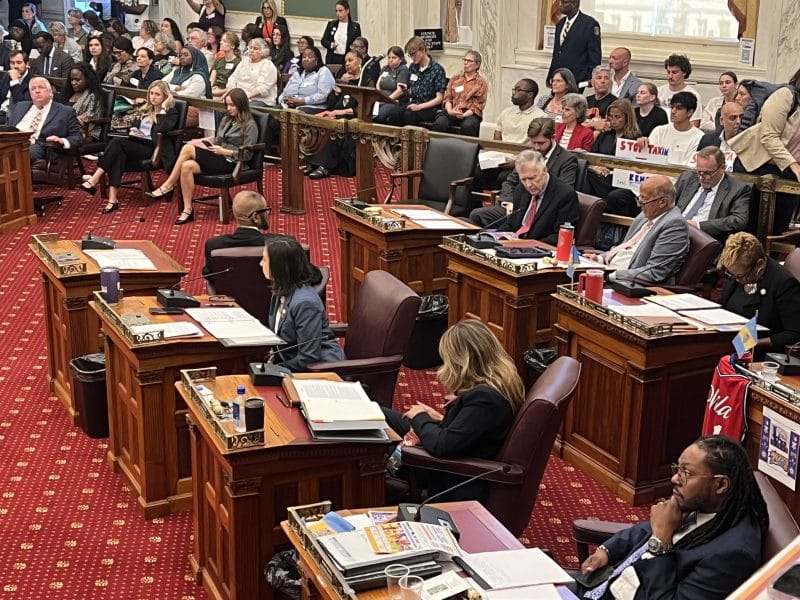
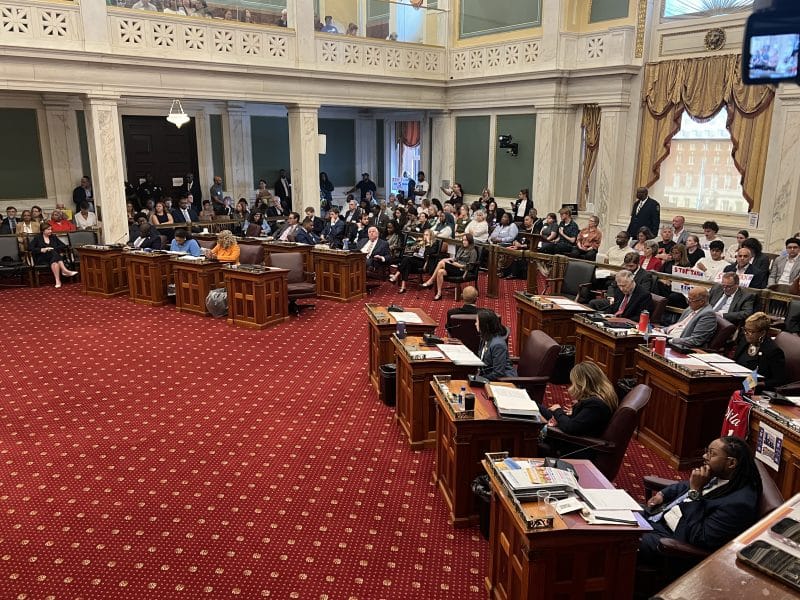
Councilmember Isaiah Thomas introduced a resolution “authorizes the Council Committee on Education to conduct hearings into the governance model of the School Board.”
The dispute between City Council and the School Board has reached a fever pitch as of late, with members of Council angrily confronting the School Board at the meeting where the contentious facilities plan, which is slated to close 17 district schools, was passed by a 6-3 vote. The plan will likely have grave ramifications between Council and the Board well beyond this year’s budget hearings.
Currently, the School Board is appointed by the Mayor after a nominating panel vets potential candidates. The panel selects 27 applicants, from which the Mayor chooses nine. The nine names are then sent to Council for confirmation.
In one instance, Mayor Cherelle Parker circumvented the process by unilaterally reappointing Joyce Wilkerson to the Board without Council approval, which has been a major point of contention between Council, the Mayor’s office, and the Board. The question of Wilkerson’s legitimacy on the Board would have been a much larger concern had the facilities vote been 5-4, with Wilkerson supporting the measure.
The hearing is likely to be held this spring before the end of Council’s spring session.
Medicaid Cuts Could Affect 73,000 Philadelphians
During last week’s budget hearings, Councilmember Nicholas O’Rourke asked if the Health Department had taken proactive steps to alleviate the federal cuts to Medicaid, which could affect 73,000 Philadelphians.
“Is there any collaboration with the state to prepare for following the cuts? Any public awareness information campaigns that you are preparing?”
Donna Bailey, who represents the city’s contracted care organization that serves Philadelphians who use Medicaid, said the cuts could lead to a loss of coverage is a major issue for the city, and reduced enrollment would affect reimbursements.
“We’re funded 55% by the federal government and 45% by the state,” Bailey said. “So we really wanted to try to delay these changes. We were unsuccessful, so our strategy has been one of education and outreach. We (have been) focused on provider and stakeholder education. Now we’re shifting towards member engagement.”
Bailey said estimates that 73,000 Philadelphians would lose coverage was a low estimate, and that she believed closer to 90,000 would lose behavioral health services.
“We understand that a lot of people don’t know they have Medicaid,” Bailey said. “They think (their insurance is separate, but in fact it is actually paid by Medicaid), so that really is our talking point.”
According to information provided by the Department of Behavioral Health, Philadelphians with Medicaid should take the following steps:
Check mail for renewal letters from the Pennsylvania Department of Human Services
Open and respond to notices right away
Update contact information with PA DHS to ensure notices are being received
Online: via COMPASS compass.state.pa.us
Phone: Call 1.866.550.4355
In person: Visit your local County Assistance Office
Ahmad Seeks Answers of Health Centers
Councilmember Nina Ahmad asked about the status of the new health center being built on the Friends Hospital campus in the Northeast, which is slated to be operational in 2030.
“There’s a nine month-to one year wait for people to be seen (at the city health centers),” Ahmad said. “We are already facing so much stress from the federal government that is undermining the health of our country, we need to have every resource to support our communities to have health care access.”
Ahmad expressed concern with the timeline of the project, saying that projects of this size would not take nearly as long. The location had been the subject of litigation which has since been resolved, leaving a clear path for the project to proceed.
“It’s unacceptable,” Ahmad said. “I need to know exactly the barrier to expediting this in a timely fashion. Our constituents in this part of town (need) access to health care.”
Palak Raval-Nelson, Ph.D., M.P.H., The Health Commissioner for the City of Philadelphia,
said building the health centers was a complicated procedure, as the structures required a mult-faceted set of exam rooms and other necessities.
“(Building health centers is not the same) as patching a roadway,” Raval-Nelson said. “We all know what recently happened with the (Children’s Hospital parking garage collapse). I don’t want to move anything faster than it needs to be.”
Gauthier Seeks Clarity on Chester Trash Incinerator
Councilmember Jaime Gauthier renewed her questions to the Administration regarding the Chester City incinerator, pressing the Health Department on their participation in Mayor Parker’s deliberations regarding the city trash contract, which sees 30% of city trash sent to Chester’s incinerator. As of now, Gauthier’s legislation banning sending trash to Chester does not have Administration support.
“Was (the Administration’s) opposition to the ‘Stop Trashing Our Act’ informed by a public health perspective?” Gauthier asked.
City Health Commissioner Dr. Palak Raval-Nelson said her background was in environmental health policy, and discussed the city of Chester’s new Health Commissioner, with whom she recently met.
“(We’re) trying to figure out the ways that we can partner and work on the items that are within our control in terms of providing them assistance,” Raval-Nelson said. “We are monitoring the air, and we gladly share the data. As far as the incinerator, wherever possible, we can partner and help.”
Gauthier then asked if the city’s contracting, which would include the incinerator contract with Reworld, the company which owns the facility, has control over its own contracting processes, to which Raval-Nelson agreed it did.
“So this would be one of the things in our control that we could do to help Chester?” Gauthier asked.
Raval-Nelson said she would review the studies and follow-up with Gauthier’s office.
This article is a part of Every Voice, Every Vote, a collaborative project managed by The Lenfest Institute for Journalism. The William Penn Foundation provides lead support for Every Voice, Every Vote in 2024 and 2025 with additional funding from The Lenfest Institute for Journalism, Comcast NBC Universal, The John S. and James L. Knight Foundation, Henry L. Kimelman Family Foundation, Judy and Peter Leone, Arctos Foundation, Wyncote Foundation, 25th Century Foundation, Dolfinger-McMahon Foundation, and Philadelphia Health Partnership. To learn more about the project and view a full list of supporters, visit www.everyvoice-everyvote.org. Editorial content is created independently of the project’s donors.
Our reporters sit through hours of city council meetings, dig through piles of documents, and ask tough questions other media overlook. Because we’re committed to addressing Philadelphia’s poverty crisis — and challenging those who sustain it. If you think this work is important too, please support our journalism.
We’re counting on readers like you.