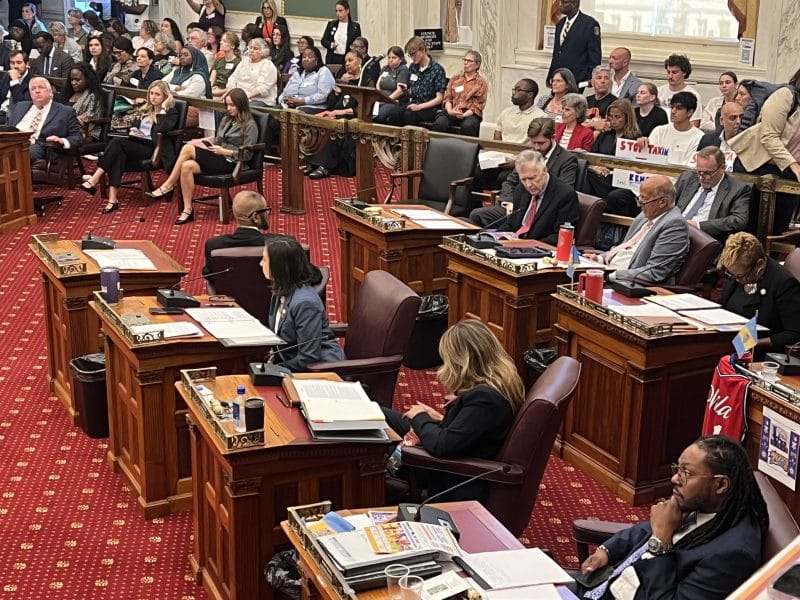
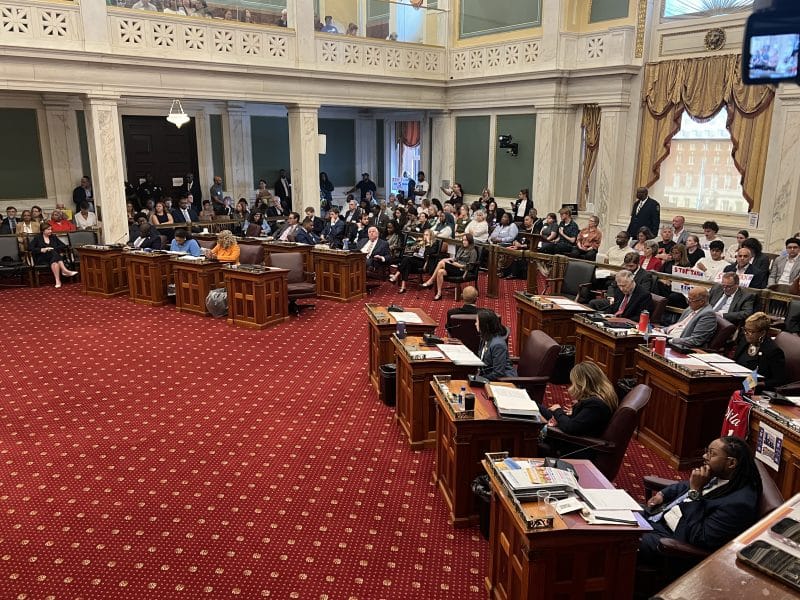
An unusual budget season came to an end on Thursday, as Philadelphia City Council’s Committee of the Whole favorably recommended the city Operating Budget, the Capital Budget, the Capital Program. Meanwhile, Council rejected Mayor Cherelle Parker’s Rideshare Tax, and the proposed increase on the Hotel Tax, which seemed unlikely to survive a Uniformity challenge, was scuttled by the State Assembly’s unwillingness to approve required authorization legislation.
However, the $48 million that would have been collected by the Rideshare tax, which was intended for the School District, was allocated through other means by Council, with $25 million coming from the General Fund, and the remainder from the budget surplus.
Despite receiving the funds, Mayor Parker, in a press conference on Thursday afternoon, considered Council’s reluctance to pass the Rideshare tax a defeat, claiming that companies such as Uber and Lyft, had skirted their responsibility to contribute to the city’s tax base.
“I want to address the elephant in the room today,” Parker said. “I want to be absolutely clear…that in this budget process, billionaire tech companies won round one today. These are billion-dollar technology companies that generate enormous revenue from business conducted in Philadelphia, and they do not contribute to our tax base in proportion to the businesses that do contribute to our economy and our neighborhoods every day.”
The populist messaging now employed by the Mayor, however, seemed directed towards City Council, rather than the tech companies. Throughout the budget process, the Administration, the School District, and their allies constantly pressured City Council to pass the tax, repeating the debunked message that 340 district support staff would lose their jobs if the tax was not implemented.
During their budget hearing, the School District and Mayor’s Office were forced to admit job losses would not occur if the funding was not secured, but that some or all of the 340 employees would be relocated to other positions, forcing them to abandon students who needed extra educational support. To date, Hall Monitor has not received a satisfactory answer as to why the relocation of any employee would occur at a time when the district has 2000 vacant teaching positions and Superintendent Tony Watlington, who presumably has some say over personnel decisions, would have to move any employee if it were determined an employee was needed at a specific school working with a specific population. When Hall Monitor attempted to ask this question at the press conference, the Mayor’s Communications staff ended the press conference before Watlington could answer.
For a Mayoral Administration who employs strict message discipline, it is unclear why they chose not to spin the failure of the Rideshare tax as a win. It would have been easy for the Administration to save face by claiming they had found the necessary funds for the schools while not raising taxes, and that a dedicated funding stream would be found in the coming budget years. This would have also avoided yet another unnecessary fight with City Council, who accurately read the mood of Philadelphians who were angered at the possibility of tax increases while also seeing schools closed and utility bills continue to climb.
After the budget had it’s first reading in Council on Thursday, Councilmembers made clear their frustration with the process.
In a press statement, Councilmember Isaiah Thomas, chair of the Education Committee, said it was important to avoid tax increases in this budget.
“Today’s preliminary approval of the city budget shows a united City Council delivering a common sense, no new tax budget that delivers for Philadelphians. In a time where Philadelphians of all kinds are struggling with a crippling affordability crisis and with city schools in need of urgent funding solutions, Council negotiated a comprehensive budget that makes whole on our obligations to our residents, students, and families – all without raising taxes on working Philadelphians.”
Majority Leader Katherine Gilmore Richardson described the final budget deal as a difficult process, and reiterated Council’s desire to avoid tax increases.
“We heard loud and clear from Philadelphians that raising taxes is not an option right now. Residents are concerned about the cost of living and with good reason. Many Philadelphians are struggling financially, and as a body, we could not in good conscious move forward with the proposed taxes. At the same time, we recognize we must address the deep, systemic, and long-standing issues with the School District of Philadelphia and its structural deficit.
This was not an easy process, and I am proud of the changes we made to limit additional financial burdens on our residents, while also directing more resources to the School District and continuing to pursue a long-term, sustainable funding solution for our schools. We will continue to do everything within our power to address these challenges.”
The budget will be finalized after a final vote by City Council on June 11th. The Mayor will then sign the budget legislation and submit it to the Pennsylvania Intergovernmental Cooperation Authority for final approval.
Hall Monitor will provide a deeper analysis of the budget on next week’s Hall Monitor radio/television program.
This article is a part of Every Voice, Every Vote, a collaborative project managed by The Lenfest Institute for Journalism. The William Penn Foundation provides lead support for Every Voice, Every Vote in 2024 and 2025 with additional funding from The Lenfest Institute for Journalism, Comcast NBC Universal, The John S. and James L. Knight Foundation, Henry L. Kimelman Family Foundation, Judy and Peter Leone, Arctos Foundation, Wyncote Foundation, 25th Century Foundation, Dolfinger-McMahon Foundation, and Philadelphia Health Partnership. To learn more about the project and view a full list of supporters, visit www.everyvoice-everyvote.org. Editorial content is created independently of the project’s donors.
Our reporters sit through hours of city council meetings, dig through piles of documents, and ask tough questions other media overlook. Because we’re committed to addressing Philadelphia’s poverty crisis — and challenging those who sustain it. If you think this work is important too, please support our journalism.
We’re counting on readers like you.