The future of public education in Philadelphia is at a crossroads. Mayor Cherelle Parker has signaled that over the next her administration will exercise full mayoral control, which is not, as some believe, synonymous with local control.
Last week, an assembly on public education held at the central branch of the Free LIbrary asked the question: Will you get a seat at the table? If the “you” in that sentence refers to students, parents, educators, the answer, from all indications, would be “No”.
The host and sole facilitator of the event was charter consultant and lobbyist Dawn Chavous. Chavous presently occupies seats at numerous tables. She serves as co-chair of Mayor Parker’s education subcommittee. Parker also tapped her to be one of thirteen members on the Education Nominating Panel that will review applications for seats on the Board of Education and submit their recommendations to the mayor. Chavous has been a visible and vocal lobbyist for local charter administrators. Both she and her husband, City Council President Kenyatta Johnson, have been part of State Senator Anthony Williams’ political network. Their bribery trial four years ago illuminated their close relations with the Universal charter company, which has benefited greatly, both financially and politically, by its hostile takeover of neighborhood schools through the Renaissance program. Williams has been the recipient, in several political campaigns, of large donations from hedge fund manager and charter proponent Jeffrey Yass. Since 2017 Chavous has also done political consulting work for Laborers’ District Council 332, whose business manager, Ryan Boyer, was chosen by Mayor Parker to lead her transition team.
Perhaps a better question would be: Who will Dawn Chavous be giving a seat at the table?
Johnson was one of several elected officials who attended the event. The panel included one district principal and three charter operators but no parents, students or community members. Chavous asked those in attendance whether they thought that the city’s education system was working. When most answered no, she assured them that this event was the beginning of “grass-roots organizing” for a “new model” of education in the city. Had the question-and-answer not been so brief, someone might have asked Chavous how a new model might look different from the one she has been instrumental in creating over the years: the expansion of privately managed charter schools, an experiment that has clearly failed. When I asked at a table outside the auditorium for a flyer with more information about the people or organization sponsoring the event and how they would be leading a grass-roots movement to improve public education, I was told there was no information available. I have heard from no one since the meeting.
Who has a seat at the education table now? Parker has tapped administrators and investors from several charter organizations to serve as education advisors. Neither their schools’ failure to meet academic standards nor their questionable financial practices seemed to count against them. Despite the fact that over half the city’s charter schools are underenrolled, Parker has made clear her intention to return to the days of charter expansion and control unseen since the state-appointed School Reform Commission.
Charter investors and real estate developers, who operate behind the scenes but wield significant political power, will maintain their seats at the table. Billionaire proponents of school privatization who don’t live in the city, such as Yass, who never lived or worked in the city, whose children attended suburban schools, will maintain their seats, even if at a distance.
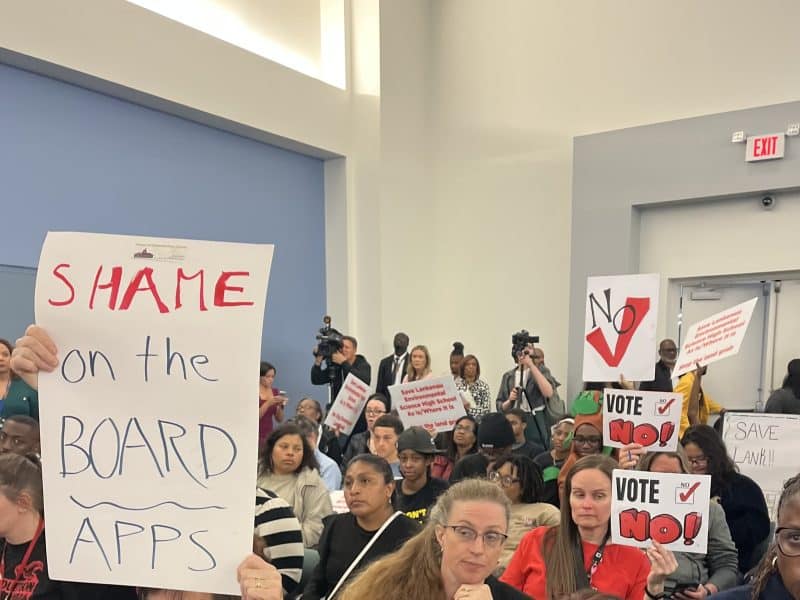
With the rich and politically connected keeping their seats at the table, fewer are reserved for parents, students, educators, and community members–the same people who have been crowded out. The Board of Education has implemented speaker suppression policies that limit the number of people who can testify at their meetings; at many meetings, those not on the speaker list have been barred from entering the auditorium. Mayor Parker has directed her Nominating Panel to conduct all business in executive session. The public has no opportunity to express their preference for any candidate because they do not know who has applied or who the panel’s final recommendations will be. In fact, the only time the people of Philadelphia can even address the panel will be after their final selections have already been made.
Members of the public who do make it onto the board’s speaker list have expressed their concerns and their frustration with the lack of response on many issues, including the removal of asbestos and other toxins from schools, the devastating effects of leveling, possible closure of more neighborhood schools, what the district is doing to keep teachers, the effects of more standardized testing on teaching and learning. In every other district in the state, they could vote for a candidate who represents their interests–or run for school board themselves. But Philadelphians remain disenfranchised–in more ways than one.
Lisa Haver is a retired Philadelphia teacher. She is co-founder and co-ordinator of the Alliance for Philadelphia Public Schools, a grass-roots advocacy organization.
Our reporters sit through hours of city council meetings, dig through piles of documents, and ask tough questions other media overlook. Because we’re committed to addressing Philadelphia’s poverty crisis — and challenging those who sustain it. If you think this work is important too, please support our journalism.
We’re counting on readers like you.