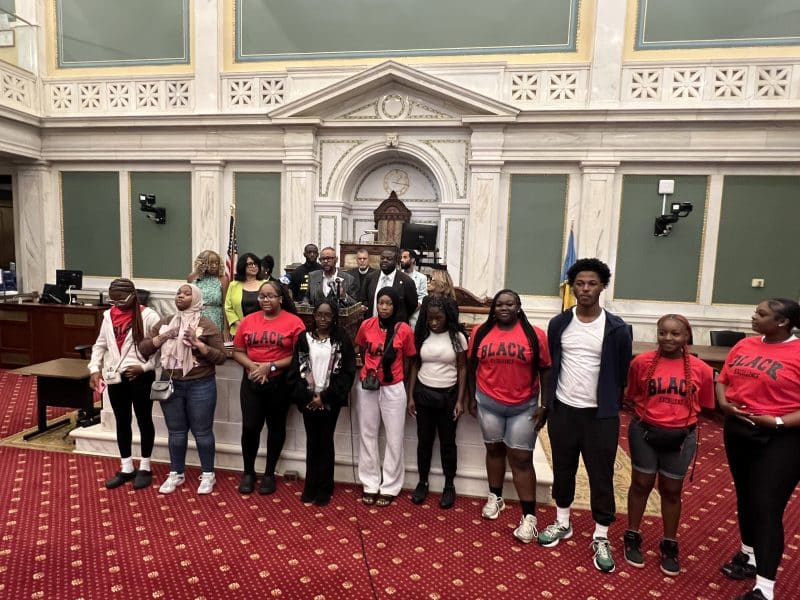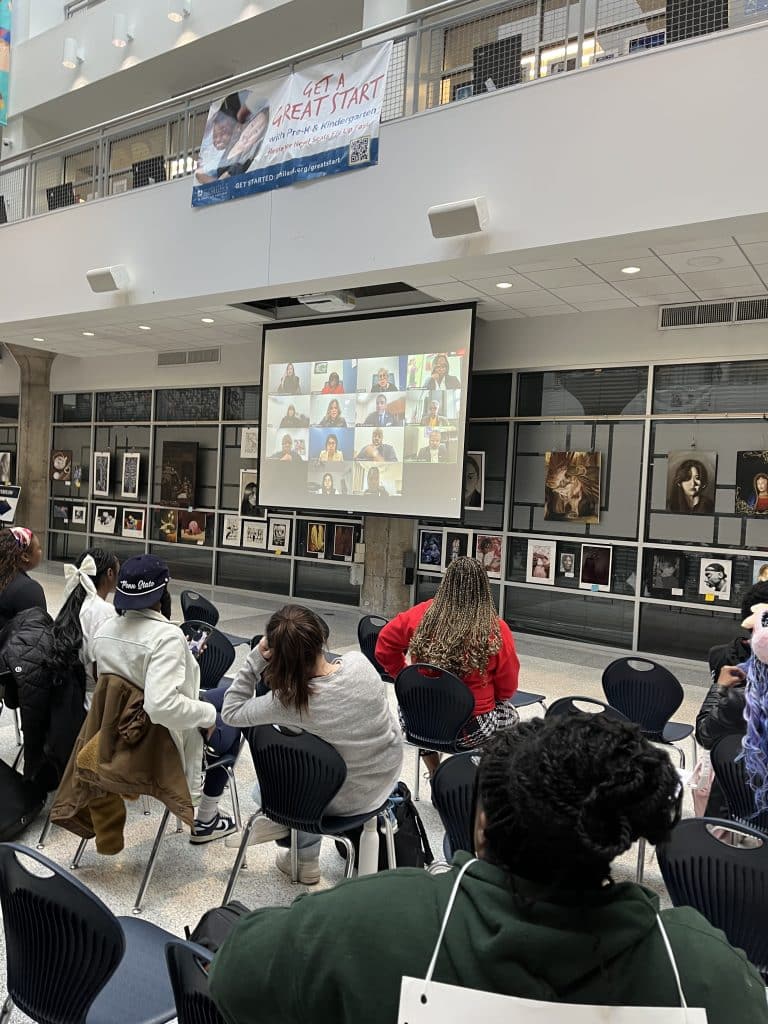
Board of Education votes on facilities plan in sequestered meeting (Photo: Lisa Haver)
Students who attended the April 30 Board of Education meeting got a lesson in how not to govern. They watched as the board, which had sequestered itself in another room, passed a facilities plan that would close seventeen of their schools, despite sustained and overwhelming public opposition. Students also saw a peaceful protest escalate as elected officials yelled at board members.
The board had kept the public guessing for two months about when they would vote on the Facilities Master Plan, the first draft of which was presented by Superintendent Tony Watlington Sr. in February. Just three days before the April 23 meeting, Board President Reginald Streater told reporters that the vote would be on the agenda.
City Council members had become increasingly critical of the plan. They grilled Watlington and Streater in Council hearings about why the district wanted to close twenty schools and how the district could raise $2 billion dollars from the state and from philanthropic sources Watlington could not identify. Some had fought to keep schools in their district open. Only Councilmember Jeffery Young called on the board to reject the entire plan.
Responding to pressure from Council, Streater announced just hours before the April 23 meeting that the vote would be postponed until the following week. Councilmember Isaiah Thomas had sent Streater a letter conveying his “deep concern” that the vote was being rushed. If the vote took place, Thomas warned him, Council may not support the reappointment of board members who voted for the plan.
Streater’s agreement to postpone the vote failed to placate Thomas. At a press conference on the morning of the April 30 meeting, Thomas, flanked by several other council members, warned the board, “ We dare you to vote against children in the city of Philadelphia…watch what we do.” Thomas said that council members were prepared to shut the meeting down, declaring, “This is civil disobedience today.” Council President Kenyatta Johnson, in Council session that day, encouraged Thomas, “Get locked up for the kids–that’s what’s up.”
Veteran political activists know that effective civil disobedience must be planned. Leaders coordinate with local law enforcement about the parameters of the protest for the safety of those involved. People who expect to get arrested notify family members and have bail money ready. Protestors present a list of demands.
Council had not issued any unified alternative to the district’s plan. Would they be happy if just a couple more magnet schools were removed from the list? Or would they use the extended time to advocate for the schools that no one had taken up for, like Harding and Stetson and Penn Treaty?
Thomas vowed to do everything in his power to delay implementation of the facilities plan. Thomas’s power lies mostly in his authority, as chair, to convene meetings of Council’s Education Meeting, something he has not done since the district began the public process on the plan in 2024.
Soon after the board meeting convened, Thomas interrupted Watlington’s presentation on the revised plan, demanding that the board take the vote. The auditorium erupted in chanting and whistle-blowing. The board left the room, returning after a 30-minute recess. Thomas interrupted again during the board’s pre-vote deliberation, yelling at Streater to “go ahead and vote…see what happens”. Steater thanked Thomas, in a sarcastic tone, for “setting a great example for our students”.
After the second disruption, the board again left the auditorium. They resumed the meeting virtually, taking the vote in a room from which the public was barred. As APPS stated in its formal objection, it is a violation of the state’s Sunshine Act for any governmental body to conduct public business in a private meeting. They should have postponed the vote.
In the end, the board passed the plan by a vote of 6-3. Board Member Crystal Cubbage voted No on what she called a “flawed first draft”, saying that it was not realistic to expect the district to raise $200 million every year for ten years. Whitney Jones echoed Cubbage’s concerns, pointing to “political realities” in Harrisburg and Washington. Jones, before voting No, said school closings should be “an absolute last resort”. Wanda Novales stated that the school closings were not the deciding factor for her No vote; it was the significant “financial uncertainty” of the plan and its unclear timeline.
None of those who voted Yes cited specifics from the plan. Streater had made his position clear for months, in Council sessions, board meetings and in his Inquirer commentary. So it was jarring to hear him say, “OK, yes, we may not get the $2 billion”, as if the funding were a mere technicality. Both Joyce Wilkerson and Joan Stern acknowledged that the plan was “not perfect”. Wilkerson served for decades in the top echelons of government. Stern is a public finance attorney with experience in government and higher education. Yet neither expressed any concern about the plan’s non-existent funding or its lack of spending projections.
Philadelphia’s children learned that night that no matter how well they make their case or how many people show up to support them, the adults in charge still do not hear them.
Lisa Haver is a retired teacher. She is a co-founder and co-ordinator of the Alliance for Philadelphia Public Schools @apps.philly
Our reporters sit through hours of city council meetings, dig through piles of documents, and ask tough questions other media overlook. Because we’re committed to addressing Philadelphia’s poverty crisis — and challenging those who sustain it. If you think this work is important too, please support our journalism.
We’re counting on readers like you.