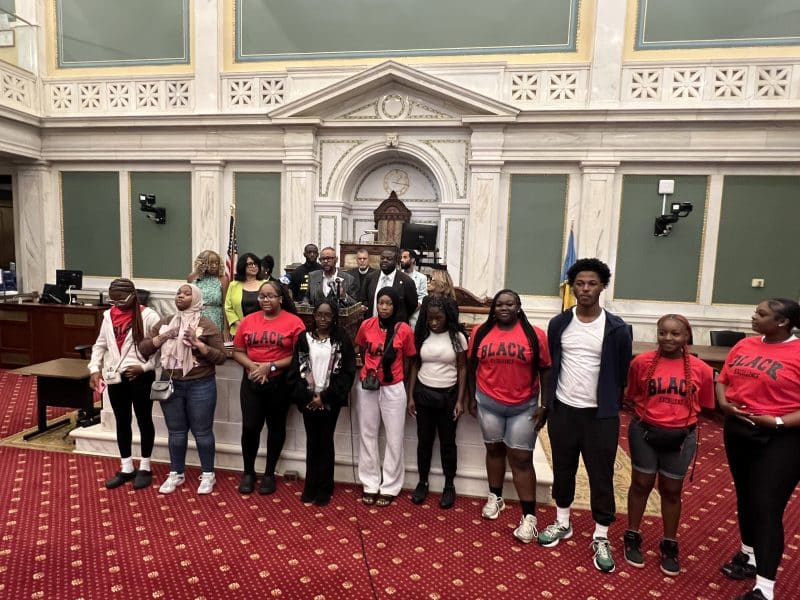
City Council Budget Hearings continued with the Office of Property Assessment, the city agency tasked with evaluating property and determining the tax owed on every individual building in the city. James Aros Jr., the director of OPA, said the city would perform a property reassessment this year, but did not expect taxes to increase as substantially as they had during previous reassessments.
“We’re on schedule to mail notices around the end of May,” Aros said. “We still do see an increase in the overall value of the property in the city, but it’s significantly lower than either of the last reassessments we have undergone in Tax Year 2023 or Tax Year 2025.”
Many members of council, including Councilmember Rue Landau, expressed concern with how the reassessment notices were written, leading to residents’ confusion regarding the overall process.
“(It’s) confusing for people when we talk about a “first level review” and an appeal in the same letter,” Landau said. “I see some really easy fixes there. Some people miss their appeal deadlines because they thing they’re filing an appeal and they’re actually going to be filling for a first level review.”
Councilmember Quetzy Lozada was much more blunt in her criticism, accusing OPA of creating conditions which create serious strains for longtime residents of city neighborhoods, and offered criticism for the largely unknown process for how OPA develops individual assessments.
“This is gentrification. Can we be honest and just say it’s gentrification?” Lozada said. “There is no reason why we should not be able to tell people why and how we whatever the assessed value (is) and how we came to that assessment.”
Lozada was also bothered by OPA’s lack of knowledge regarding the appeals process, which is handled by the Board of the Review of Taxes (BRT), telling Aros that OPA still has a responsibility to assist Philadelphians through the process.
Planning Commission Faces Tough Questions on HOME Plan
In response to a question from Councilmember Jim Harrity, Jessie Lawrence, Director of Planning and Development, said the city planned to build 3900 new housing units in 2027, of which 1900 will be multi-family. Over 1000 will be developed through the Turn-the-Key program, of which 200 are currently in development. Overall, 1500 total units are currently under construction.
The Turn-the-Key program offers eligible first-time home buyers up to $75,000 in assistance to purchase new homes built on public land. Program participants can also take advantage of the $10,000 Philly First Home grant to help with closing costs.
Councilmember Jaime Gauther, one of City Council’s most passionate advocates for housing, asked the Planning Department how HOME Plan funds would be allocated in 2027.
Angela Brooks, the Chief Housing and Urban Development Officer said the city had just received the funds, and the allocations were not yet in writing.
“We do have projections on what we think that spend-down will be,” Brooks said. “There will be a resolution coming to make the fiscal year and the year-one Home bond aligned from July 1st, 2026 to June 30th 2027.”
Gauthier followed by asking about specific programs, making sure the operation of the package of programs is prepared to be fully implemented immediately. Administration officials told Gauthier they would provide her with a comprehensive list of the programs and the full budget allocations.
Councilmember Quetcy Lozada was more pointed in her questioning of the Administration, asking Lawrence directly if he believed the public should have a say in how public land was used, to which he replied ‘yes.’
“Okay, Do you believe that the HUD (Housing and Urban Development) way of determining a person’s AMI (Area Median Income) responds to the realities of some in our community?”
According to the HUD website, “Area median income — often referred to as simply AMI — is a key metric in affordable housing. Area median income is defined as the midpoint of a specific area’s income distribution and is calculated on an annual basis by the Department of Housing and Urban Development. HUD refers to the figure as MFI, or median family income, based on a four-person household.”
The problem with calculating median income in this fashion, at least for Philadelphians, is that the geographical region in which Philadelphia’s AMI is calculated includes wealthier counties such as Montgomery and Bucks. This creates an inflated view of the average Philadelphian’s median income.
“I do believe there is a misalignment between what the metro area designated as HUD AMI based on the federal census data,” Lawrence said.
Lozada said her district was receiving projects from the Planning Commission that exacerbated the conditions that create gentrification, including programs that consider AMI, which, in certain areas of her district, actually increase the property values.
“Certain parts of the HOME Initiative do not work in neighborhoods that have been quickly gentrified and have displaced people who can afford these programs,” Lozada said.
The implementation of the HOME Initiative will be closely monitored by City Council, particularly district council members.
Council Holds Hearing on Library System Improvements
The joint committees on Legislative Oversight and Parks & Recreation held a hearing “to investigate the current conditions and future of Philadelphia’s public libraries.”
Councilmember Jeffrey Young, the sponsor of the resolution that called for the hearing, said libraries are lived-spaces, community anchors, and they deeply matter to his constituents.
“We owe the city of Philadelphia clear answers about the current condition of our libraries and the future of our library system,” Young said. “At a moment when much is being asked of our libraries, we have a responsibility to take a hard, honest look at whether we are equipping them to meet that demand. This is about accountability, but it’s also about vision and (what) a 21st century library should look like.”
Kelly Richards, President and Director of the Free Library of Philadelphia, explained the process by which the library system evaluates structural issues of the library buildings, particularly cooling and heating units, as HVAC concerns have caused long-term closures at several branches.
“The assessments that we’re doing for th HVAC are taking place by staff and our current contractors who handle (the library system’s) day-to-day needs,” Richards said. “Some of the systems are very old and they break (unexpectedly). We are assessing (our needs) all the time.”
During his testimony Richards said the library system had a concerted plan aimed at addressing both the larger and smaller needs of each individual branch in a coordinated manner, as addressing larger needs only would allow smaller issues to compound and creator more difficult problems in the future.
Council seemed inpatient with the pace of upgrades and repairs to library facilities, lamenting the months-long closures some facilities have seen. Richards said this was due to the necessities of repairs when a problem arises, as parts have to be obtained, which can be a laborious process, modification to existing facilities mut be made to accommodate upgrades, and additional improvements, such as electrical systems, must be considered so new machinery can be powered sufficiently.
Councilmember Anthony Phillips seemed particularly concerned, telling library system facility staff they should have a better grasp on the needs of the library branches.
“Your responses to these questions make me worry,” Phillips said. “You should be able to articulate a strategic plan that shouldn’t be reactionary. You should be more proactive on these issues.”
Regarding what council perceived as the slower pace Capital Programs Office Director Apama Palatino said complete renovations of library branches average $10 million each, and the city had performed ten such renovations in the past year with ten more scheduled for the coming year at the same cost. Adding more full renovations beyond that would be cost prohibitive.
Library staff offered testimony on the issues they face daily while trying to do their jobs. Elizabeth Gardner, a supervisor from the Fishtown Community Library, said the branch’s summer program had already begun, and a video game tournament would be taking place on the library’s third floor that afternoon as soon as school let out.
“The only problem is that the third floor is at 82% humidity-a level for a well functioning rain forest, but disastrous for a library,” Gardner said. “The pages of our books are beginning to curl and the building smells like damp earth. There are sinister dark splotches on the carpet near the public computers and the children’s area where babies and toddlers often play, and there are mold blooms on an office wall.”
Gardner said staff complain of respiratory issues and skin irritation, but the library system has not heeded numerous requests for assistance. Other issues with the branch’s heating and cooling exist, including winter temperatures of over 85 degrees because the heating controls are largely inoperative.
Schools Facilities Plan Vote
The Philadelphia School Board passed the controversial facilities plan that will close 17 schools across the city. Hall Monitor will dedicate extensive time on next week’s program to the practical and political consequences of this decision
EVEV Acknowledgement Language for Partners
This articleis a part of Every Voice, Every Vote, a collaborative project managed by The Lenfest Institute for Journalism. The William Penn Foundation provides lead support for Every Voice, Every Vote in 2024 and 2025 with additional funding from The Lenfest Institute for Journalism, Comcast NBC Universal, The John S. and James L. Knight Foundation, Henry L. Kimelman Family Foundation, Judy and Peter Leone, Arctos Foundation, Wyncote Foundation, 25th Century Foundation, Dolfinger-McMahon Foundation, and Philadelphia Health Partnership. To learn more about the project and view a full list of supporters, visit www.everyvoice-everyvote.org. Editorial content is created independently of the project’s donors.
Our reporters sit through hours of city council meetings, dig through piles of documents, and ask tough questions other media overlook. Because we’re committed to addressing Philadelphia’s poverty crisis — and challenging those who sustain it. If you think this work is important too, please support our journalism.
We’re counting on readers like you.