
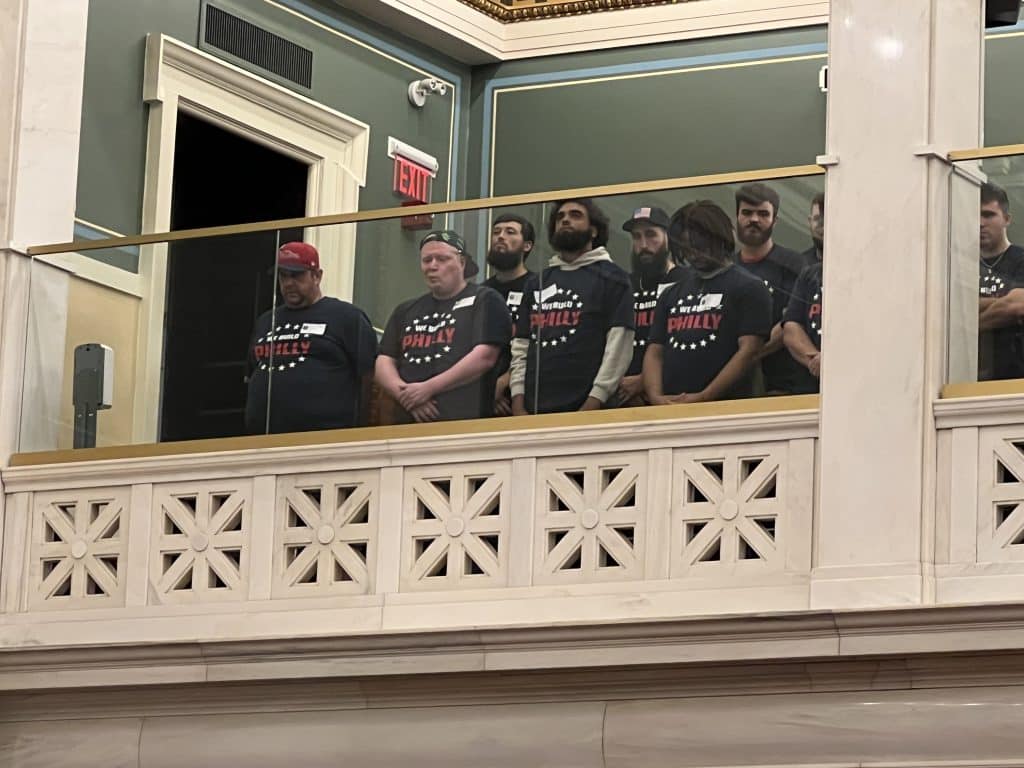
Despite rumors that Councilmember Mark Squilla would introduce legislation related to the proposed 76ers arena in Chinatown at Thursday’s council meeting, no such bill was offered. Still, it is possible the legislation will be introduced in the coming weeks. Even without the arena bill, council still took important stances on several key issues.
Landau Introduces AI, SEPTA Resolutions
Councilmember Rue Landau introduced a resolution “authorizing the Committee on Technology and Information Services to hold hearings exploring the current status of Artificial Intelligence technologies and how Philadelphia can prepare for their impact on the public, private, and nonprofit sectors.”
The Massachusetts Institute of Technology Review defines AI as “a catchall term for a set of technologies that make computers do things that are thought to require intelligence when done by people. Think of recognizing faces, understanding speech, driving cars, writing sentences, answering questions, creating pictures.”
Read More
The resolution mentions how the city already utilizes AI technology via “smart streetlights,” which monitor the condition of city streets, and how the city has used “sensors on municipal vehicles to identify cracks and unevenness in the road.”
There are concerns about how AI could impact employment and the economy; according to research from the Federal Reserve Bank of Philadelphia, “18% of the jobs in Philadelphia are at high risk of automation, with women, young people, and Black communities (being) disproportionately impacted.”
Furthermore, the resolution describes drawbacks to AI, particularly regarding health care where predictive models relating to health costs perceive Black patients as needing less healthcare.
Currently, the city has no public policy regarding government use of AI.
Landau also introduced a resolution “calling on The School District of Philadelphia to expand SEPTA Student Fare Passes to all students for usage at all times, and regardless of their residential distance from schools.”
Currently, school districts in the Commonwealth of Pennsylvania are permitted to provide free transportation to students who live over 1.5 miles away from the school, or they are required to walk a hazardous route. In Philadelphia, students from 7th to 12th grades who live more than 1.5 miles from their school are eligible for free SEPTA fare cards. However, the cards can only be used for travel to and from school between the hours of 5:30 AM and 8:00 PM, with a limit of eight “taps” per day. These restrictions can limit student access to after-school programming, jobs, and other useful activities after 8:00 PM and on the weekends.
In 2019, SEPTA provided over 60 million rides to Philadelphia students.
O’Rourke Recognizes Hunger Awareness Month
Councilmember Nicholas O’Rourke introduced a resolution “recognizing September 2024 as Hunger Action Month in the City of Philadelphia and calling this observance to the attention of our citizens.”
According to the resolution, 1 in 7 Philadelphians, or just over 15%, including 1 in 3 children, “are food insecure and do not know where their next meal will come from.” Nationally, at least 47 million people, including 14 million children, are food insecure.
Read More
The resolution praises Philadbundance, a Philadelphia-based hunger relief organization, for distributing over 20 million meals to Philadelphians in 2023. As a member of the Feeding Pennsylvania and Hunger-Free Philadelphia consortiums, Philabundance helped distribute 164 million pounds of food across the state to 1.5 million Pennsylvanians.
Brooks Condemns Criminalization of Homelessness
Minority Leader Kendra Brooks introduced a resolution “condemning the Supreme Court’s decision to allow the criminalization of homelessness in Grants Pass v. Johnson, and reaffirming the City of Philadelphia’s commitment to housing as a human right.”
The ruling allowed the city of Grants Pass, Oregon, to apply anti-public camping laws to homeless individuals, thus criminalizing homelessness, despite earlier precedents that declared such an interpretation as cruel and unusual punishment.
Read More
Recently, in Philadelphia, sweeps throughout Kensington resulted in 34 people being sent to an understaffed and under-prepared prison system, leading to the death of Amanda Cahill.
Our reporters sit through hours of city council meetings, dig through piles of documents, and ask tough questions other media overlook. Because we’re committed to addressing Philadelphia’s poverty crisis — and challenging those who sustain it. If you think this work is important too, please support our journalism.
We’re counting on readers like you.


