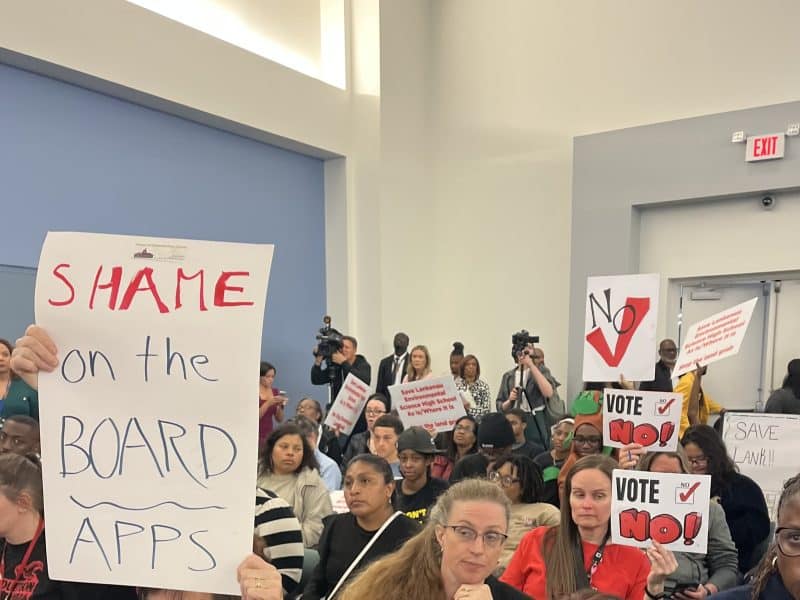
At the October 24 meeting of Philadelphia City Council, activists from Chinatown and nearby communities filled the public seats on the floor of the chamber and the mezzanine. About fifteen minutes into the meeting, those activists stood, held up signs and chanted their demands: that Council reject the proposed 76ers arena that would have a devastating impact on their communities. Council President Kenyatta Johnson waited about two minutes until they stopped, then told them that they should not disrupt Council business. About ten minutes later, the protesters stood, held up their signs and chanted again. Johnson waited about two minutes until the protesters left, most of their own accord. He said, “This is why I love America”, and resumed Council business.
Later that day, protesters at the action meeting of the Board of Education went to the front of the auditorium, held up signs, and chanted their demands: that a Northeast High School teacher who had been suspended in a controversial case be reinstated to her position. Forty seconds after the protestors stood up, the board members, without any explanation or comment to the audience, left the auditorium. Attendees waited in vain for word from the board about when they would return and the meeting would resume. About twenty minutes later, the screen in the auditorium showed that they had resumed the meeting in an undisclosed location. President Reginald Streater stated that he recessed the meeting (actually there was no vote by the board to recess); he gave no explanation about why they had to lock the doors and hold a private meeting.
News stories have reported that the protestors shut down the meeting, but that is not accurate. The board shut down the meeting. To be fair, the protesters at the board were closer to the board members than those in City Hall were to councilmembers. But there were no physical confrontations or threats of violence. The board could have waited, as City Council did. They could have tried to negotiate with the protestors. They could have had the protesters removed and resumed the meeting. They could have recessed the meeting and resumed it at a later time as a public meeting. There have been many protests at the Board of Education over the years: Black students demanding equal rights, anti-war protesters, union members seeking a fair contract. Never did the board–or the School Reform Commission for that matter–run away and hold a secret meeting until this board did–twice.
In 2019, student protestors, angry about a vote to install metal detectors in certain schools, went to the front of the auditorium and loudly proclaimed their displeasure. Then-Board President Joyce Wilkerson made several unsuccessful attempts to resume control of the meeting.
After a few minutes, the board left, went to their office, locked the door and held a private meeting. APPS members demanded to be admitted to the meeting, but the board refused.
When we saw the board get up this time, we were pretty sure that they would be going down to their first floor committee room. We saw them, escorted by security, file into the room. I knocked on the door as they came in and continued to knock until they adjourned their secret meeting about fifteen minutes later. Some of the board members were heard on hot mics asking “Why is she knocking?” and “Is she taking pictures?” Several other people came down and demanded to be let in, but district security and Philadelphia police officers stood in their way, told them their demands were futile and ordered them to leave. Reporters were also denied access. At no time did any of the board members come out and talk to them.
Streater attempts to justify his actions, as Wilkerson did in 2019, by saying they had no choice but to leave and that live-streaming the private meeting was sufficient. But Melissa Melewsky, media law counsel for the Pennsylvania NewsMedia Association, told the Inquirer, “This situation raises significant Sunshine Act compliance issues, creates potential liability under the act and runs counter to the public interest,” said Melewsky. “There’s nothing in Pennsylvania law that allows a virtual-only meeting.”
Streater told the Inquirer that the board had no choice but to hold a meeting without the public in attendance because the board needed to conduct the business of the school district “on behalf of the children.” Also, apparently, on behalf of the developers who own property at the Navy Yard and at the Hilco/Bellwether district who asked for–and got–extensions on their Keystone Opportunity Zone (KOZ) tax abatements, which will mean less income for the district and for the children who attend the city’s public schools.
Lisa Haver is a retired Philadelphia teacher. She is co-founder and coordinator of the Alliance for Philadelphia Public Schools. @APPSphilly
Our reporters sit through hours of city council meetings, dig through piles of documents, and ask tough questions other media overlook. Because we’re committed to addressing Philadelphia’s poverty crisis — and challenging those who sustain it. If you think this work is important too, please support our journalism.
We’re counting on readers like you.