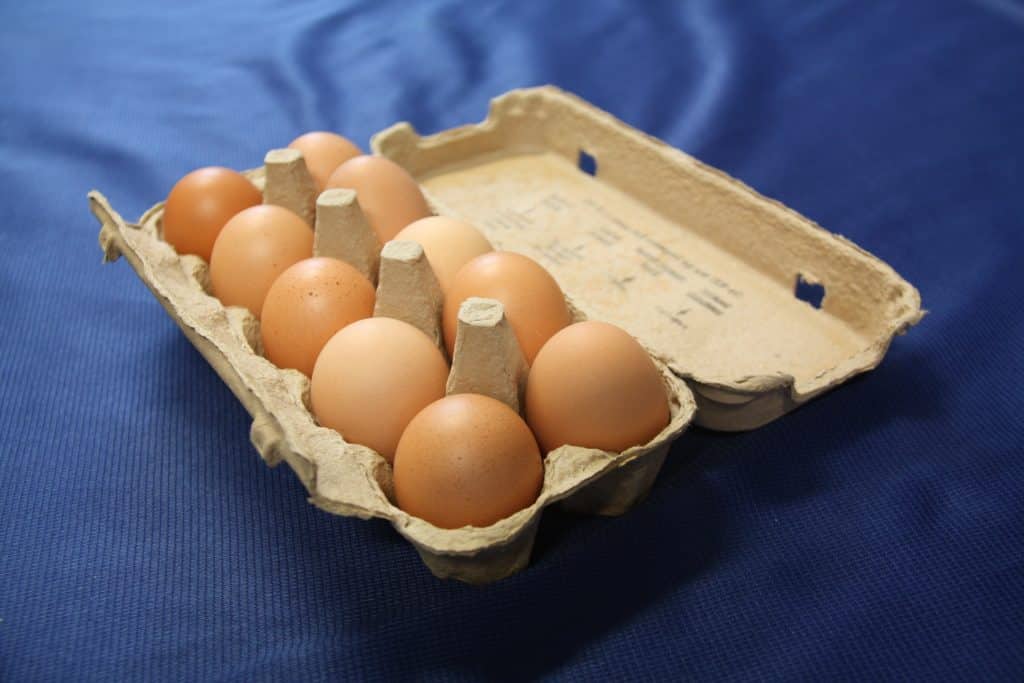
Photo: Silver Spoons via Wiki Commons
Last week, 18 states and the DOJ Antitrust Division settled an antitrust suit against the three major egg producers — Cal-Maine, Versova, and Hickman’s Egg Ranch. The antitrust case was backed with hard-to-refute evidence, including emails from CEOs. The companies conspired to manipulate egg prices from 2022 to 2025. The cover for the price-fixing was the avian flu, which led to a reduction in egg production but did not correlate with the doubling and quadrupling of egg prices.
“The settlement doesn’t require the companies to plead guilty.” As Matt Stoller, the author of the newsletter Big that follows mergers and antitrust actions, writes: “Most antitrust lawyers I know are mocking this settlement as a farce, since it looks so obviously like criminal behavior, but instead ended up with a no-admit/no-deny parking ticket. Put that aside and just look at the cost/benefit. Cal-Maine has to pay $1.5 million; let’s throw in another $1.5 million to cover the cost of the 30 million eggs they had to donate. That means they are out $3 million for a scheme that netted them more than $3 billion. That’s a thousand-fold return.
Importantly, these firms also admitted no wrongdoing, meaning there can be no follow-on civil suits by victims based on such admissions. Restaurants and consumers who paid for eggs are out of luck. And the alleged conspirators are released from all claims.”
The settlement doesn’t stop the consolidation of egg producers.
The scam was ingenious. The companies sell a significant portion of their eggs at prices reported by the industry journal, Urner Barry. The companies reported agreements to sell to themselves to keep prices up. Unbelievably, there are emails between company executives urging each company to report artificially higher-priced sales to Urner Barry. Urner Barry reported the higher prices.
It’s not the first time egg producers have fixed prices. Cal-Maine Foods was ordered to pay $17.7 million to the plaintiffs in a lawsuit alleging the defendant participated in a conspiracy to limit egg supply and drive up egg prices. The same jury ruled that the two largest egg producers in the United States, along with the two industry organizations, conspired to restrict supply between October 2004 and December 2008. In both cases, the penalty, like in the antitrust settlement, was a small percentage of the companies’ profits, proving that crime can pay.
The settlement shows that egg prices were being manipulated, increasing profits and turning voters against the Democrats who were in power. It also shows that many of the experts and academics who claimed there was no price manipulation were nothing more than bought and paid for by the multinational corporations. Even the Cato Institute, which claims to support competition, was on the side of market manipulation, saying, “Egg Prices Don’t Need to Be Investigated — It’s Just Supply and Demand.”
Why didn’t the federal government demand that the egg monopolies be broken up to help small farmers and consumers? There is no definitive answer, only conjecture. In general, it could be that the Trump Administration supports monopolies and wealthy interests. The weeks after the presidential election saw an explosion in proposed and rumored mega-mergers. This trend has accelerated since the changing of the guard at the FTC and DOJ, as Trump’s new antitrust enforcers have demonstrated a willingness to facilitate dealmaking by increasing early terminations and settlements.
But it could be more nefarious. The egg monopolies, like many other large corporations, might have wanted to get rid of Biden’s appointment to the Federal Trade Commission. Knowing that Trump would fire the antitrust enforcers, the egg monopolies gave him an issue to use.
Yes, it sounds like a conspiracy. But consider, Henry Kissinger, the winner of the Nobel Peace Prize, secretly persuaded the North Vietnamese to withdraw from the peace talks until after Nixon was re-elected. It doomed more young men, not to pay more for eggs, but to dismemberment and death.
So is it beyond belief to consider that a multinational corporation might fix egg prices to increase its profits and help Trump? On the TV show “Meet the Press,” Trump credited the companies, saying: “When you buy apples, when you buy bacon, when you buy eggs, they would double and triple the price over a short period of time, and I won an election based on that.”
If that was Cal-Maine’s strategy to make additional billions and avoid potential antitrust action that could stop mergers, it has been working. They were only asked to refund a very small percentage of what they illegally made, and the company’s mergers are continuing. On March 3, 2026, Cal-Maine’s CEO said “the acquisition of Creighton Brothers and Crystal Lake advances our strategy by expanding the scale and geographic reach of our shell egg platform, adding meaningful growth to our portfolio.”
Not a bad plan for a bunch of corporate executives who used easily accessible emails to price-fix.
Our reporters sit through hours of city council meetings, dig through piles of documents, and ask tough questions other media overlook. Because we’re committed to addressing Philadelphia’s poverty crisis — and challenging those who sustain it. If you think this work is important too, please support our journalism.
We’re counting on readers like you.