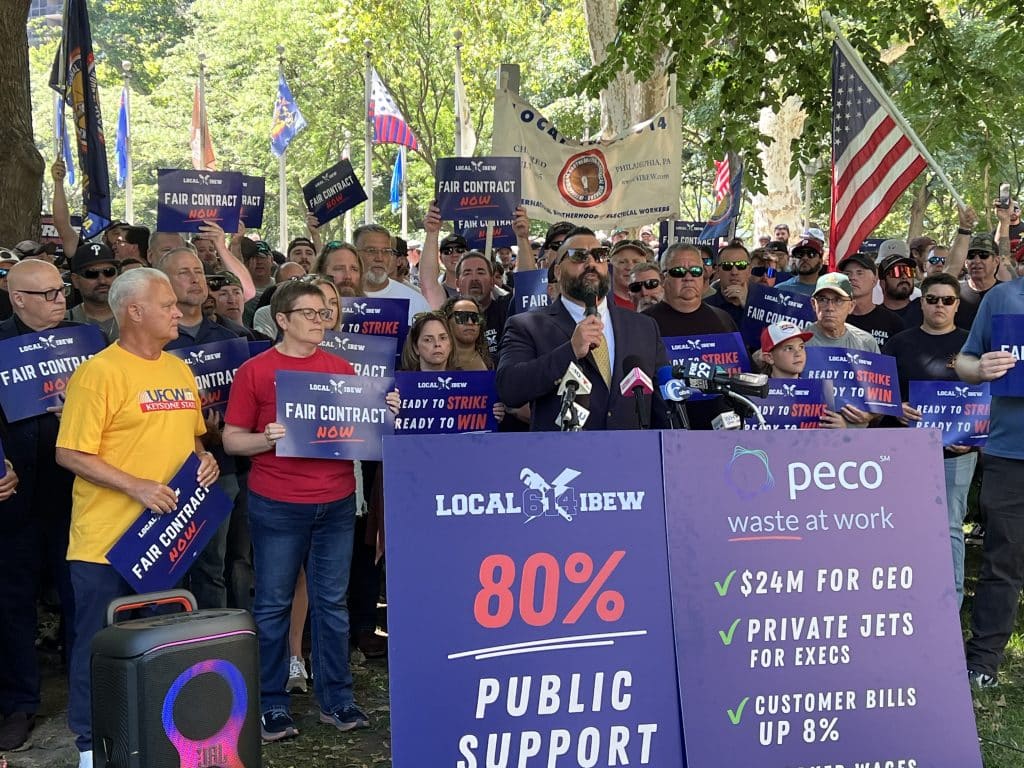
PECO Workers and their union representatives held a press conference on Thursday announcing their intention to strike if their demands are not met by the company.
Lawrence Anastasi, President and Business Manager of Local 614, the union representing the electrical workers who, amongst other things, perform maintenance and repair work on power lines and other electrical infrastructure, said the union would go on strike at 12:01 AM on July 4th if their contractual demands are not met.
“We did not come to this decision lightly,” Anastasi said. “We know the impact that will be felt across Philadelphia and (the four surrounding) counties. We understand that the strategy of Exelon (parent company of PECO), a company of kings, a monopoly of monopolies, have decided they want us to go on strike…they think this will divide us. But like many poor decisions Exelon has made, they have not understood that this has untied us.”
At issue are certain benefits promised to workers of 614 that have not been realized. Union officials said their previous contract stipulated they would receive the same medical and retirement benefits as non-represented employees. However, 614 discovered that over the previous five years, the non-represented employees had been given different, better plans.
Jim McGill, an assistant business manager for Local 614, said that while workers were proud of the services they provide, repairing electrical infrastructure under sometimes difficult and dangerous conditions, Exelon’s treatment of its employees have led to Local 614’s first ever strike authorization.
“They have done nothing more than decimate the benefits of the workers,” McGill said. “My own retirement benefits have been slashed multiple times and taken from me. Our membership needs a fair contract, and they need it now.”
Meanwhile, the first item greeting visitors to the Exelon website is a post about quarterly earnings, followed by information about stock dividends. The compensation package for Calvin Butler, Exelon’s CEO, exceeded $15 million last year. At press time, Exelon’s stock price was $47.29 per share. The company reported over $24 billion in revenue in 2025, a 5% increase from 2024.
While other utilities in the city, such as the Water Department, the Gas Company, and SEPTA are municipally owned and theoretically answerable to the public, PECO is not. Manoj Simha, in his article Broken Trust: Understanding the Private Distribution of Electricity in Philadelphia, explains the history behind the city’s privately owned electricity concern as a consequence of ineffective and unimaginative leadership in 19th century city government. The majority of electric customers in the United States, nearly 75%, receive their electricity from private companies.
The ubiquitous nature of private electric suppliers has a negative impact on certain aspects of service and on electricity rates. Municipal suppliers are not subject to shareholder concerns and thus do not have to provide returns to investors. Private suppliers, on the other hand, are obligated to maximize shareholder returns, usually at the expense of rank-and-file workers; not CEOs and other executive level staff.
According to information provided by the American Public Power Association, a Washington DC based organization representing publicly owned electricity suppliers, Pennsylvanians subjected to privately-owned electric companies pay about 15% more than those who are able to utilize their public counterparts. However, as is the case in most areas, there is only one electricity option. In other states, the disparity in cost between public and private suppliers can reach as high as 47%, as is the case in Iowa.
These price differentials never lead to better service; rather, they are used to fund investor returns and executive bonuses. This is the case when any privately owned utility or business entity takes control of a public good; the basic means of survival for the public becomes a commodity from which revenue is extracted, rather than an instrument meant for the public good.
When any public entity, whether it be a government or a utility, is taken over by those looking to “run it like a business,” it is very clear what they mean: raise rates, reduce service, and take all that is possible from the rank-and-file workers to increase shareholder value and corporate bonuses. That is the case with PECO, which leads to a larger question regarding nationalization of every essential utility.
Our reporters sit through hours of city council meetings, dig through piles of documents, and ask tough questions other media overlook. Because we’re committed to addressing Philadelphia’s poverty crisis — and challenging those who sustain it. If you think this work is important too, please support our journalism.
We’re counting on readers like you.