
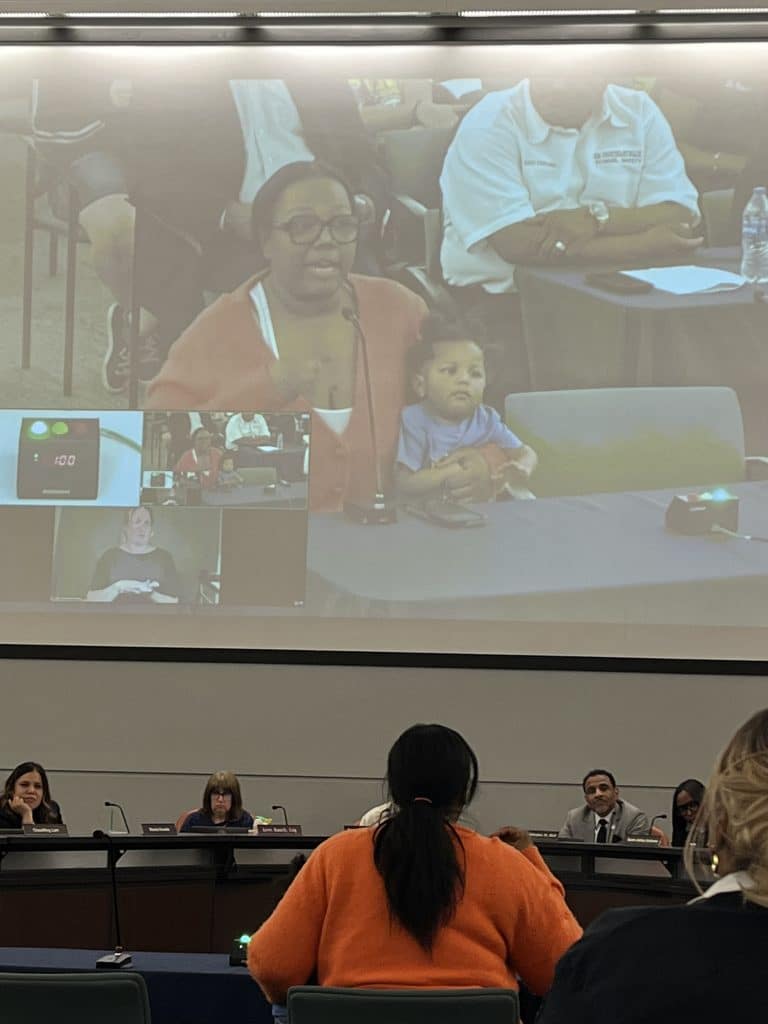
Luflow Elementary parent urges board to vote No on facilities plan and the closing of Ludlow at 5th and Master in North Philadelphia. (Photo: Lisa Haver)
Thousands of Philadelphians, in board meetings, town halls and City Council hearings, have spoken: the Board of Education must reject the Facilities Master Plan. Yet there is still doubt that the board will carry out the will of the parents, students, educators and community members who have testified and protested against the plan for months.
In late February, Superintendent Tony Watlington Sr. released the final draft of his Facilities Master Plan. Much of the media focus, understandably, has been on the 18 school closures (down from 20) that would displace close to 5,000 students. Because of the district’s later release of additional recommendation and and its decision not to hold hearings on them, less attention has been paid to the proposed 12 co-locations, 8 buildings to be given to the city at no cost, grade band changes in 34 schools, 16 catchment areas redrawn affecting approximately 33 schools in over 20 zip codes, and modernization projects at 159 schools to begin in 2032.
In order to counter some of the misinformation presented by the district,
APPS members released their analysis after taking a deep dive into the full draft of the 10-year plan. Our conclusion: it’s hard to see this plan as anything beyond magical thinking based on imaginary funding.
A few crucial reasons emerge that make clear why this facilities plan can not, and should not, ever come to fruition.
There are no projected costs for any of the recommendations or modernization projects in the plan, thus no guarantee of equitable distribution of resources. No funding sources are identified for future projects. In fact, most of the items begin with this caveat: “If the district is granted additional government and/or philanthropic funding…” Which government is not specified, but the district surely cannot be referring to the state, which even after being sued fails to provide adequate funding for the city’s schools. Watlington could not identify any philanthropic sources when asked by City Council members at a February 17 hearing. Nor has the superintendent explained how he came up with his $2.8 billion price tag.
Much of the information disseminated by the Watlington administration does not reflect the reality of district schools. At the March 26 board meeting, for example, one Stetson Middle School teacher testified that the school landed on the closure list largely because of the district’s neglect and subsequent misleading data. Their assigned 59% utilization score does not reflect the fact that the 4th floor is not usable because of the district’s failure to fix the roof and the resulting damage. The score for the usable floors is actually closer to 85%, she told the board. For some reason, the district’s plan includes no enrollment figures for any of the schools, making it impossible to verify the district’s utilization score for any of the 200+ schools.
The district has used misleading terms like “merger” to deflect from the brutal reality of school closings. APPS’ analysis shows that once a school is closed, it ceases to exist, no matter how many honors or other programs the district sets up in another school. Parents, teachers and students at high schools targeted for closure have asked a simple question: Why are you closing our school? They received little beyond this non sequitur: We are putting more resources into other high schools.
The board is poised to vote on the plan in the near future despite the fact that district administration held no hearings on any recommendations other than the closings. Most of the schools received notice of changes in grade configurations and catchment areas as fait accompli after the final draft was released. Parents and teachers wondered why no one had asked them whether they wanted to convert from an elementary to a middle school or wanted their K-5 school converted to a K-8. Members of the Bache-Martin community in Fairmount, for example, had repeatedly requested a meeting with district staff to discuss how the closing of two schools in their neighborhood, Waring and Morris, would affect their school. Only when 5th District Councilmember Jeffrey Young interceded did that meeting finally take place.
City Council members and state elected officials have urged the board to postpone its vote until the district comes up with a plan that serves communities rather than devastates them. Third District Councilmember Jamie Gauthier has been outspoken in her opposition to school closings, especially the high-performing Robeson High. Last week, Gauthier announced her counterproposal, one that would save three West Philadelphia schools by establishing a K-12 education hub in one of the district’s underutilized buildings. Her plan took shape after hearing from constituents and consulting with some school principals. Gauthier has brought hope to her constituents, and she has demonstrated that leadership means coming up with solutions, not just rubber-stamping the first plan the district comes up with.
Board members must acknowledge the undeniable heartlessness of this plan and its shocking lack of regard for the city’s children. Nowhere in the plan or in any of the district’s presentations does it say that the district has no choice but to close neighborhood schools. It’s just their chosen strategy for “right-sizing” the district. The thousands of students who would be forced out of schools they describe at board meetings as “home” are still waiting to be told why.
Passage of this plan will affect the city’s children, their families and their communities for years to come. We should not let 9 unelected, unaccountable board members have the final say. The public should have a vote on the future of their public schools. Let’s put this on the ballot as a referendum in the next election.
Lisa Haver is a former Philadelphia teacher. She is co-founder and coordinator of the Alliance for Philadelphia Public Schools (APPS).
Our reporters sit through hours of city council meetings, dig through piles of documents, and ask tough questions other media overlook. Because we’re committed to addressing Philadelphia’s poverty crisis — and challenging those who sustain it. If you think this work is important too, please support our journalism.
We’re counting on readers like you.


