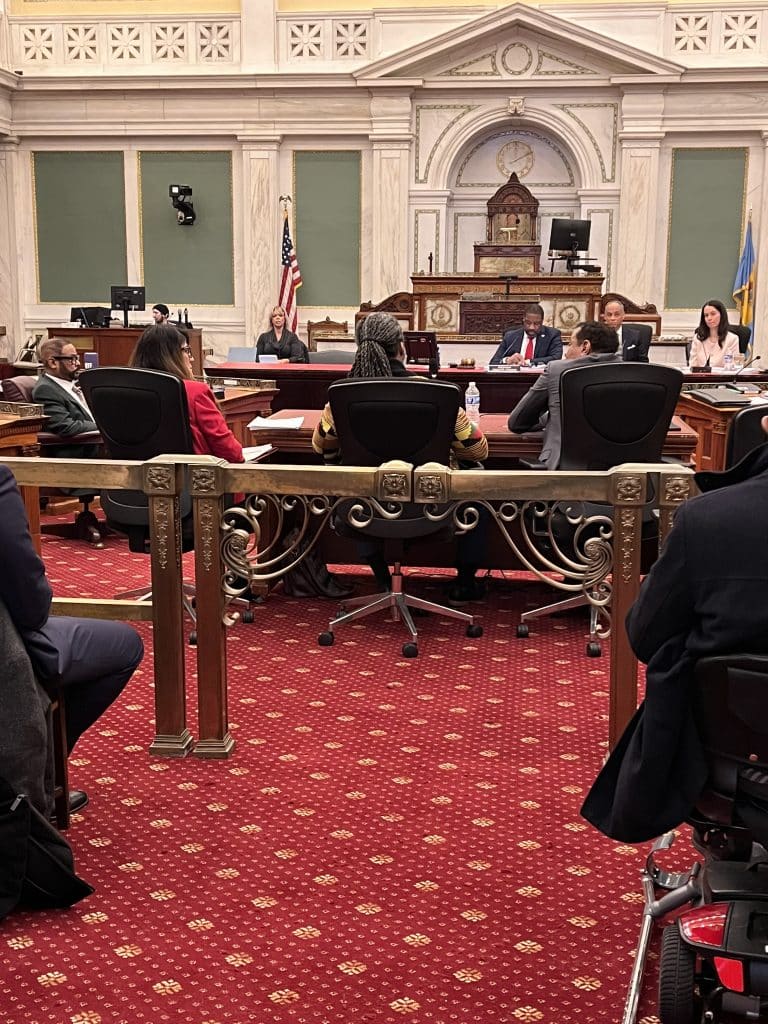
City Chief Education Officer Debora Carrera, School Board President Regional Streater, and Superintendent Tony Watlington Sr. testify at the October 17th City Council hearing on the facilities plan. Photo by Lisa Haver
Parents don’t want their children’s schools closed. Students, teachers, principals and community members made clear, in meetings across the city over the past year, that they don’t want the School District of Philadelphia to close their school or any school. City Council members have vowed to fight to stop the closure of schools in their districts.
Why, then, is district Superintendent Tony Watlington moving ahead with a Facilities Master Plan that includes the closing of twenty neighborhood schools? Why is the Philadelphia School Board poised to vote to approve the plan as early as next month?
Although Mayor Cherelle Parker has not been seen at any of the recent community meetings, the reality is that she is the decider.
Philadelphia, unlike all other districts in the state, does not have an elected school board. The mayor appoints all nine members. Although the city’s Home Rule Charter mandates that the board act as an independent governing body, the board’s actions leave little doubt about who pulls the strings. They have approved tax abatements on large commercial properties every year, despite their cost to the district, including those that would have benefited developers of the aborted midtown arena. In anticipation of the release of the facilities plan, the board, at a special meeting on December 11, passed a resolution to consider giving away district property, with a combined potential worth of over $100 million, to the city. The Facilities Master Plan, released by the Watlington administration last month, includes recommendations that future shuttered buildings be “conveyed” to the city at no cost.
Opposition to the proposed closures was immediate and fierce. Parents, students, and teachers packed community meetings. They disputed the misinformation and deceptive language presented by district staff and their consultants, whose firms the board has paid a total of over $5 million. They vowed to fight to save the schools they had fought hard to establish and maintain.
Last week, Philadelphia City Council held its own hearing on the facilities plan. Council members, many of whom had attended meetings at schools under threat of closure, including Lankenau, Robeson and Penn Treaty high schools and Conwell Middle School, challenged the district’s presentation. They asked Watlington where the data is in a plan billed as “data-driven”. They cited analyses that showed that Black students would be affected most by school closings. They corrected the district’s assertion that middle schools were being phased out, noting that middle magnet schools were actually being expanded, citing Masterman’s expansion in the building now occupied by Waring Elementary. They questioned the plan’s massive $2.8 billion price tag and Watlington’s naive contention that most of that could be raised by additional state funding and through unnamed philanthropic sources. If the district has the ability to raise almost $3 billion, some Council members wondered, why not use that to build up the system, to make schools safer and lower class size? Councilmember Cindy Bass regarded the plan as a “breakdown of public education in Philadelphia”.
Council members echoed their constituents’ frustration at not being able to get an answer about why their schools–most of which were high-performing, well-maintained, and well-attended–were on the chopping block. More than one promised to remember the district’s elimination of these schools when budget time next rolled around.
In contrast, the mayor endorsed the district’s plan before the public hearings even began. She co-authored, with Watlington, a February 3 op-ed in the Philadelphia Inquirer that describes the facilities plan as “a long-term investment in equity, excellence, and opportunity.” Parker has not addressed her constituency directly about the plan. In 2024, she announced the imminent appointment of her own “interdisciplinary facility planning committee”, but that never materialized. Several meeting participants noted Parker’s strong backing from real estate developers who may benefit from the closing of schools in gentrifying neighborhoods.
The most disturbing feature of the district’s proposal—it’s really too muddled and incomplete to call it a plan—is its cruelty and lack of humanity. Teachers who stayed for decades and dedicated themselves to their schools through the privatization and over-testing and neglect—not to mention the district itself sabotaging their enrollment—are now being tossed aside. Parents who managed to navigate the district’s application process and find a safe and nurturing school for their children feel that they are the victims of a bait-and-switch. Students who worked hard to get into special admit schools and are happier and more successful now wonder why none of that counts with the district. Alumni see part of their history erased. And the community members who volunteer through their “Friends of” and Home and School groups are made to feel that their support doesn’t count. The people who have worked to establish and maintain schools, and who have dedicated themselves to their students and their families, have told the district that they feel now that they have no choice and no real say in the future of their schools.
APPS came together in 2012 to fight the mass school closings carried out by the state-imposed School Reform Commission. It is a betrayal of all of those who fought to regain local control that this mayoral-controlled board may carry out another round of public school closings.
The district’s facilities plan is incomplete and incomprehensible. The recommendations fail to take into account what students, parents and educators have told them they want and need. It will result in school deserts in struggling communities and will have a disproportionate effect on Black and Brown students. The Board of Education should vote to reject the entire plan.
Lisa Haver is a former Philadelphia teacher and co-founder and coordinator of the Alliance for Philadelphia Public Schools. appsphilly.net
Our reporters sit through hours of city council meetings, dig through piles of documents, and ask tough questions other media overlook. Because we’re committed to addressing Philadelphia’s poverty crisis — and challenging those who sustain it. If you think this work is important too, please support our journalism.
We’re counting on readers like you.