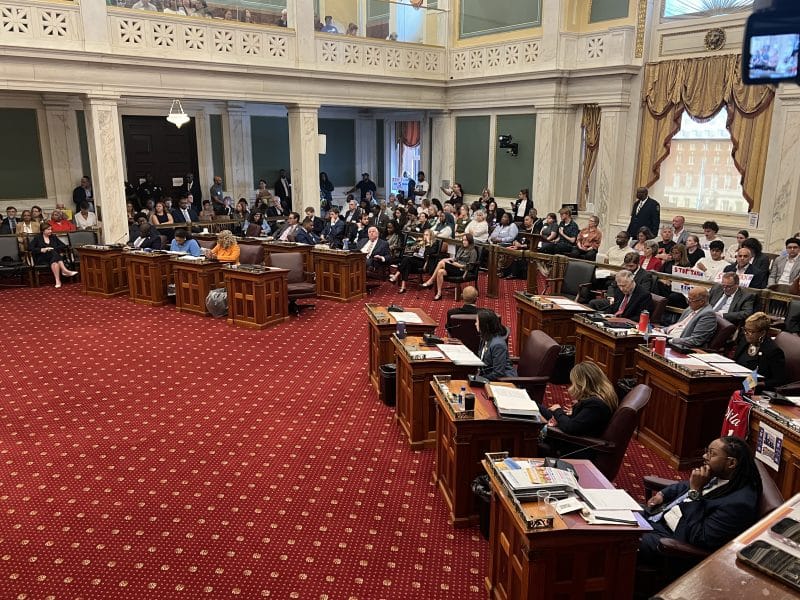
Before we do our usual discussion of City Council legislation, we must address a troubling situation that occurred at Thursday’s Stated Meeting, the Mayor of Downington, Erica Deuso, who is the first transgender mayor in Pennsylvania history, attended the meeting as a guest of Council. During the public comment section of the meeting while Majority Leader Katherine Gilmore Richardson was presiding over the meeting in council President Kenyatta Johnson’s stead, Mayor Deuso, along with others, was the subject of transphobic insults by a small group of regular council attendees. I will not publish what was said, but it can be viewed on the City Council Youtube page. What surprised me was the fact that not one member of Philadelphia City Council took a moment to push back on the hateful rhetoric. Not one.
Later in public comment, Judith Robinson, a frequent commenter, said the word “hell” in her testimony and had her microphone cut by Council President Kenyatta Johnson, who had returned to chair the meeting. It seemed unusual to limit someone’s ability to speak for such a minor infraction, and highly dubious the Council President would do so after the insults hurled at Mayor Deuso were allowed without interruption or comment.
After the meeting, I asked Council President Johnson why hate speech was tolerated during the meeting, while the word “hell” warranted a member of the public having their comments halted. Below is what he said verbatim:
“First, I wasn’t at the podium, and they were talking about the hate speech. But also, you know, one we do allow freedom of speech, allow individuals to say what they need to say. But in terms of her curse, that’s just something I objected to, right? And she decided that, you know, she wanted to leave and say the things that she had to say. But at the end of the day, we usually get wild discretion of individuals come down here and say pretty much what they wanted to say, but I just took objection. I’m just saying, you know, hell, we can agree to disagree, but that’s all you’re gonna get out of me, write as you want to see fit. But at the end of the day, I didn’t want to use in that. That’s it. That’s all I have for you, sir.”
The quote above, of course, means nothing. Because Johnson led with telling us he had not been at the podium, we contacted the office of Majority Leader Katherine Gilmore Richarson regarding the matter and received the following statement:
“I vehemently disagree with the hateful and hurtful speech used by some individuals during public comment at today’s City Council session. Those remarks were disgraceful and deeply troubling, and do not reflect my views, my values, or the Philadelphia that I know and love.
However, we live in a country where everyone has the right to freedom of speech, no matter what their beliefs are and whether you and I like it or not. Everyone knows that I am a stickler for the rules, and I follow Mason’s Manual of Legislative Procedure and the Standing Rules of City Council to a “T.” When I am chairing a stated meeting or hearing, it is my responsibility to uphold the democratic values of our government and enforce the time limits that have been established. No matter how strongly I disagree, I will not interfere with their constitutional right to speak.”
The above statement is understandable, but it would have been much better if the first two sentences had been said by someone on the floor at the time comments were made. Instead, the meeting moved along as if nothing untoward happened. By not defending their guest, in their own house, City Council made us all look like lousy hosts.
Landau Introduces Four Resolutions
Councilmember Rue Landau introduced four resolutions; two each on LGBTQ issues and technology.
Landau introduced a resolution “recognizing October 4 to October 10, 2026, as Digital Inclusion Week in the City of Philadelphia.” Digital Inclusion Week occurs the first week of October and aims to raise awareness of digital equity and address the challenges that keep many from accessing digital resources and understanding how to use them.
Additionally, Landau introduced a resolution “recognizing October 2026 as Cybersecurity Awareness Month in the City of Philadelphia, and acknowledging the importance of empowering individuals and organizations to prevent and recognize online threats, providing resources to protect sensitive data, and fostering a culture of digital safety by educating the public on best practices.”
Cybersecurity Awareness Month is an international event organized by private-sector organizations, including the National Cybersecurity Alliance and the Cybersecurity and Infrastructure Security Agency, to share information with the public on how to protect against cyber threats and stay safe online.
National Coming Out Day, which takes place on October 11th, was also recognized by Landau. The first Coming Out Day was celebrated in 1988, which coincided with the Second National March on Washington for Lesbian and Gay Rights. The resolution explains coming out as a very personal and courageous act for those in the LGBTQ+ community. The larger purpose of the day is to also highlight inequities faced by the LGBTQ+ community in areas such as housing, criminal justice, education, employment, and health care access.
The City will also recognize the month of October as LGBTQ+ History Month, which honors “the activists, advocates, and members of the LGBTQ+ community who continue to fight for civil rights and equality.”
Philadelphia has an important place in the LGBTQ+ movement, as events, known as the Annual Reminders,” were held outside Independence Hall and protested harassment faced by the LGBTQ+ community at the hands of the Philadelphia Police Department.
Affordability Hearing
The Philadelphia City Council Committee on Global Opportunities and the Creative/Innovative Economy met Wednesday, September 30th, to hear testimony on Councilmember Nicholas O’Rourke’s Cost of Living Task Force’s “Affordable Philly Now” plan.
The plan, released last week by O’Rourke’s office, identifies housing, utility costs, transit, the care economy, and food access as major issues affecting the city that City Council can address through legislative action.
Eva Gladstein, former xxx for the City of Philadelphia and a contributor to the plan, said tax relief provisions for homeowners are often promoted, but enrollment in one program does not automatically register Philadelphians for other plans.
“If someone was eligible and enrolled for TAP (Tiered Assitance Program), could they enroll in the electricity program for Gasworks payment programs automatically?” Gladstein asked. “The answer is no.”
Most reduced-cost programs for people living at 150% or 200% (depending on the program) of the federal poverty level were created by Philadelphia City Council, which could pass legislation to enable immediate registration for those who qualify.
Our reporters sit through hours of city council meetings, dig through piles of documents, and ask tough questions other media overlook. Because we’re committed to addressing Philadelphia’s poverty crisis — and challenging those who sustain it. If you think this work is important too, please support our journalism.
We’re counting on readers like you.