The Consumer Financial Protection Bureau (CFPB) was originally championed by a then-law professor, now United States Senator Elizabeth Warren. It is being demolished.
The Agency was established after the banks, mortgage companies, and investment houses that were “too big to fail” caused the 2008 financial crash. The economic and human cost of the crisis – almost nine million lost jobs, 12 million homeowners facing foreclosure and an estimated $10 to 15 trillion in lost GDP led to reforms, including the creation of the CFPB.
Unlike Ireland, Iceland, and other countries, US bankers were not prosecuted; they were bailed out.
Instead of jailing the bankers as a deterrent, the CFBP developed regulations to control financial institutions. That seems to be too much for President Trump. Asked if he intended to eliminate the CFPB, Trump replied, “I would say, yeah, because we’re trying to get rid of waste, fraud, and abuse.”
Will eliminating the CFPB eliminate waste, fraud and abuse, or make it easier for corporate criminals to act?
According to the CFPB’s web page, which is controlled by President Trump’s appointee, former hedge fund manager Scott Bessent Every consumer, including our arm services, had some protections from predatory practices, such as payday lenders and title loan companies. The CFPB’s enforcement actions provided $130 million in compensation to service members, veterans, and their families.
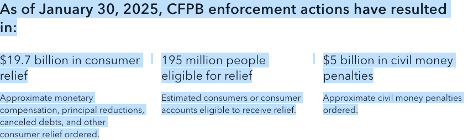
The CFPB investigated Wells Fargo, one of the country’s largest banks, for its account handling failures that affected over 11 million people. Wells Fargo’s repeated misconduct caused consumers to lose their homes, cars, and even access to their own money. The CFPB forced Wells Fargo to refund and pay penalties of over 3 billion. The CFPB also took action against Regions Bank in 2022 for imposing over $140 million in junk overdraft fees, ordering the bank to give $ 100 million back to its consumers.
CFPB fought for students. It shut down Navient, the country’s largest private student loan servicer, in 2024. For years, the company had been abusing students (particularly disabled veterans) and profiting from its exploitation by collecting interest and fees that it should not have charged.The list goes on. The Agency has gone after unscrupulous debt collectors, fought against car loan companies that take advantage of consumers, and fought against “cash transfer apps” that failed to set up a system to refund consumers who had been defrauded.
That is the Agency Elon Musk, the billionaire head of Trump’s Department of Government Efficiency has targeted: He posted on the social media company he purchased, “Delete the CFPB” and “CFPB RIP.” The man who wants to get into the mobile payments business via a partnership with Visa intends to eliminate the Agency that protects consumers from the abuses of those types of services.
While the courts have reversed President Trump’s dismissal of almost 90% of the CFPB staff, it will not change the Agency’s direction. The director decides what investigations to open, who to prosecute, and even when to allow a corporation to have a regulation thrown out by choosing not to oppose a corporation’s appeal.
In the months to come, here is what should be expected unless Congress decides to act:
Repeal of the Credit Card late fee caps. In the past, credit cards were free to charge whatever they wanted in late fees and to shorten the time a consumer had to pay the bill, increasing the amount of late fees collected.
Debt collectors will have more freedom to call people repeatedly at most hours of the day and will be free to include medical debt on your credit report again.
Car loan companies will be able to repossess cars for add-on fees, and non-bank lenders, title loan-type companies, will have more freedom to charge exorbitant interest rates and fees.
Even if every CFPB worker stayed on the job, the consumer protections would disappear as the new director decided not to allow corporations to regulate themselves.
“Since the Trump administration moved to dismantle the Consumer Financial Protection Bureau last month, the bureau has dropped nine lawsuits that it had brought on behalf of consumers.”
The actions effectively freed major financial firms like Capital One and the mortgage giant Rocket Homes from the threat of consequences for their alleged significant wrongdoing, shocking consumer advocates and raising questions about the future of America’s consumer watchdog.
For their part, when the cases were dropped, the companies lauded the decisions, with a bank spokesperson welcoming the dismissal of the case, “which we strongly disputed,” and Rocket Homes calling the suit an “empty claim.”
However, the administration’s new hands-off approach to enforcement at the CFPB extends far beyond those public lawsuits. Behind the scenes, dozens of ongoing investigations into alleged corporate malfeasance are now frozen at the Agency, potentially denying accountability and financial relief for untold numbers of consumers, a ProPublica investigation has found.”
Does Congress believe this is what Trump voters wanted? If not, why don’t they act?
Our reporters sit through hours of city council meetings, dig through piles of documents, and ask tough questions other media overlook. Because we’re committed to addressing Philadelphia’s poverty crisis — and challenging those who sustain it. If you think this work is important too, please support our journalism.
We’re counting on readers like you.