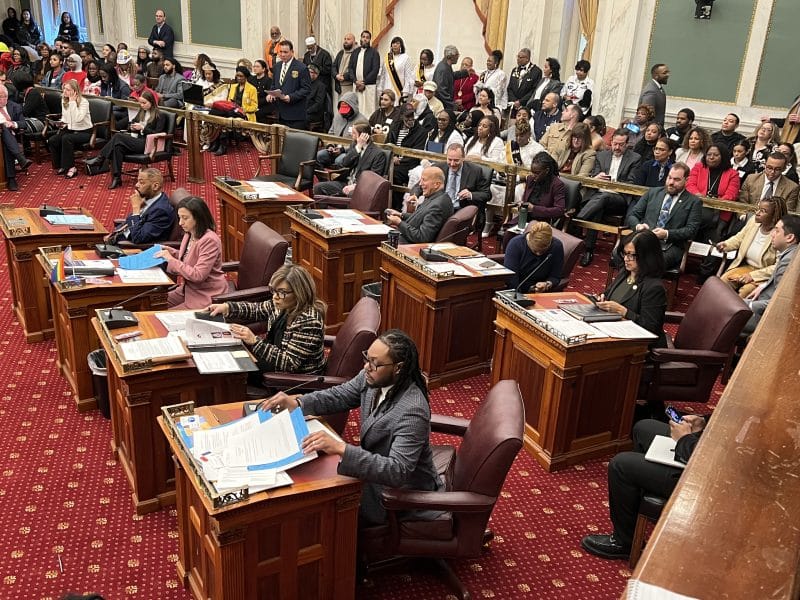
Council Holds Hearing on Carbon Emissions
With the effects of global climate change becoming more and more apparent, Philadelphia City Council held a hearing to determine if the city was meeting its carbon usage goals.
In 2021, the Kenney Administration established a plan to reduce Philadelphia’s carbon footprint by 80% by 2050, essentially making the city carbon neutral.
Read More
Liz Lankenau, the Interim Director of the Office of Sustainability, explained her office’s goal of advancing environmental justice, reducing carbon emissions, and preparing for a hotter and wetter future.
“While our office is immersed in this mission, we realize that for most people, goals like carbon neutrality can feel far off and unrelatable,” Lankenau said. “However, we also know that the impacts of decades of global inaction are already widely felt with vulnerable populations and people of color being affected most.”
Lankenau touted recent city efforts, including a solar energy facility that provides 25% of the city’s electricity for municipal buildings as progress on the city’s goal of a 50% carbon reduction by 2030.
However, despite the city’s efforts to reduce its own carbon footprint, municipal emissions only account for 2% of emissions across the region. While local emissions have been reduced by 20% due to a cleaner energy grid, a larger effort is needed to achieve the city’s stated goals. Currently, 70% of city wide emissions come from buildings and industry, 26% is generated by transportation, with 4% caused by waste and wastewater.
Rob Kuper, Associate Professor of Landscape Architecture, Department of Architecture & Environmental Design, Tyler School of Art & Architecture, Temple University, contributed facts about Philadelphia’s carbon emissions and recommendations as to how the city can continue to curb emissions.
Kuper said a global rise in temperature of 5.4 degrees Fahrenheit would increase Philadelphia’s number of days above 95 degrees from 8 to 29 yearly, which would cause the dense, urban areas of the city to see a 10-12 degree increase in temperature.
Kuper recommended improvements in green water infrastructure, more investment in solar and wind-power, providing pools, splash pads and other infrastructure.
Further changes would be useful regarding rules on development, including requiring developers to publicly report energy and greenhouse emissions.
Council Decries Gun Violence
While not addressed by any specific legislation at yesterday’s meeting of council, gun violence was once again brought to the forefront by multiple high-profile acts of violence this past week.
On Wednesday, 30 shots were fired at Philadelphia school students as they waited for a bus, injuring 11. The reaction from council ranged from helplessness to anger.
Read More
Councilmember Phillips represented the former emotion, lamenting the violence and referring to the situation as a crisis.
“I am feeling powerless and surrounded by a pall of desperation,” Phillips said. “Our children, most specifically teenage Black men are at the crosshairs of a seemingly on ending crisis of senseless gun violence.”
Councilmember Curtis Jones, however, rebuffed the idea council was unable to effect needed change.
”I got elected, not to be helpless,” Jones said. “We have a President of City Council, we have a Mayor, we have a police commissioner and 7000 (police officers).”
Jones touted the recommendation of the Blueprint for a Safer Philadelphia, the document compiled and prepared by his office in late 2023, as a compendium of possible solutions to the gun violence problem.
The tenor of the discussion was notable for the unusually emotional response from members of council. While members have long spoken out against gun violence, the impact of multiple events involving children in rapid succession clearly affected the body, including Councilmember Cindy Bass, in whom’s Distrcit the latest event occurred. Bass called for families to be more involved in making sure children do not commit acts of violence by being more assertive when discussing these issues.
“What do you do when the shooter lives with you?” Bass asked, repeating the question she has asked in multiple hearings. “Because these guns were in people’s houses. We have to call on parents and caregivers, if you have someone in your house that you suspect is involved (in a violent crime)…you need to go into heir room and flip the mattress. You have to check the closet and the drawers.”
Ahmad to Hold Hearings on Electric Vehicle Infrastructure
Councilmember Nina Ahmad introduced a resolution Authorizing the Committees on the Environment and Global Opportunities and the Creative/Innovative Economy to hold joint hearings regarding the reliability and servicing of publicly accessible electric vehicle charging stations in the City of Philadelphia.
As we reported earlier, vehicles account for around 25% of Philadelphia’s carbon emissions (buildings create the most, at 70%). Creating further urgency on the matter is the Biden Administration’s stated goal of national auto sales being 50% electric.
Read More
The resolution mentions EV usage increased by 63% in Philadelphia between 2022 and 2023. Philadelphia has also received a $1.5 million federal grant for developing more EV infrastructure.
Our reporters sit through hours of city council meetings, dig through piles of documents, and ask tough questions other media overlook. Because we’re committed to addressing Philadelphia’s poverty crisis — and challenging those who sustain it. If you think this work is important too, please support our journalism.
We’re counting on readers like you.