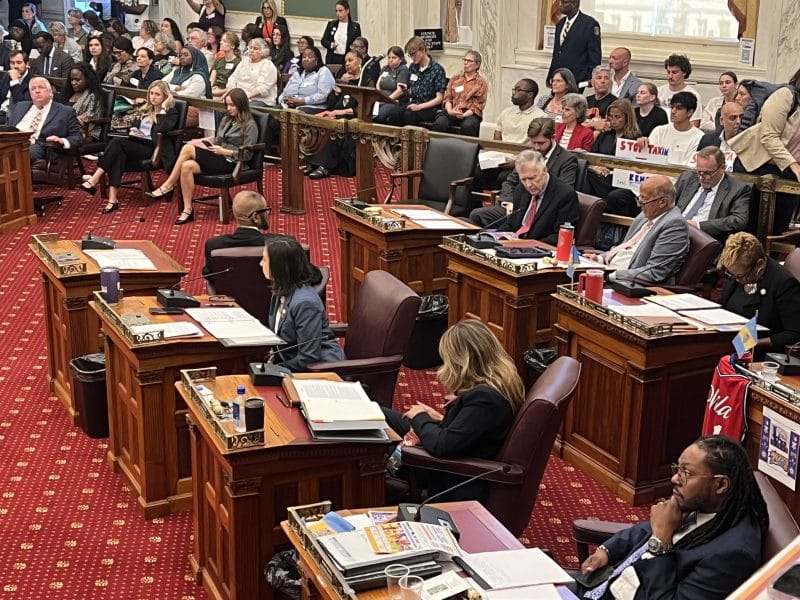
Councilmember Cindy Bass introduced a resolution “authorizing the Committee on Licenses and Inspections to hold a hearing to examine the implementation and enforcement of laws and regulations governing nuisance businesses, including Stop and Go establishments, signage, and window coverings, and to assess how enforcement practices can improve public safety, strengthen community trust, ensure due process, and reduce neighborhood conflict.”
Long a topic of concern for Councilmember Bass, who has authored, sponsored, and passed several pieces of nuisance business legislation, cites the concerns of community members as the impetus behind the need to better understand how the city enforces current laws in relations to fines, closings, and other possible actions.
The hearing will also consider other possible forms of enforcement for repeated offenders, and review signage requirements for businesses which inform the public on the goods and services offered by the establishment.
Brooks and O’Rourke Recognize Labor
Councilmember Kendra Brooks introduced a resolution “honoring the legacy of Black labor in Philadelphia, including the first Colored Convention in 1830, and the Black organizers who for centuries have been at the heart of the American labor movement.”
According to the resolution, Philadelphia held the first Colored Convention on September 20th, 1830, at Mother Bethel AME church. This, and other events, helped set the stage for future Black labor organizing and contributed to the burgeoning civil rights movement. Labor has always had its struggle against management, and early pioneers helped future labor leaders make long-term progress.
This sentiment was especially prescient at Thursday’s meeting, as Brooks’ colleague and fellow Working Families Party member Nicholas O’Rourke introduced a resolution “unequivocally standing with unionized workers by endorsing the boycott of Starbucks called for by Workers United-SEIU by encouraging residents, neighboring local councils, and Philadelphia City Council to refrain from purchasing Starbucks products until Starbucks finalizes a fair union contract.”
O’Rourke said that over 12,000 Starbucks baristas across the United States are currently represented by Workers United-SEIU, which has been attempting to organize and bargain for the past five years without Starbucks agreeing to a contract. Studies show that Starbucks has become the largest violator of US labor law in modern history.
Landau Opposes Weakening Banking Regulations
Councilmember Rue Landau introduced a resolution “urging the Office of the Comptroller of the Currency and the Federal Deposit Insurance Corporation to withdraw the proposed amendments to their Community Reinvestment Act rules, which would roll back anti-redlining standards and weaken banking services to low- and moderate-income communities while threatening investments in affordable housing and community development.”
Redlining, the discriminatory act of denying financial services to communities of people based on race and ethnicity, had been a long-established practice in American banking. In 1977, Congress passed the Community Reinvestment Act to address the issue. However, the proposed rule changes raising the asset threshold could reduce transparency around the actions of certain banks.
According to the resolution, services like checking and savings accounts could also be affected, as banks will no longer be required to ensure these services are affordable, which will make them less available to communities that are already underbanked.
Gauthier Recognizes Historic Black Bottom
Councilmember Jaime Gauthier introduced a resolution “recognizing “Black Bottom” as the first and official name of the neighborhood in West Philadelphia bounded by 32nd Street to the east, 40th Street to the west, University Avenue to the south, and Lancaster Avenue to the north; ensuring that future communication or action on the part of the City of Philadelphia acknowledge this community’s importance to our city.”
According to information from Gauthier’s office, the Black settlement of this section of West Philadelphia predates the Civil War, with expansion aided by the Great Migration, leading the area to become a destination for Black Philadelphians.
However, in the 1960s the Philadelphia Redevelopment Authority began demolishing homes and other buildings at the behest of the University of Pennsylvania, Drexel University, and other local institutions. Over 10,000 Black residents were displaced and forced to move to different parts of the city.
Harrity Hosts Wellness Expo

Our reporters sit through hours of city council meetings, dig through piles of documents, and ask tough questions other media overlook. Because we’re committed to addressing Philadelphia’s poverty crisis — and challenging those who sustain it. If you think this work is important too, please support our journalism.
We’re counting on readers like you.