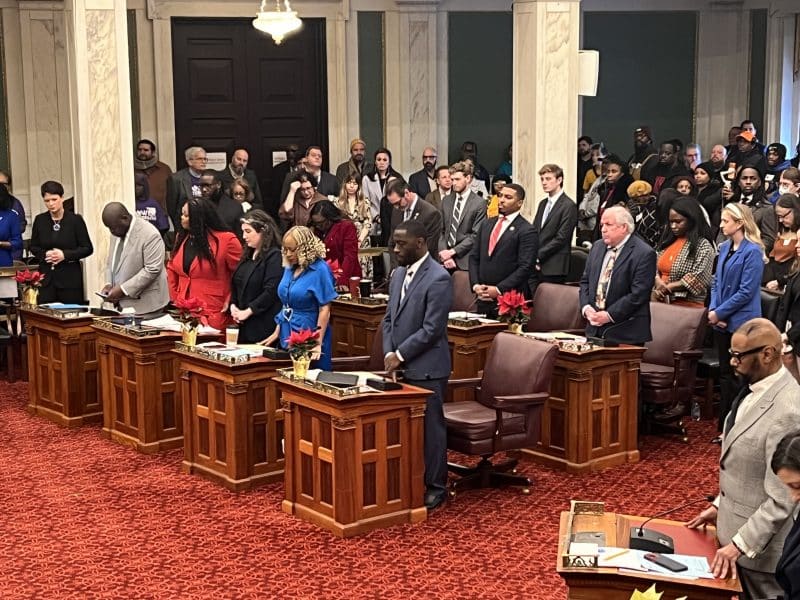
The Philadelphia City Council Committee on Public Health and Human Services met to hear testimony on a resolution “examining the current state of Philadelphia’s reproductive health care system, the current federal landscape affecting reproductive policy, and the city’s response to protect reproductive freedom.”
Councilmember Nina Ahmad, Chair of the committee, began the hearing by reminding those assembled of the difficulties women face in obtaining reproductive healthcare in the current political environment.
“We are here today because reproductive health is not a headline,” Ahmad said. “It is an afterthought, and we have to reverse that. It is the appointment you cannot get, it is the prescription you have to stretch, it is trying to find a provider who takes your insurance and is actually accepting new patients.”
Ahmad said reproductive health care included services dedicated to sexual violence, birth control, STI care, prenatal visits, labor and delivery, postpartum care, cancer screenings, fertility care, menopause care, and abortion care.
LaQuisha Anthony, Senior Manager of Advocacy at WOAH, the Philadelpha Center Against Sexual Violence, testified that nearly 1 in 5 women has experienced completed or attempted rape in their lifetime, and each year of thousands of people experience sexual assalut.
“For many survivors, the violence does not end when the assault ends,” Anthony said. “The harm often continues in their bodies.”
Anthony said that approximately 5% of rapes result in pregnancy, leading to tens of thousands of rape-related pregnancies in the United States each year. Victims also face the risk of sexually transmitted infections, long-term reproductive health conditions, and severe psychological trauma.
“For a survivor,” Anthony said, “access to emergency contraception, STI treatment, abortion care, prenatal care if that is their choice, and trauma-informed follow-up services is not elective, It is emergency care. Reproductive health access is violence intervention.”
Gilmore Richardson Introduces New Nuisance Business Legislation
Majority Leader Katherine Gilmore Richardson introduced two pieces of legislation directed at curbing nuisance businesses in the city.
The first “establishes restrictions and regulation related to the sale of certain intoxicating substances and provides for associated penalties and enforcements.”
According to information provided by Gilmore Richardson’s office, there has been a proliferation of hemp-derived products and other substances such as kratom, which are advertised as sleep aids. Many of these products are made at unsafe facilities and contain toxic elements, with not state oversight or regulation.
The legislation would add a new section of the city code creating definitions for these products and mandating that they not be sold within the city if they have not been approved by Food and Drug Administration (FDA). Retailers selling these products would require a license, and sales would be prohibited to anyone under the age of 21.
The second bill allows the City to take legal action against landlords who knowingly allow illegal smoke shops to operate in their spaces. City Council has passed several pieces of legislation aimed at combatting illegal smoke shops, and holding the owner of a retail space accountable is another enforcement mechanism which has been used in other localities, such as New York City.
Landau Celebrates Consumer Protection Week
Councilmember Rue Landau introduced a resolution “declaring March 1-7, 2026 as National Consumer Protection Week in the City of Philadelphia.”
The Federal Trade Commission reports Americans lost more than $12.5 billion to fraud an scams in 2024, a 25 percent increase over 2023. The groups most susceptible to fraud are seniors, immigrants, and non-English speakers. The rise in fraudulent activity has been exacerbated by the Trump Administration’s gutting of the Consumer Financial Protection Bureau, an agency created after the 2008 financial crisis to protect consumers.
National Consumer Protection Week is a national event intended to raise awareness of scams and fraud, and provide resources so consumers can identify and report fraudulent activity to federal, state, and local authorities. In recent years, Philadelphia created its own Consumer Protection Ordinance which fines businesses harming residents up to $2000 per violation.
This article is a part of Every Voice, Every Vote, a collaborative project managed by The Lenfest Institute for Journalism. The William Penn Foundation provides lead support for Every Voice, Every Vote in 2024 and 2025 with additional funding from The Lenfest Institute for Journalism, Comcast NBC Universal, The John S. and James L. Knight Foundation, Henry L. Kimelman Family Foundation, Judy and Peter Leone, Arctos Foundation, Wyncote Foundation, 25th Century Foundation, Dolfinger-McMahon Foundation, and Philadelphia Health Partnership. To learn more about the project and view a full list of supporters, visit www.everyvoice-everyvote.org. Editorial content is created independently of the project’s donors.
Our reporters sit through hours of city council meetings, dig through piles of documents, and ask tough questions other media overlook. Because we’re committed to addressing Philadelphia’s poverty crisis — and challenging those who sustain it. If you think this work is important too, please support our journalism.
We’re counting on readers like you.