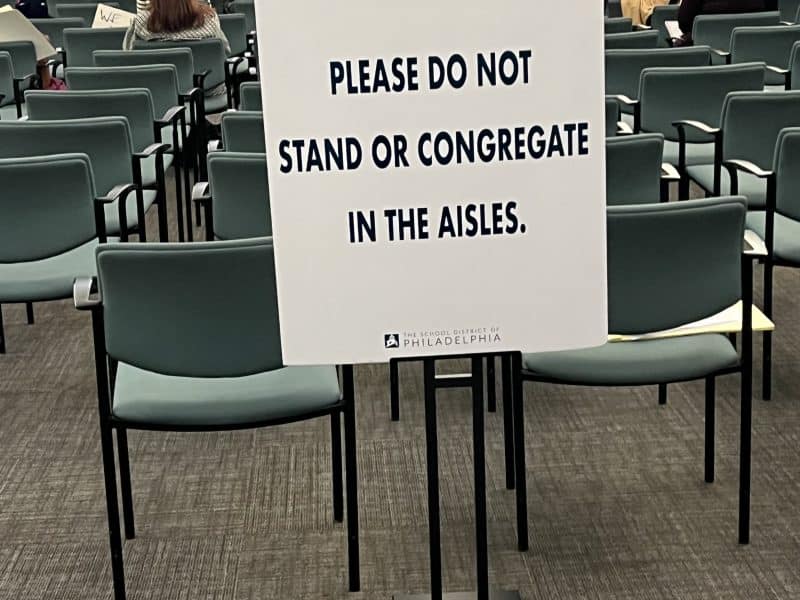
While the Philadelphia 76ers were in City Council chambers trying to convince Councilmembers to support a new arena for the team, Mayor Cherelle Parker took her support of the project to church.
One of the things that I was taught when I first started studying government is that America, technically, is not a theocracy.
What that means is, the affairs of the church and the affairs of the state are supposed to be conducted separately. There’s a fairly significant chunk of the First Amendment that clearly states that, unlike other countries, we don’t have a national religion and, most importantly, we don’t run our country based on what any religion dictates.
But because America’s contradictions have contradictions, one of the first places that politicians tend to gravitate toward when running for office is the church. You can’t get elected to anything as an openly practicing atheist in this country. And if you’re a Muslim or a Jew, certain sections of the electorate will view you with suspicion. The fact that Philadelphia’s City Council includes two Muslim members — Councilmembers Curtis Jones and Nina Ahmad — is fairly significant.
Heck, when John F. Kennedy Jr. ran for president, his membership in the Catholic Church was seen as questionable.
So, who you pray to, or if you pray at all, is a big deal in America.
That goes double for the Black community in places like Philadelphia. One of the last places I saw President Joe Biden before he dropped out of the presidential race was at the Mount Airy Church of God In Christ.
It was also where Mayor Cherelle Parker held the first of a series of town hall meetings to try and sell residents on the idea of the Philadelphia 76ers proposed downtown arena, 76 Place.
Parker presented her vision for the project directly to people gathered at the church, which is in Councilmember Cindy Bass’s district, and took questions from them afterward. She also allowed members of her cabinet, most notably Chief of Staff Tiffany Thurmond, to speak to those gathered about the project. It was in many ways like the mayor’s presentation of the plan at the Convention Center, except that the chairs were more comfortable.
Actually, that depends on whether or not you find church pews comfortable. But I digress.
The latest of these town halls was held on Tuesday nightat the Church of Christian Compassion in Cobbs Creek, shortly after officials from Harris Blitzer Sports and Entertainment came to Council chambers to answer questions from councilmembers about the project. This one got a little more contentious as members of the Save Chinatown Coalition also attended the meeting.
Now, I guess I should mention that the Black Clergy of Philadelphia and Vicinity is one of the groups that is standing behind the Mayor as supporters of the 76 Place project. So, the location of at least the first two of these citywide town halls should be no surprise.
But I have a problem with this.
Like I said at the beginning of this column, America is not a theocracy. Unlike places like Afghanistan and Iran where not doing the church’s bidding can get you beaten or worse, America is, at least technically, a secular democracy. So, using religion, even tangentially, to bring people to your way of thinking kinda doesn’t pass the smell test for me.
Especially if you’re using it as a wedge. While I believe that the divide that 76 Place has exposed between the Black community and Chinatown is the product of decades and decades of unaddressed mistrust and a perceived lack of support when it comes to issues like police brutality, using churches to help widen it is bad. Really bad.
Thankfully, the time for theatrics on both sides of this project is coming to an end. The last scheduled hearing on the project was held on Tuesday and negotiations are continuing between City Council and the Sixers to get something that everyone can agree on.
If you want to pray for a resolution to this issue on either side, fine.
But let’s try and leave the pulpits out of this.
Our reporters sit through hours of city council meetings, dig through piles of documents, and ask tough questions other media overlook. Because we’re committed to addressing Philadelphia’s poverty crisis — and challenging those who sustain it. If you think this work is important too, please support our journalism.
We’re counting on readers like you.