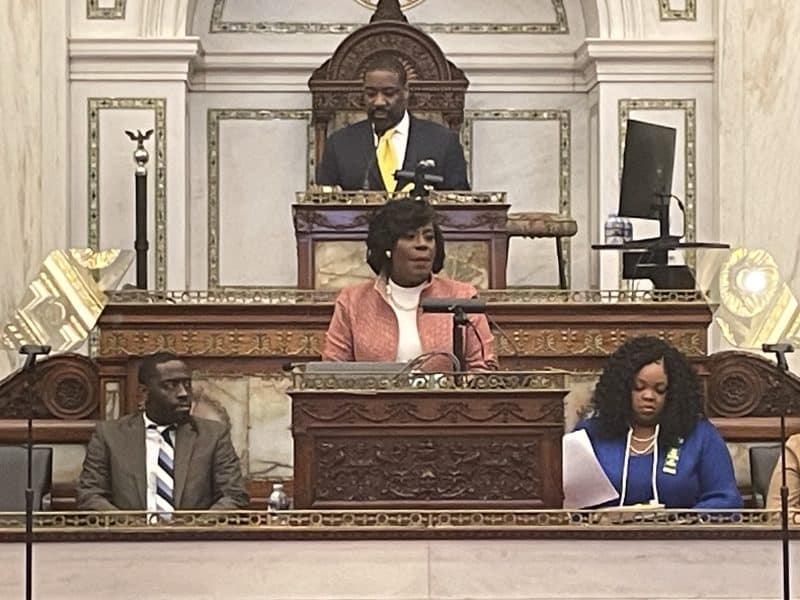
In late October, at the request of Mayor Cherelle Parker, legislation was introduced in Philadelphia City Council that would grant the owners of the 76ers the right to build a new arena on land and property in Center City, which may include the former bus station and some public streets.
If passed, the team’s owners would be able to avoid paying legally set tax rates, instead paying a much smaller, negotiated rate—something no homeowner or small business can do.
Under the proposed agreement, the City would own the land, which it would lease to the Pennsylvania Authority for Industrial Development (PAID). PAID would then lease the land and the new arena to the team’s owners. Thus, no real estate taxes would be owed.
The owners will make payments in lieu of taxes (PILOT) in amounts far less than what they would pay if the investors owned the land and the building.
All amounts are estimates at this point, as no one can know what the arena will be worth in 20 to 30 years. The agreement calls for the 76ers to pay just $5 million in PILOTs annually. The City’s current real estate tax rate is 1.3998%. For every $100,000 of assessed value, $1,400 is owed. The team owners have said they will spend $1.5 billion to build the arena. If the arena is assessed at 2/3rds of the building cost, its appraised value would be $ 1 billion.
If the owners were required to pay real estate taxes at the same rate as other Philadelphians, the amount would be $13.998 million per year (.013998 (tax rate) X $1,000,000,000 (assessed value), or $13,998,000).
Under the agreement, the owners negotiated the $13.998 million annual tax bill to $5 million a year, legally avoiding $8,000,000 annually.
Over 30 years, that would be $240,000,000. But of course, based on inflation and rising real estate prices, the “actual value” assessed in 15 years may be $1.75 billion, so the savings in the legislation would be even greater.
If the $5 million payment weren’t a tax break and the owners paid the same rate as everyone else, the arena would be worth $359 million. ($357 X .013998 (current RE tax rate) or $5 million)
The legislation is either a tax break, or the 76ers are paying 1.5 billion for an Arena worth $359 million.
Under the agreement, real estate taxes are not the only taxes being legally avoided. It’s also a business tax called the Use and Occupancy Tax (U&O). Just like the RE tax, the U&O tax is set by legislation. It is currently 1.21 % of the assessed value of the property. The City’s web page says no one is excused from paying it. But if the legislation passes, the 76ers’ owners will not have to pay it.
As with the RE taxes, the owners have written into the agreement that they will only have to pay $500,000 instead of the legislated rate. Under the agreement, the team’s owners will pay an amount that would be paid if the arena was worth $348 million, not the $1.5 billion that the owners will pay for it.
If the arena’s appraised value is 66% of what the owners are paying for it, it would be taxable on a $1 billion value. The U&O tax would be 12.1 million a year. Over 30 years, the tax savings for U&O taxes would be $348 million.
The total taxes the owners will be allowed to avoid are $348 in U&O taxes and $240 mil in real estate taxes, or $588 mil in savings. Of course, if the arena’s value, like most real estate, goes up over 30 years, the tax savings to the owners will be even more.
The arena advocates say there are “no city subsidies.” These claims recall the Bill Clinton quote, “It depends on what the meaning of the word ‘is’ is.”
| Tax Type | Rate | Actual Value | Tax Owed | Owners Paying | Owners Savings |
| Real Estate | .013998 | $1,000,000,000 | $13,998,000 | $5,000,000 | $8,998000/yrOver 30 years, $269,940,000 |
| U&O | .0121 | $1,000,000,000 | $12,000,000 | $500,000 | $11,600,000/yrOver 30 years$348,000,000 |
Indeed, the City is not giving the 76ers’ owners any cash. Still, under the legislation, the 76ers will avoid the legally required taxes and have the City be the backstop for any financial difficulties.
The actual amounts the owners will save may well be much higher, but in the first few years, they may be lower as the owners may qualify for the City’s tax abatement program and only owe RE taxes on the land. There is no tax abatement on the U&O tax other than the deal the legislation gives the owners, so the savings on the U&O tax will be at least $11,500,000 per year.
Proponents of the Arena say increased businesses and more concerts will pay for the tax breaks. The comparisons offered compare what may happen against no changes to the existing buildings in either use or occupancy.
For example, if a new arena were to be built elsewhere and/or there were other possible uses for the existing buildings that would not put pressure on China Town, the Reading Terminal Market, and other neighborhoods, there would be a greater increase in businesses and real estate taxes than what the owners and their supporters suggest.
The policy question is: Should billionaires be able to negotiate the discount they get off the expected tax bill? And should City life be harmed so that the billionaire owners of the 76ers can get what they want?
Our reporters sit through hours of city council meetings, dig through piles of documents, and ask tough questions other media overlook. Because we’re committed to addressing Philadelphia’s poverty crisis — and challenging those who sustain it. If you think this work is important too, please support our journalism.
We’re counting on readers like you.