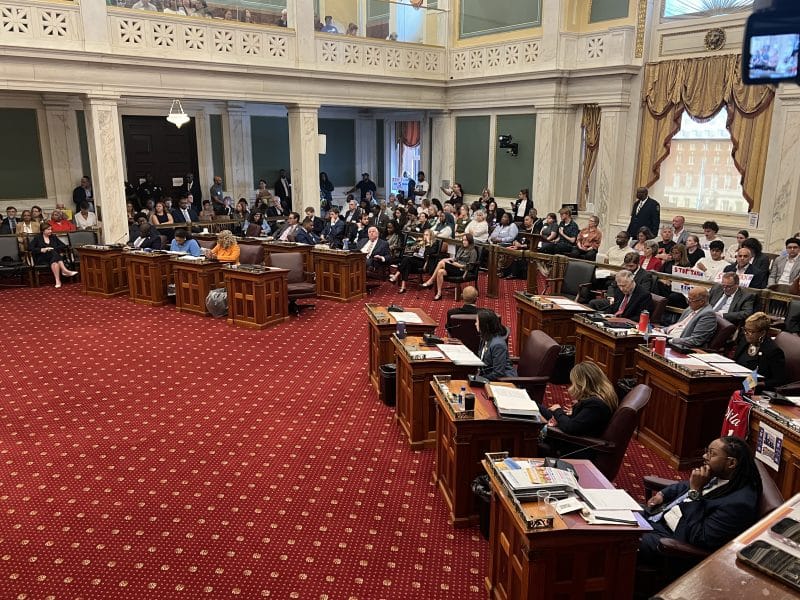
The Philadelphia City Council Committee of the Whole heard testimony on Resolution No. 250895, which authorized Council to discuss the state of Philadelphia school facilities.
Philadelphia School District Superintendent Tony Watlington recently introduced a 10-year, $2.8 billion plan to modernize school facilities. This comes after the district announced the impending closing of 20 district schools, which has led to pushback from parents and lawmakers.
Councilmember Isaiah Thomas, Chair of the Education Committee, said that while he liked certain aspects of the plan, such as no comprehensive neighborhood schools being closed, he questioned the logic of some of the potential closures.
“There are decisions that were made that puts us in a position where schools that currently don’t have enough space in their building are going to be asked to add more seats, decisions that will put neighborhoods in a position where they might not have elementary schools,” Thomas said.
Thomas wasn’t the only councilmember to voice concerns regarding the district’s facilities plan, as Councilmember Jim Harrity expressed his frustration at closings in the Kensington area of the city and issued a warning regarding the district’s finances.
“I’m infuriated that we (Council) don’t get a say,” Harrity said. “(But we all know) we do get a say because budget (hearings) are (coming up). So ‘mindful’ is the word I would use for today. Be mindful.”
In prepared testimony, school board President Reginald Streater said the average age of a school district building is 73 years, with many of the buildings requiring significant investment to maintain and modernize. Streater also cited declining enrollment in city public schools as a factor in school closing decisions.
Currently, more than one-third of school-aged children are enrolled in charter schools, which, while funded by the school district, are not subject to district authority.
“The current enrollment realite present misalignment between our building capacity and the number of students we serve, forcing the District to take a critical look at our current footprint and realign resources,” Steater said.
School District Superintendent Tony Watlington’s presentation to Council offered four guiding themes for the facilities plan:
Strengthening PreK-9 Programming Through Better Use of Space
Reinvesting in Neighborhood High Schools as Community Anchors
Reducing Unnecessary School Transitions for Students
Expanding Access to Grades 5-112 Criteria-Based and CTE Schools
Watlington also touted District outreach efforts, which included 8000 survey respondents from 100% of city Zip codes.
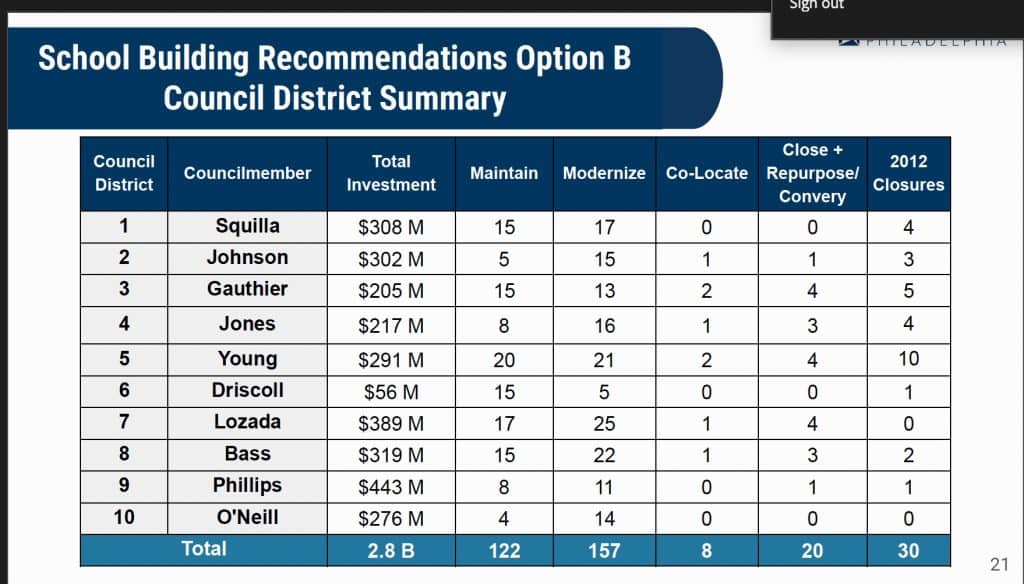
The $2.8 billion plan would be comprised of $1 billion in bond funding and $1.8 billion in new government and philanthropic dollars. 122 schools will be maintained, 159 will be modernized, 6 will be colocated, 12 will be closed and repurposed for district use, and 8 will be closed and conveyed to the city.
Council President Kenyatta Johnson inquired as to the methodology utilized to make the closure decisions, wondering why some schools were being closed and students relocated when it might be more beneficial and cost-effective for an aging school to be torn down and a new one built to replace it.
“(Closing schools) in certain neighborhoods would create an educational gap zone, because for most neighborhoods, the school is the hub (of neighborhood activity),” Johnson said.
Councilmember Cindy Bass was more direct in her comments, telling the Superintendent and Board President that those who create the conditions are responsible for the result.
“I feel like this is a breakdown of public education in Philadelphia,” Bass said. “It’s almost as if you are (cutting of a limb) rather than addressing the symptoms of the problem.”
Details of that plan were provided to Council, and were broken down by council district as follows:
Final recommendations will be presented to the school board on February 26th.
Puppy Breeding Ban Passes
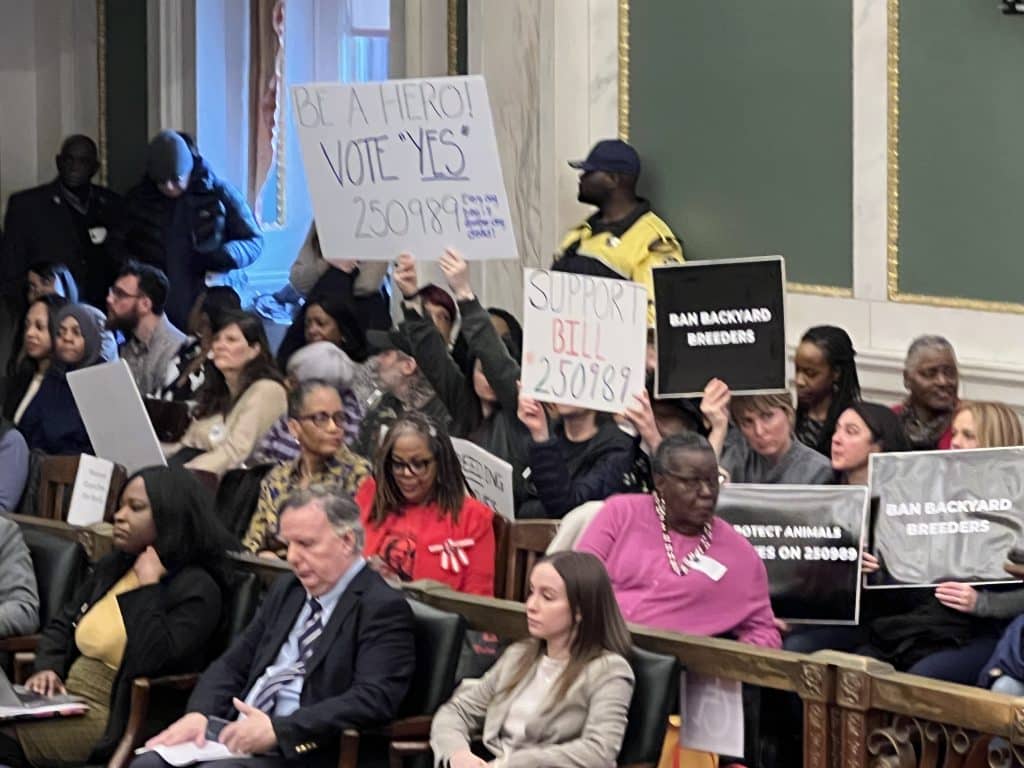
Councilmember Cindy Bass’s legislation, which places a three-year moratorium on backyard puppy breeding, passed the City Council unanimously last Thursday.
The legislation was created in response to overcrowding conditions in Philadelphia animal shelters, such as ACCT (Animal Care and Control Team). There have been numerous cases of unsold puppies being taken to the shelters, sometimes when ill with serious conditions such as Parvo.
“This bill is about responsibility, compassion, and common sense,” said Councilwoman Cindy Bass via press release. “Philadelphia’s animal shelter system is under real strain, and unregulated breeding has contributed to overcrowding, abandonment, and public safety risks. Bill 250989 gives our city the breathing room it needs to protect animals, support responsible pet ownership, and safeguard our neighborhoods, while we work toward sustainable, long-term solutions.”
EVEV Acknowledgement Language for Partners
This articleis a part of Every Voice, Every Vote, a collaborative project managed by The Lenfest Institute for Journalism. The William Penn Foundation provides lead support for Every Voice, Every Vote in 2024 and 2025 with additional funding from The Lenfest Institute for Journalism, Comcast NBC Universal, The John S. and James L. Knight Foundation, Henry L. Kimelman Family Foundation, Judy and Peter Leone, Arctos Foundation, Wyncote Foundation, 25th Century Foundation, Dolfinger-McMahon Foundation, and Philadelphia Health Partnership. To learn more about the project and view a full list of supporters, visit www.everyvoice-everyvote.org. Editorial content is created independently of the project’s donors.
Our reporters sit through hours of city council meetings, dig through piles of documents, and ask tough questions other media overlook. Because we’re committed to addressing Philadelphia’s poverty crisis — and challenging those who sustain it. If you think this work is important too, please support our journalism.
We’re counting on readers like you.