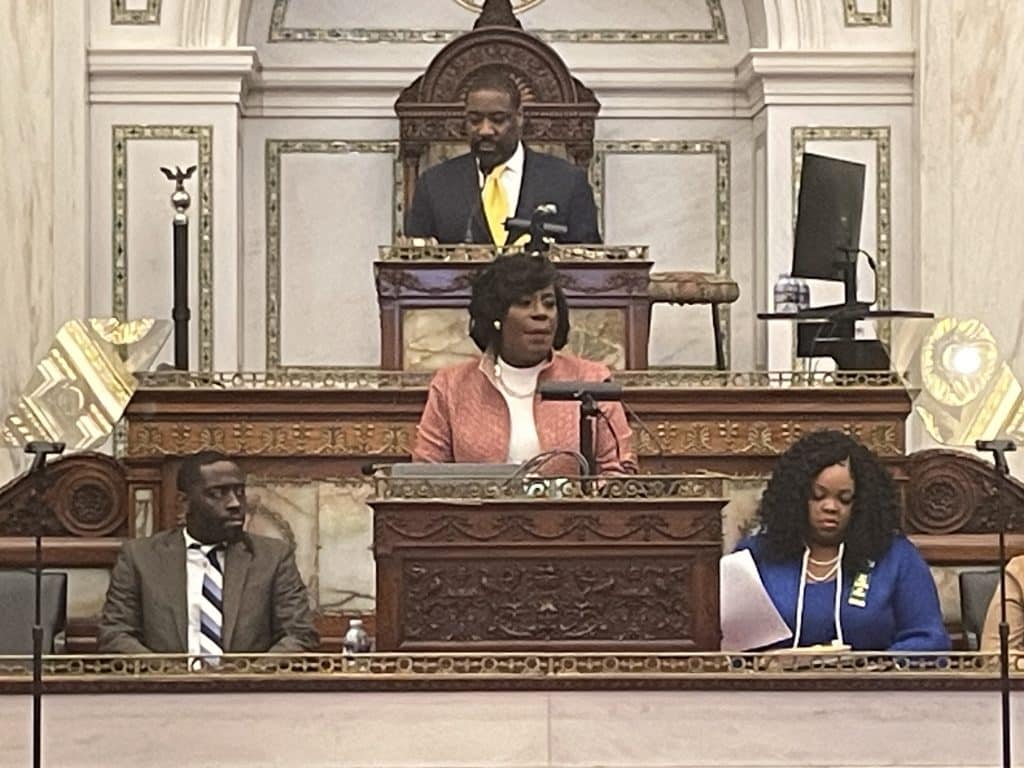
Exclaiming that the fiscal health of the city is good, Mayor Cherelle Parker outlined her her budget priorities in her first budget address before City Council.
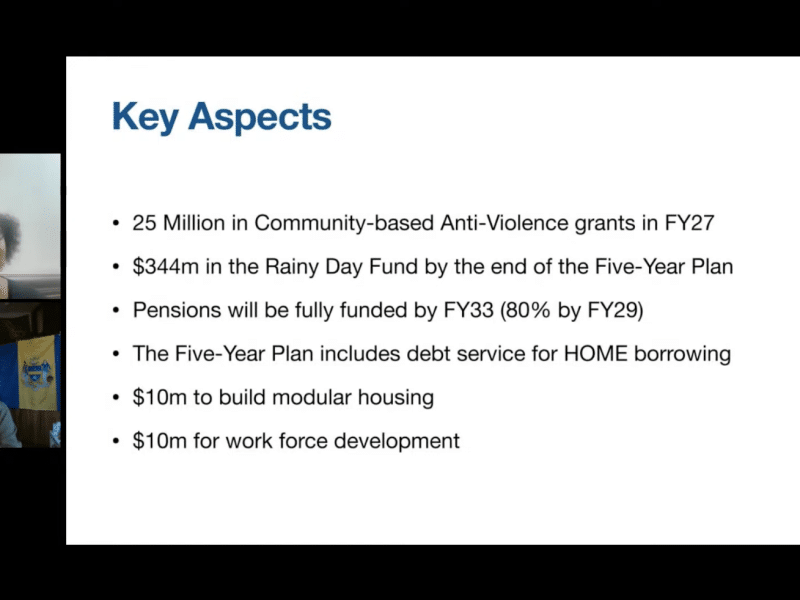
The optimistic picture Parker painted included touting a five-year investment of $2 billion in capital spending focusing in the five pillars of Parker’s top priorities: public safety, “clean and green,” economic opportunity, housing, and education.
Read More
Regarding public safety, Parker’s FY25 budget makes a $33 million appropriation for new investments in public safety, and $600 million overall in the five-year plan. Part of the investment is the hiring of 400 new police officers every year, as well as 100 officers dedicated to community policing, and 75 new police cars and related equipment.
Monitoring of the city’s existing 1600 cameras is also a priority, and Parker has pledged to add more staff dedicated to task, as well as new 911 operators, a crucial city need. In addition, the budget makes a $45 million investment in the city’s long underequipped crime lab. Community groups working in the anti-violence space will receive an additional $24 million.
Understanding the importance of providing young people recreation activities, Parker earmarked $3.2 million for youth sports, the first such investment in recent memory.
Hall Monitor has been covering the city’s approach to ending the open-air drug markets in Kensington, and Parker did not mince words about her objectives. Promising $100 million to long-term care options, treatment and housing, and homelessness and mental challenges, Parker said Managing Director Adam Theil is reviewing options and looking to bring groups together to develop a plan of action.
One of the flash-points of the Kensington debate is needle exchange, which Parker said the city would no longer fund. However, Parker said the city’s refusal to fund needle exchanges programs do not denote a lack of compassion for individuals dealing with addiction.
“This administration supports an array of public health strategies from dispensing naloxone and narcan and fentanyl testing strips to administering care, and providing access to treatment and counseling and other services,” Parker said.
Parker’s budget also provides an additional $117 million for SEPTA and $500 million in new street paving, which would account for 130 miles of road being paved each year, more than double the current amount.
Regarding the over 350,000 Philadelphians living in poverty, Parker said she supports Governor Josh’s Shapiro’s call to raise the state-wide minimum wage to $15 per hour. The budget will also include nearly $20 million for investments in economic opportunity, and more than $130 million over the five year plan. Other economic development plans include an additional $1 million to the Enterprise Center’s Innovate Capital Growth Fund.
Parker also called for 30,000 units of housing to be built, and creating a one-stop application for the city’s multiple home repair programs. Parker said affordable housing must be high quality, which she has coined “affordable luxury.”
”My administration will ensure all new city supported housing has the knmids of high quality fixtures and finishes that we all want in our homes,” Parker said. “Don’t put me somewhere else and give me less because I’m low income.”
The PHL Taking Care of Business Clear Corridors Program will also see a large investment of 10s of millions of dollars so as to hire new street cleaners.
Investments in education appear to be increasing in Mayor Parker’s new budget, with the Community College of Philadelphia receiving an additional $10 million in FY25 while also establishing a program for municipal employment.
A further $10 million will go towards workforce development, and $14 million added to the PHL Open for Business initiative.
The city will also change the property tax funding system from a 55-45 split between the school district and city, respectively, to a 56-44 split, which will net the school district an extra $22 million per year. The budget will also include $24 million in new operating investments in FY25 with nearly $140 million within the Five-Year Plan.
Five Minutes With the Mayor
After the Budget Address, Hall Monitor was invited to speak to Mayor Parker one-on-one in the Mayor’s Reception room near her office. It was a unique opportunity to ask direct questions regarding the budget, and to discuss how she manages running the sixth largest city in the country.
Hall Monitor: Can you elaborate a little bit more on how poverty is addressed in the budget?
Mayor Parker: So for poverty, our goal is to put people on a path to self sufficiency. So when you hear us talk about access to year round public education, when you hear us talk about out-of-school time activities, all of those activities benefit the whole family. That means you give parents the opportunity to get connected to viable employment that will pay them a living wage, hopefully give them health care and retirement security. When you hear us talking about safe, clean, and green neighborhoods, that also helps with poverty because we’ve got to hire people via the program PHL TCB that I started when I was in council, we’ve got to hire people who work in those programs, and then to have the municipal university for city employment, where you can come and get trained for good city jobs. Wow, man, its jobs, jobs , jobs! Support for Life Sciences and biotech, the building trades. You know, that’s the best anti-poverty plan that you can ever have to put people on the path to self sufficiency and I’m super proud of it.
Hall Monitor: I was really interested to hear about the partnership with the community college because one of the roadblocks to city employment is the literacy test and things like that. So this would be a comprehensive plan?
Mayor Parker: Thank you for just acknowledging CCP, the very important work that they do, but they’ve been underutilized by the city of Philadelphia. So to have Dr. Guy Generals, the president, working with a school district of Philadelphia superintendent, Tony Watlington. Wow. And to create a pipeline connected to our human resources department connected to our unions. I’m super excited about the different life sciences and biotech. You know, it’s nice to say those industries have grown, but you know what makes you mad? The industry is growing. However, we don’t have enough skilled workers in Philadelphia to fill the jobs that are available. It makes me angry. So I tried to come up with the answer. I’m a solutions oriented person. I don’t profess that any of it is perfect. But I want the people in that city to know I’m doing the best I can.
Hall Monitor: I know you just announced this today. But how long before Do you think this can be?up and running?
Mayor Parker: As soon as as soon as we get this budget passed I will make the purchases to get these trash trucks, get the uniforms for the workers get the RFP out to the community based organizations so that they can hire the workers. As soon as we get this budget passed, I’m ready to go.
Hall Monitor: So one of the things we’ve been hearing a lot about lately is Kensington. We know what the problems are. We know what the challenges are. But we’ve been hearing from a lot of people in the harm reduction community that they have concerns. Today you had said that the city won’t be funding anymore needle change. Is there enough support from from outside to take over needle exchange and make sure the HIV rates hepatitis rates all the blood borne illnesses do not increase?
Mayor Parker: I will tell you this. I think between the private sector and philanthropic communities, the state and even federal government, all of them probably with a better revenue generating capacity than the city of Philadelphia. They have the ability to make those kinds of contributions to those harm reduction organizations. I have strong faith and believe that we can come together and collaborate and get things done, and I think the harm reduction community will get the support that it needs for the needle exchange. We just won’t fund it here in the city of Philadelphia, but we will fund those things that I mentioned in the budget address that our first responders use when they’re out there trying to save lives when someone’s overdosing. You know, we’re using Naloxone on a daily basis, we’re going to continue doing that because this public health and safety of Philadelphia is my number one priority. And we have to make some tough decisions to get there. But I commit to you, you know, we’re not afraid to do it, and we’re gonna do it to the best of our ability.
Hall Monitor: So the safety of the people who are stuck in this cycle of drug abuse, their safety isn’t going to be compromised by any plans to city puts in place.
Mayor Parker: Listen, some people, and I’m just giving you an example. Some people think walking by someone on the street, openly injecting drugs and just walking by them or giving them a pamphlet saying, “I hope you’ll consider treatment,” think that’s compassionate. That’s not compassionate to me. We want to help develop systems and structures that give people access to long term care, treatment and housing. That’s how we help people. That’s compassion to me. It’s just a difference of opinion. And quite frankly, lived life experience.
Hall Monitor: You were inaugurated on January 2nd, and now it’s March 14th. It’s been a couple of months. What has the experience been like?
Mayor Parker: Why did you have to ask the tough question? It’s been humbling and I’m not comfortable being vulnerable. You’re very vulnerable as the mayor. You realize that you’re one person and you can’t get anything done by yourself. You depend on an entire workforce, over 25,000 people and only when everyone is plugged into the same message, the same vision to say, Can you all work together to implement (that vision)? And that’s what I’ve been feeling, to be honest, and just figuring out how to hire the best people and to find people who share that vision. That’s extremely important. And I know I’ve gotten kicked in the teeth a bit about not hiring fast enough and like I get it some people wanted me you know on day one to say okay, all of the positions are filled. But my experience, you know, my academic preparation, my professional experience, you know, as a legislator and understanding government and how it works said “don’t rush.” It is much more important to find people who share your vision to implement it, because if you don’t end up in big trouble.
Hall Monitor: You must get so many ideas brought to you each day. How do you say okay, this is the thing we’re going to focus on?
Mayor Parker: So one, make sure that you’re getting the best, the most accurate information possible and that’s where faith in the people who do the work, and their job is to provide all the information for me the data, the facts, the research, everything associated with whatever the issue will be, and then it’s up to me to review that information. Then I’ll make a decision.
*This transcript has been lightly edited for clarity.
Our reporters sit through hours of city council meetings, dig through piles of documents, and ask tough questions other media overlook. Because we’re committed to addressing Philadelphia’s poverty crisis — and challenging those who sustain it. If you think this work is important too, please support our journalism.
We’re counting on readers like you.