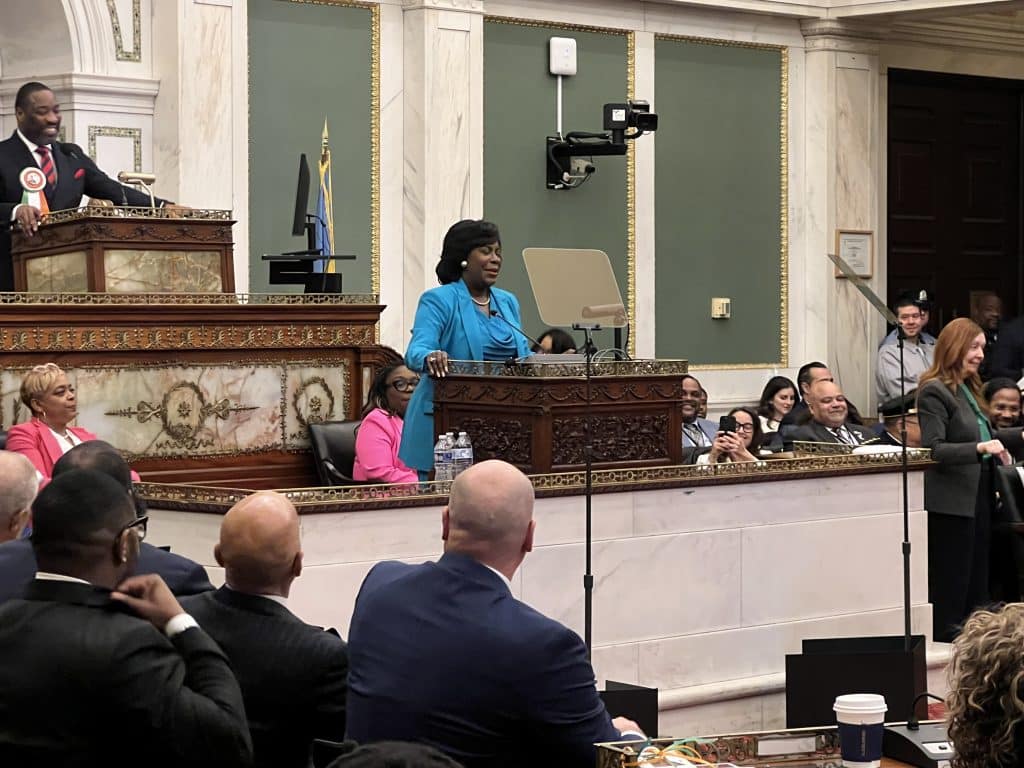
Philadelphia Mayor Cherelle Parker offered her second budget address before the Philadelphia City Council Thursday, March 13.
The two major items discussed by the Mayor are significant tax cuts and the borrowing of $800 million to address the city’s housing crisis.
Touting $3.77 billion in “new, targeted investments” in Parker’s “Cleaner, Greener and Safer” strategy, the proposed operating budget prioritizes public safety ($186 million in new money), economic opportunity (over $87 million in new money), housing (almost $25 million in new money) and clean and green (nearly $15 million).
Over the next five years, Parker’s budget adds $745 million for public safety, over $450 million for economic opportunity, $180 million for housing, and $65 million for clean and green.
Complicating the overall fiscal picture is the sunsetting of the Covid-era American Recovery funds, inflation, and uncertainties at the federal level, which could affect nearly $3 billion in grants, contribute to concerns over the city’s ability to make its usual projections.
Despite this, the city will still seek to cut taxes. The proposed budget plan reduces both the Gross Receipts tax and the Net Income portions of the Business and Income Receipts tax. The taxes will be reduced as follows:
Gross Receipts: .1415% in FY25 to .1380% in FY30 and elimination within 7 years of the city Pension Fund reaching full funding (projected to happen in 2032)
Net Income: 5.81% in FY 25 to 5.5% in FY30. The tax will be further reduced to 2.8% within 7 years of the Pension Fund reaching full funding.
In her budget address, Parker called the BIRT tax a “double-tax.”
“Just think about your own paycheck, Philadelphia,” Parker said. “Right now, you pay taxes on the GROSS amount you earn – the total you make. Fair enough. But here, if you were a business in this city, we’re taxing the WHOLE amount you earn AND your NET – what you have left after paying your bills and daily expenses! That’s like a double tax. And our Administration is finally going to address it.”
The wage tax is also scheduled to be reduced in FY26. The resident portion will move from 3.75% to 3.70%, and non-residents will see a reduction from 3.44% to 3.39%.
The Mayor’s budget presentation expressly acknowledges cuts in both the BIRT and Wage taxes have not occurred in the same year since 2008.
The Real Estate Tax millage rate will shift again in FY30, from 56% to 56.5%, which will send an additional $12 million to the school district.
The 1% Construction Tax, a Covid-era measure enacted at the behest of former Council President Darrell Clarke, will be eliminated this year.
The Real Estate Transfer Tax will increase from 3.278% to 3.578% in order to offset the costs of the borrowing for the Housing Opportunities Made Easy (H.O.M.E.) initiative (the city’s plan to build or renovate 30,000 units of affordable housing).
A $3 Document Recording fee will add $300,000 and will be dedicated to the city’s tangled title issues.
Center City parking meter rates will increase by $1. The additional revenue will support the school district.
The Use and Occupancy tax will be eliminated.
The reduction in and eventual elimination of parts of the BIRT follows the recommendation of the recently published Tax Reform Commission report, which calls for complete elimination of the entire BIRT in 8-12 years. The commission also recommends the reduction of the Wage Tax to 3% or less-which would greatly impact the city’s revenue, as Wage Tax is the largest portion of the operating budget.
The proposed FY 26 tax revenues break down as follows:
Wage Tax: $2.08 billion (39%)
Real Estate Tax: $930 million (15%)
BIRT: $725 million (14%)
Realty Transfer: $372 million (7%)
Sales Tax: $324 million (6%)
Beverage Tax: $64 million (1%)
Other Taxes: $52 million (1%)
The city’s proposed FY26 expenditures:
Personal Services (city employees) $2.3 billion (35%)
Purchase of Services : $1.57 billion (23%)
Personal Services/Employment Benefits: $909 million (14%)
Pensions: $734 million (11%)
Indemnities and Taxes: $434 million (6%)
Debt Service: $231 million (3%)
Materials/Supplies: $166 million (2%)
Labor Reserve: $101 million (2%)
Other Payments: $85.8 million (1%)
Budget Stabilization: $58.6 (1%)
The Mayor also announced an unprecedented $800 million investment in affordable housing in the form of two $400 million bond issuances. The full details of the plan will be introduced at a special session of council scheduled for March 24th.
“This is going to be an historic, unprecedented investment for Philadelphians,” Parker said. “I have long said that this plan – housing preservation and building of new – will be one of our ‘Maynard moments’ – referencing the late Atlanta Mayor Maynard Jackson who created real, tangible and ONGOING economic opportunity for Atlantans.”
According to information previously released by the Mayor, the plan will look to develop various housing types in every neighborhood, preserve existing housing stock, providing rental assistance, and creating incentives to promote home ownership.
Other Budget Highlights:
Nearly $50 million will be budgeted for the city’s 2026 festivities
$10.9 million to expand the Extended Day/Extended Year initiative from 25 to 40 schools
$15 million over five years for the Community College of Philadelphia
$67 million for the police forensics lab (over the course of the Five-Year plan)
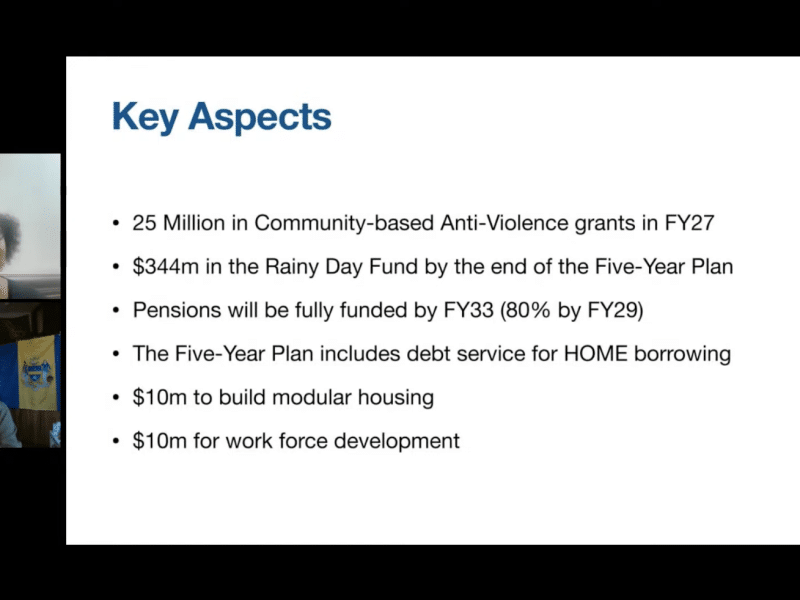
$25 million in FY 26 for antiviolence grants
$5 million for Vision Zero
$716 million dedicated to SEPTA from FY 26 to FY 30
$76 million in capital support for SEPTA from FY 26 to FY 31
Parker also discussed the humanitarian crisis in Kensington, highlighting the pilot Neighborhood Wellness Court launched in January, which provides “fast-track diversion for people arrested for drug-related offenses.”
Regarding the Riverview site, built to treat those experiencing addiction, Parker said the plan was to add more beds in 2026 and beyond.
“We will invest another $216 Million over the next Five-Year Plan to support all our Wellness operating costs,” Parker said. “Riverview provides not just food and shelter, but medical care, behavioral health care, job training, and a host of other services.”
Hall Monitor will provide further analysis in the coming weeks as we study the budget plan. Next week on the program we will broadcast our annual “Budget 101” segment. In subsequent television programs and articles we will discuss the capital budget.
This article is a part of Every Voice, Every Vote, a collaborative project managed by The Lenfest Institute for Journalism. The William Penn Foundation provides lead support for Every Voice, Every Vote in 2024 and 2025 with additional funding from The Lenfest Institute for Journalism, Comcast NBC Universal, The John S. and James L. Knight Foundation, Henry L. Kimelman Family Foundation, Judy and Peter Leone, Arctos Foundation, Wyncote Foundation, 25th Century Foundation, Dolfinger-McMahon Foundation, and Philadelphia Health Partnership. To learn more about the project and view a full list of supporters, visit www.everyvoice-everyvote.org. Editorial content is created independently of the project’s donors.
Our reporters sit through hours of city council meetings, dig through piles of documents, and ask tough questions other media overlook. Because we’re committed to addressing Philadelphia’s poverty crisis — and challenging those who sustain it. If you think this work is important too, please support our journalism.
We’re counting on readers like you.