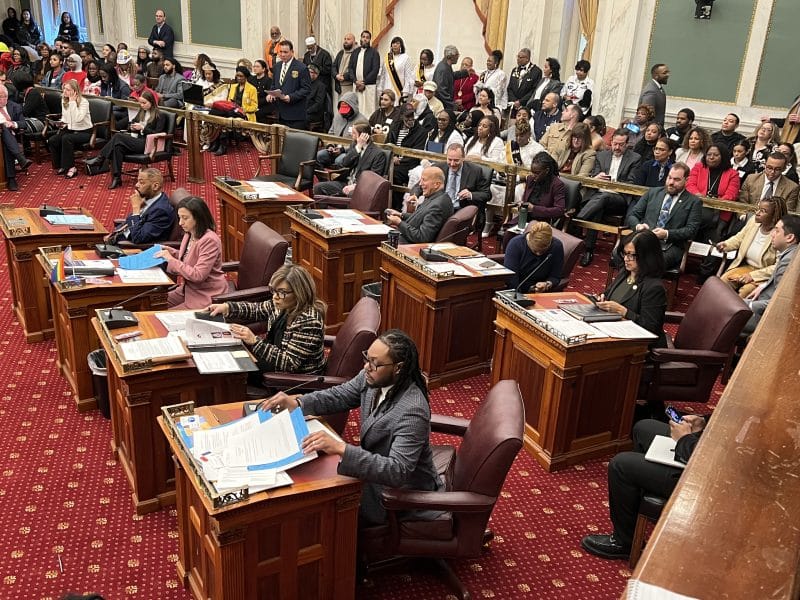
The Philadelphia Kensington Caucus held a hearing “to convene and explore best practices in substance use disorder outreach and to investigate the effectiveness of current methods used by the City of Philadelphia and its partners.”
Amanda David, the Interim Deputy Commissioner of the Department of Behavioral Health and Intellectual Disability Services (DBHIDS), testified that DBHIDS Homeless Outreach teams are coordinated through Project HOME’s Outreach Coordination Center (OCC). The OCC then manages the Homeless Outreach Hotline and dispatches teams for support calls according to zones and proximity.
“The main goal of the outreach teams are to engage individuals, build rapport, and connect individuals to services,” David said. “During a response call, an outreach worker engages individuals and offers connections to resources such as housing, treatment, physical health care, and other resources as needed.”
According to information provided by DBHIDS, individuals who have more contacts with outreach teams have higher rates of placement. Individuals who have had one contact have a 17% placement rate, while those who have had five or more contacts have a 46% placement rate.
David also discussed the DBHIDS Mobile Outreach and Recovery Services (MORS) team, which provides “on-the-ground support for individuals experiencing Substance Abuse Disorders through screening and referrals to treatment.”
The MORS teams provide wound care, warm handoffs to hospitals, and utilize the Community Wellness Engagement Unit, which “provides access to behavioral and wellness related resources as well as linkages to care at a community level.”
David’s testimony included the following recommendations for outreach best practices:
Creating a varied approach that includes multiple touchpoints for individuals on the street
Ensuring an accessible care system that has low-barrier placement opportunities
Including Peer Specialists and individuals with lived experiences as an integral part of the outreach team
Case consultations address challenging cases
The hearing grew contentious at times, as members of the caucus had harsh words for David. Councilmember Nina Ahmad was particularly chagrined with what she considered a lack of forethought by DBHIDS.
“Are we not enabling (this behavior),” Ahmad said. “One of (the city’s) biggest funding segments of our budget is health, and as the chair of the Public Health and Human Services Committee I am disappointed that we are not being proactive.”
DBHIDS’s reluctance to take a position on legislation being considered at the state level that would allow the city to involuntarily commit those dealing with addiction also drew Ahmad’s ire.
“Can we figure out best practices and come up with a plan?” Ahamd continued. “For you to sit here and say you are not willing to answer is really disappointing. Why are we continuing to do the same thing and (not having a resolution) to the problem?”
Experts with whom Hall Monitor have spoken do not believe involuntary commitment of people suffering from addiction would be useful and instead advocate for a more comprehensive approach to the problem.
Hall Monitor will provide more reporting on this issue on the next episode of the Hall Monitor Broadcast on Wednesday at 6 PM.
Brooks Call for Antitrust Legislation Against Meta
Councilmember Kendra Brooks introduced a resolution “Calling on the Federal government to maintain its antitrust litigation that would break up Meta’s social media monopoly.”
According to the resolution, Facebook purchased Instagram and WhatsApp in 2012, for $1 billion and $19 billion, respectively. The combined companies then rebranded as Meta. Together, the three apps are amongst the most widely used across the world, with more than 7 billion monthly users collectively.
Antitrust litigation was begun by the US Federal Trade Commission during the Biden Administration, which Meta is currently fighting and asking to be thrown out of court. Media consolidation, particularly amongst popular social media platforms, can lead to the demise of more “traditional” news outlets despite the dubious content shared on social media. Furthermore, discourse on social media has declined significantly, and due to corporate control, standards are not likely to improve.
Landau Introduces LGTBQ Resolutions
With June commemorating LGTBQ Pride Month, Councilmember Rue Landau introduced several legislations honoring and bringing awareness to issues in the LGTBQ community.
The first Recognizing May 28, 2025, as LGBTQ+ Domestic Violence Awareness Day in the City of Philadelphia, to shed light on domestic, family, and intimate partner violence in LGBTQ+ communities.
Citing the 2010 National Intimate Partner and Sexual Violence Survey, the resolution contained the following statistics:
44% of lesbians, 61% of bisexual women, 26% of gay men, and 37% of bisexual men have reported experiencing rape, physical violence, and/or stalking within an intimate relationship.
According to the 2015 US Transgender survey:
Transgender individuals experience some of the highest levels of intimate partner violence, with 54% reporting violence in their relationships.
32% of LGTBQ+ Philadelphians who received support from the District Attorney’s Office are victims of violent acts, and 75% of all arrests involving violence against LGBTQ people are because of domestic violence.
Furthermore, one in four LGTBQ youth will experience intimate-partner violence.
Philadelphia is home to organizations dedicated to assisting the LGBTQ community through these and other matters, such as The Attic Youth Center and GALAEI.
The second resolution declares “May 16, 2025, as National Honor Our LGBTQ+ Elders Day in the City of Philadelphia, a day to recognize and celebrate the contributions of LGBTQ+ elders who have been pivotal in the fight for justice, equity, and rights for every member of the LGBTQ+ community.”
The day recognizes such luminaries as Marsha P. Johnson, Harvey Milk, Sylvia Rivera, Bayard Rustin, Barbara Gittings, Frank Kameny, Tyrone Smith, Thom Cardwell, Gilbert Baker, Michael Hinson, Miss Major, Ms. Jaci Adams, Ms. Charlene Arcila, Ms. Dawn Munro, and Ms. Nizah Morris.
The third declares June 2025 LGTBQ+ Pride Month in the City of Philadelphia.
The first Gay Pride March took place in Philadelphia on June 11, 1972, and went from Rittenhouse Square through Center City to Independence Hall. According to the resolution, Philadelphia is home to one of the earliest annual demonstrations for LGTBQ+ rights, known as the Annual Reminders (although these events excluded Transgender and gender nonconforming people).
Philadelphia was one of the first cities in the country to prohibit discrimination based on sexual orientation in housing, employment, and public accommodations.
Our reporters sit through hours of city council meetings, dig through piles of documents, and ask tough questions other media overlook. Because we’re committed to addressing Philadelphia’s poverty crisis — and challenging those who sustain it. If you think this work is important too, please support our journalism.
We’re counting on readers like you.