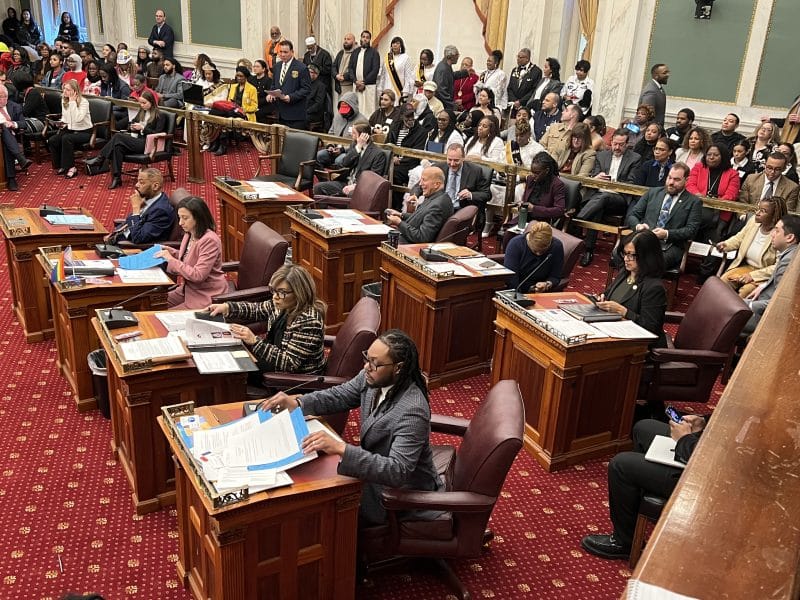
The most contentious hearing of the week was the Mayor’s Office callback for the HOME initiative. Council seemed increasingly frustrated with the Administration’s lack of key answers regarding specifics of the complicated project.
The program’s $800 million price tag, which council does not find objectionable in and of itself, will be paid for by two bond issuances and will cost the city $1.5 billion in total over the course of 20 years.
Of major concern is the project’s timeline, how many units will be new as opposed to preserved, and what exactly the definition of “preserved ” is. Additionally, the council is unclear as to how the city will disperse funds to the programs and how homeowner needs will be assessed.
With two $400 million borrowings, it is crucial to have a robust plan in place to distribute the funds in a timely fashion. Otherwise, borrowed funds could be left in city back accounts while interest payments are being incurred. Currently, the lack of a timeline for this project is a significant sticking point for the council.
The number of new homes and apartments and the percentage dedicated to the city’s neediest residents remains in doubt. As it stands, only 9000 units are for those earning the least, with a large portion of those falling into the “preserved” category, the meaning of which is still unclear. Council is concerned homes receiving minor repairs, such as a new water heater, would count towards the tally of preserved homes.
It is unclear if this plan and the necessary legislation will be completed before the end of the council’s spring term on June 12th, 2025. If not, it could give the Administration and Council more time to consider the plan’s finer points. Passage of the legislation in early September would not preclude the referendum presenting the borrowing to be brought before the voters on the November ballot.
However, the Administration seems intent on passing the legislation before council’s summer recess. With budget negotiations likely to continue until the last possible moment, as has been the case in previous years, there may not be enough time to devote to both the HOME program and the city’s mandate to pass a budget before the beginning of the fiscal year on July 1st. Progress on both matters should become clearer in the coming weeks.
Education Committee Hears DEI Testimony
The Philadelphia City Council Committee on Education met on Friday, May 9th to hear testimony on Resolution No. 250185, which authorized the committee to “investigate federal DEI program rollbacks and their effects on Philadelphia’s tax-exempt higher education institutions.”
The hearing resolution, sponsored by Councilmember Jamie Gauthier, is in response to the Trump Administration’s threats to American universities that do not acquiesce to demands they eliminate all DEI policies.
In addition to members of the Philadelphia City Council, members of Philadelphia’s State House and State Senate delegations, including State Senators Anthony Williams, Art Haywood, and Nikal Saval, and State Representatives Rick Krajewski and Napoleon Nelson, were also in attendance.
In her opening remarks, Gauthier scolded the University of Pennsylvania for abandoning their promise to make their campus more inclusive.
“At the first sign of danger, the University of Pennsylvania refused to attend this hearing and explain their decision to abandon DEI,” Gauthier said. “We know when Penn cares about something, they fight. Just look at how the institution fought against PILOTS (payments in lieu of taxes).”
While Penn is capitulating to Trump, other Ivy League universities, such as Harvard and Princeton, are openly defying Trump’s threats and allocating more resources to DEI initiatives. Meanwhile, despite their acquiescence, Trump still froze $175 million in federal funding designated for Penn.
The most damning comments came from State Senator Anthony Williams, who had attended a meeting with University of Pennsylvania President J. Larry Jamison, which Williams described as “more troubling than the actions being taken” regarding the removal of DEI programs from the university.
Williams said Penn officials said the impetus behind the decision was the potential loss of millions of dollars, which Williams understood was not a “moral position or a legally-driven position but a money decision.” He also described his encounter with Jamison as insulting.
“I’ve met (Jamison) twice,” Williams said. “The first time I met him (he explained) he’s from the South, (raised by) enlightened people who did not conform to other folks during their period of time, and that they had a particularly kind heart (in understanding that African Americans stood separate from them).”
“As I’m asking (Jamison) questions, I’m not cussing, I’m not yelling,” Williams continued. “I’m being very firm. In response, he turns to me and says ‘I’m feeling a bit uncomfortable about how you are speaking to me; I feel a bit intimidated.”
Williams said Jamison did not understand how Black people raised by other Black people from earlier generations would interpret such a remark as a warning to be quiet- something Williams said his grandfather had explained to him.
“(If you were Black in the South) you didn’t raise your voice (to a white person),” Williams said.
When it came time to question Jamison during the hearing, the Education Committee agenda listed him first and took the unusual step of speaking to an empty chair.
The committee also heard testimony from legal and DEI experts, including Stacy Hawkins, Rutgers University Professor of Law, Jonathan Feingold, Professor of Law from Boston University, and Paulette Granberry Russell, J.D., president of the National Association of Diversity Officers in Higher Education, who all agreed that DEI policies in and of themselves were not illegal nor discriminatory, as the Trump Administration has alleged.
“Because DEI practices combat biases and cultivate inclusion, they’re not only lawful, but they (also assist) with universities fulfilling their ongoing Title VI obligations, which include avoiding unlawful disparate treatment, remedying racially hostile environments, and avoiding unjustifiable disparate outcomes,” Feingold said.
It remains unclear what further impacts the Trump Administration’s policies will have on higher education and what locally and nationally universities will do to combat these actions.
Budget Hearings Continue
The following departments testified before Philadelphia City Council regarding budget request:
The Register of Wills
What they do:
The Register of Wills & Clerk of Orphans’ Court (ROW) serves the residents of Philadelphia with professionalism, compassion, and integrity in overseeing the administration of estates, the issuance of marriage licenses, and the fee collection and record keeping of all Philadelphia County Probate Estates, Trusts, Guardian Accounts, and Marriage Licenses and Records.
FY 2025 Budget: $5,996,842
FY 2026 Budget: $5,968,094
Net Change: $28,748
Notes:
Department of Behavioral Health and Intellectual Disabilities
What they do:
The Department of Behavioral Health and Intellectual disAbility Services (DBHIDS) envisions a Philadelphia where every individual can achieve health, well-being, and self-determination. Our mission is to educate, strengthen, and serve individuals and communities so that all Philadelphians can thrive.
FY 2025 Budget: $29,202,796
FY 2026 Budget: $31,534,108
Net Change: $2,331,312
Notes:
Department of Public Health
What they do:
The mission of the Department of Public Health (DPH) is to protect and promote the health of all Philadelphians and to provide a safety net for people who are disproportionately impacted by societal factors that limit their access to healthcare and other resources necessary for optimal health in pursuit of the Mayor’s goal to improve quality of life for all Philadelphians.
FY 2025 Budget: $155,202,405
FY 2026 Budget: $161,389,004
Net Change: $6,186,599
Notes:
The City Law Department
What they do:
The Law Department acts as general counsel for the entire City government and provides legal advice to all City officials, employees, departments, agencies, boards, and commissions concerning any matter related to the exercise of their official powers within the scope of their employment. Among other responsibilities, the Law Department represents the City and its employees in all litigation matters; negotiates, drafts, and approves City contracts and real estate leases; civilly prosecutes individuals for code, health, and tax violations and collects unpaid taxes, fines, and other debts; provides counsel to the City on a wide range of regulatory law, privacy law, and compliance matters; represents the City in social services matters, including child welfare and health matters; and prepares and advises on legislative matters, including legislation introduced in City Council. The Law Department is excellently situated to support Mayor Parker’s vision for a safer, cleaner, greener Philadelphia with access to economic opportunity for all through its work with client departments.
FY 2025 Budget: $35,498,385
FY 2026 Budget: $36,680,253
Net Change: $1,181,868
Notes: The most contentious hearing of the week, other than the HOME callback, was council’s back-and-forth with the City Solicitor, Renee Garcia. As Solicitor, Garcia is the head of the Law Department, and is responsible for taking positions and offering opinions on city laws and possible litigation. She faced harsh criticism from Councilmember Isaiah Thomas regarding her decision to not fight the elimination of the BIRT tax emption on the first $100,000 of a business’ annual earnings. The exemption has long been seen as a mechanism to spur the growth of small businesses.
Garcia said the implications of fighting and losing such a legal battle could make the city liable for millions of dollars, while Thomas argued the precedent of the Law Department not consulting council regarding such an important issue sets a negative precedent. The argument was heightened by Councilmember Jeffrey Young’s repeated suggestions that City Council should have its own Law Department independent from the Mayor’s Office.
District Attorney’s Office
What they do:
The Philadelphia District Attorney’s Office (DAO) seeks justice through a safe, fair, and equitable criminal legal system in Philadelphia. With more than 600 lawyers, detectives, and support staff, the DAO is the largest prosecutor’s office in Pennsylvania and the third largest in the nation. The Office is focused on restoring balance to the criminal justice system by prioritizing public safety, supporting crime victims and survivors, ending the era of mass incarceration, and moving beyond the false promises of overly punitive policies.
FY 2025 Budget: $57,496,159
FY 2026 Budget: $58,392,464
Net Change: $896,305
Notes:
Public Defender’s Office
What they do:
The Defender Association of Philadelphia’s mission is to provide high-quality, client- centered
legal representation, courtroom advocacy, and a connection to social services. We strive to
protect the Constitution, ensure a fair and equitable criminal justice system, and improve
outcomes for vulnerable populations.
FY 2025 Budget: $66,497,780
FY 2026 Budget: $82,447,800
Net Change: $15,950,020
Notes: The Defender’s Association is a quasi-city agency that is required to maintain its own building, pay city property taxes, and pay for its own benefits and pension plans. The majority of the additional funding will go towards those costs.
Philadelphia Sheriff’s Office
What they do:
The Office of the Sheriff, City and County of Philadelphia is committed to serving and protecting the lives, property and rights of all within a framework of high ethical standards and professional conduct at all time.
The Office is responsible to provide safety to all that enter Philadelphia courtrooms including, judges, juries, defendants, witnesses, courtroom personnel and the public.
It is also responsible to manage all First Judicial Court ordered foreclosures of property. Foreclosures of property include executing mortgage and tax sales all in an ethical, honest, transparent and respectful manner while offering dignity to all involved in the procedure.
FY 2025 Budget: $43,186,462
FY 2026 Budget: $54,175,558
Net Change: $10,989,096
Notes: Surprisingly, the Sheriff’s Office did not receive much criticism from City Council. Rather, council was patient with the office’s difficulty in answering questions and seemed understanding regarding recently reported errors.
Our reporters sit through hours of city council meetings, dig through piles of documents, and ask tough questions other media overlook. Because we’re committed to addressing Philadelphia’s poverty crisis — and challenging those who sustain it. If you think this work is important too, please support our journalism.
We’re counting on readers like you.