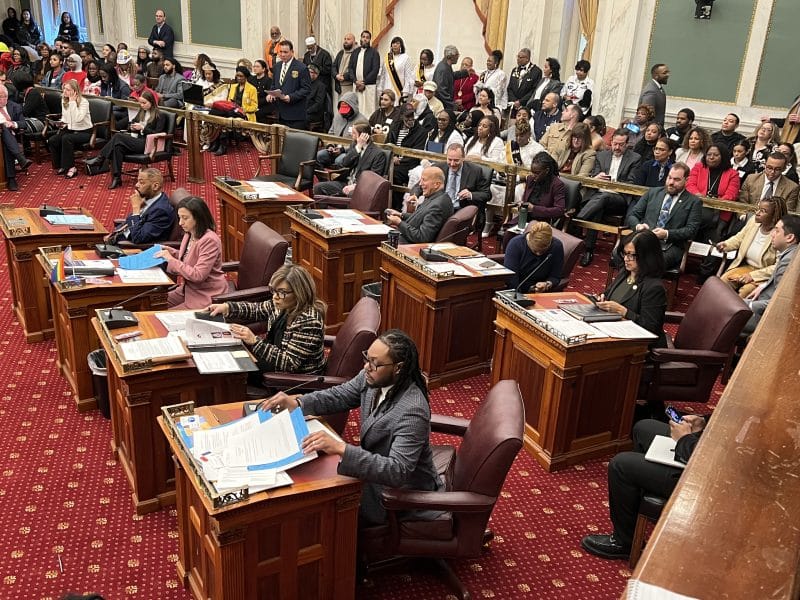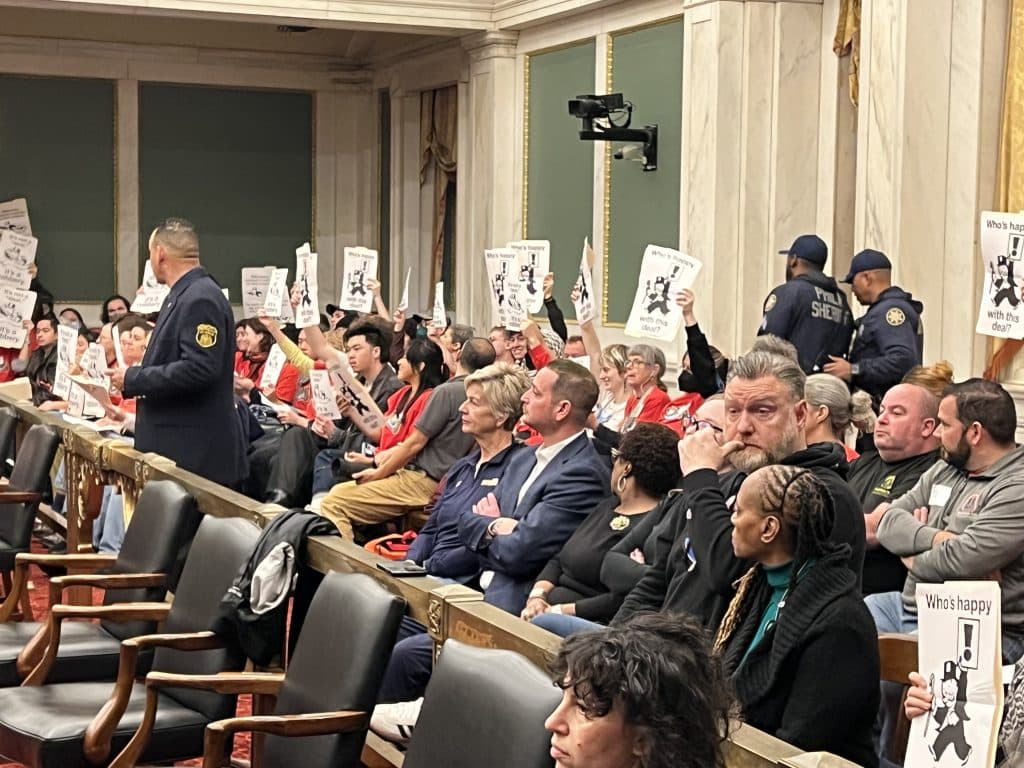
The most anticipated legislative package to come through the city council in years was finally voted out of committee yesterday.
The 11 bills and resolutions allowing for building the new 76ers arena in Center City were favorably recommended by the Committee of the Whole by a vote of 12-4. The four nays were Councilmembers Gauthier, Young, Landau, and O’Rourke. Councilmember Kendra Brooks, a critic of the plan, was not present.
One of the project’s more contentious aspects, the Community Benefits Agreement, or CBA, was finally settled as part of the legislative package.
Originally a $50 million deal negotiated between Mayor Cherelle Parker and the 76ers, the CBA became a sticking point when the council began its negotiations with the team. At various times, a number of $100 million was bandied about by councilmembers, with $75 million being seen as a compromise. The day before the final vote, Council President Kenyatta Johnson’s office even released their CBA amendment totaling $75 million, with $100 million seemingly still within reach. Between Wednesday afternoon and Thursday morning, however, the final number only grew by $10 million.
There were significant changes between the CBA proposed by Johnson on Wednesday and the final version passed by council on Thursday, including:
| Item | Wednesday Proposal | Final CBA |
| Arena Special Services District | $20,500,000 | $17,500,000 |
| Housing Support | $12,000,000 | $3,000,000 |
| Business Disruption Fund | $10,000,000 | $5,000,000 |
| Chinatown Land Trust | $5,000,000 | $250,000 |
Key aspects of the agreement, including the Business Disruption Fund, a major component of the CBA, lost half of its funding in the new agreement. Only a quarter of the Housing Support funding survived. If the possibility of a $100 million deal was to be believed, then $40 million disappeared overnight.
An attempt to ameliorate councilmembers’ concerns regarding cuts to housing came from the city Planning Department on behalf of Mayor Parker:

However, this $20 million commitment would not be financed by the 76ers, but by taxpayers.
Councilmembers Jamie Gauthier and Rue Landau, council’s most forceful advocates for housing, said they would not support the CBA because the final document lacks anti-displacement protection.
“I don’t understand how as a city we can say we care about Chinatown and vulnerable communities if we’re willing to push forward a project that our own impact study says will displace people,” Gauthier said.
Councilmember Landau said the council gave the 76ers every opportunity to negotiate a good deal but that the process had been rushed.
“We wanted to negotiate a deal that would protect Chinatown, that would make sure we had the right anti-displacement measures in place, and that would make sure affordable housing was funded,” Landau said. “And they didn’t do it.”
Regarding the letter promising the $20 million for affordable housing from the Planning Department, Gauthier was incredulous.
“I didn’t even understand the letter,” Gauthier said. “I didn’t understand where the money was coming from, and the letter didn’t state the money would be made available for the Philadelphia Chinatown CDC. It didn’t feel like a commitment, and it didn’t feel good enough to support Chinatown.”
The Save Chinatown Coalition issued a scathing response to the final CBA:
“Today was a searing indictment of the poor leadership from Council and the Mayor, who collapsed their own deal and were railroaded by billionaires and developers. It was shocking to see Council leadership declare a bottom dollar figure of $100 million and completely capitulate to pressure less than 12 hours later. We have wasted months of time and countless hours of hearings for barely any change in a deal that was written by the developers more than two years ago. It’s an embarrassing indication of the lack of strategic and tactical skills from a largely rookie Council who got played.”
Johnson said the CBA deal was the best available for the city, although it was “not perfect.”
” We were still able to address the variety of different concerns of members of City Council as well as making sure that we’re addressing the concerns of the individual who live in Chinatown and the surrounding community,” Johnson said.
Johnson argued that the agreement was really an $80 million deal when factoring in the $20 million commitment made by the Mayor for housing.
However, the additional $20 million is taxpayer money and not being provided by the 76ers.
Johnson highlighted aspects of the deal, including $48 million earmarked for individuals who live in Chinatown, $17.5 million for the Chinatown Arena Special Services District, and $3 million for housing.
“For us to turn down a $1.3 billion dollar economic stimulus for Center City would have been foolish,” Johnson said. “We wanted to make sure that we’re still addressing the issues and concerns that not only my members talked about, but we had eight public hearings that were very transparent, providing individuals the opportunity to come down here and voice their opinions.”
Johnson would not say whether he threatened to walk away from the negotiations if the 76ers did not increase the CBA, and was equally tight-lipped about his interactions with the team in general.
The legislative package will have a final vote on December 19th during a special session of council.
Ahmad Introduces Chinatown Bill
Councilmember Nina Ahmad introduced a bill ‘”Empowering Communities for Cultural Preservation and Community Controlled Development,” thereby defining the boundaries of the Chinatown Growth Initiative area; providing for and establishing the procedure for a Right of First Refusal for a land trust managed and operated by the Philadelphia Chinatown Development Corporation about certain publicly owned properties within the Chinatown Growth Initiative area; identifying certain properties subject to the Right of First Refusal; establishing use and stewardship requirements for properties the land trust acquires…”
Ahmad said in a statement, “Chinatown has been and will always be part of the fabric of Philadelphia. “This legislation would help maintain affordability, preserve cultural identity, and ensure community stewardship of land and property for years to come.
Read More
The legislation does the following:
(1) Chinatown Growth Initiative Area. Inc. The geographic area bounded by Spring Garden Street, 13th Street, Filbert Street, and 7th Street.
(2) Chinatown Land Trust. A nonprofit, community-based organization incorporated to acquire, hold, and steward land and improvements for the benefit of the community, ensuring long-term affordability of residential and commercial properties.
(3) Publicly-Owned Property. Any real property owned now or in the future by the City, a City- related agency, authority, or entity, or any property subject to City control, including but not limited to properties owned by the Philadelphia Land Bank, Philadelphia Redevelopment Authority, or another quasi-public agency.
(4) Right of First Refusal. The legally enforceable right of the Chinatown Land Trust, through PCDC as Trustee and Manager, to purchase property before the City or its agencies or quasi- public entities accept an offer from any other prospective purchaser.
§ 21-702. Right of First Refusal.
(1) The Right of First Refusal established by this Chapter shall apply to all publicly-owned properties within the Chinatown Growth Initiative Area, whether owned at the time of enactment of this Ordinance or acquired thereafter, including, but not limited to, the following properties: 227-37 N 11th Street; 1101-05 Race Street; 800 Race Street; 700-734 Race Street; 133-37 N 10th Street; 823-29 Cherry Street; and 831-35 Cherry Street.
(2) If the City desires to sell any publicly-owned property within the Chinatown Growth Initiative Area, it shall offer PCDC, as Trustee and Manager of the Chinatown Land trust, an opportunity to purchase the property, at a price and upon terms commensurate with its appraised fair market value or as otherwise determined by the City’s established property disposition policies, before offering the property for to sale any other purchaser.
(3) PCDC shall have a period of not less than ninety (90) days to decide whether to purchase a property offered to it for purchase as provided in subsection (2). If PCDC, acting as Trustee and Manager of the Chinatown Land Trust, elects to purchase the property, it shall so notify the City in writing within the specified time period. The City shall then enter into good faith negotiations and proceed to convey the property to the Land Trust, subject to any terms and conditions required by law.
(4) If PCDC elects not to purchase a property offered for sale as provided in subsection (2), the City may sell the property to another person.
(5) The provisions of Chapter 16-400 shall not apply to the sale or transfer of any property within the Chinatown Growth Initiative Area unless the requirements of this Chapter have first been satisfied.
§ 21-703. Use and Stewardship Requirements.
(1) The Chinatown Land Trust and PCDC shall maintain and develop any properties they acquire pursuant to this Chapter in a manner that ensures the long-term affordability and cultural preservation of the property. Residential units shall be subject to permanent affordability covenants benefiting income-eligible households and commercial units shall prioritize small, local, and culturally significant businesses to the extent permitted by law.
(2) The Chinatown Land Trust and PCDC shall develop a community engagement process that gives residents and stakeholders the opportunity to provide input on property use and development priorities.
§ 21-704. Implementation and Enforcement.
(1) Whatever City department the Mayor shall designate as being responsible for the implementation of this Chapter is authorized to promulgate regulations, procedures, and guidelines as necessary to further the purposes and provisions of this Chapter.
(2) The Law Department is authorized to take such action as may be necessary to enforce compliance with this Chapter, including seeking injunctive relief or other appropriate remedies.
SECTION 2. This Ordinance shall take effect immediately upon enactment. The provisions contained herein shall apply to all property dispositions initiated after the effective date.
Our reporters sit through hours of city council meetings, dig through piles of documents, and ask tough questions other media overlook. Because we’re committed to addressing Philadelphia’s poverty crisis — and challenging those who sustain it. If you think this work is important too, please support our journalism.
We’re counting on readers like you.