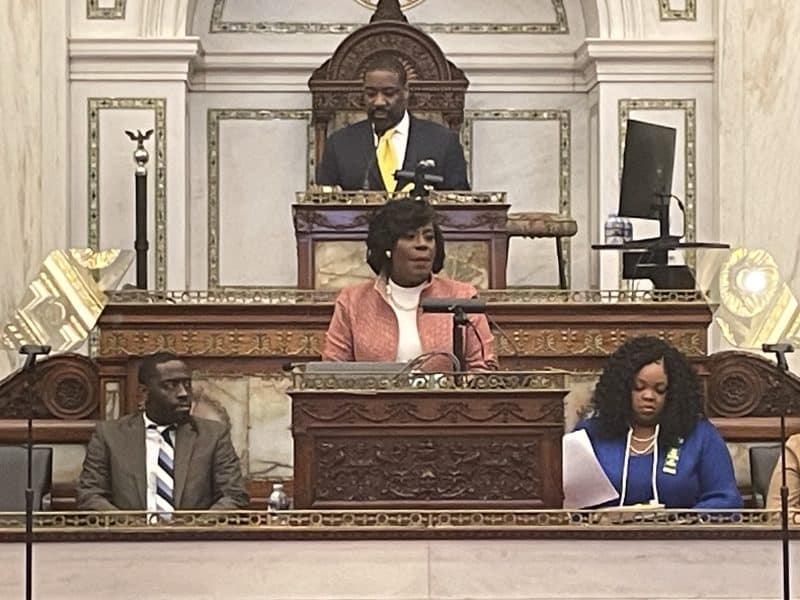
The Philadelphia City Council Committees on Commerce and Economic Development heard testimony on Resolution No. 260032, “authorizing the Committee on Commerce and Economic Development to hold hearings to assess the City of Philadelphia’s workforce development efforts and existing barriers to employment, and to evaluate job creation and workforce
development as strategies to eliminate poverty for Philadelphians.”
The hearing was held at the behest of Council President Kenyatta Johnson, who said workforce development is one of the most important tools the city has to strengthen the economy and ensure that economic growth benefits all Philadelphians.
“Philadelphia is home to workforce programs and partnerships that help residents gain new skills into growing and building long term careers,” Johnson said. “At the same time, we know that many Philadelphians still face barriers (finding) and sustaining employment.”
“Our goal is to ensure that Philadelphia’s workforce systems create a clear pathway to quality jobs that provide stability, opportunities for advancement, and the ability for residents to support themselves and their families,” Johnson added.
Cynthia Figueroa, President and Chief Executive Officer at JEVS Human Services, listed several issues that “limit access to life-sustaining wages and long-term economic stability:”
Persistent gaps in education and work credential leave too many Philadelphia unable to find jobs that pay enough to support their families. There is limited funding and support to provide education attainment for overaged and uncredited youth who have dropped out of school an cannot return to a high school setting due to aging out.
The rising cost of living outpaces wage growth for entry-and mid-level jobs.
Affordable childcare remains out of reach for many working parents
Transportation is a challenge, further limiting access to work and training
The cost of getting a degree or credential places career advancement out of reach for many
Compounding these issues is housing instability, which undermines workforce participation
At the same time, healthcare costs and coverage gaps created instability that can disrupt employment
Thousands of Philadelphians find themselves with even greater barriers to health due to the federal government’s changes to eligibility to Medicare and SNAP
One of the largest barriers to employment for Philadelphians is basic literacy. According to Council President Kenyatta Johnson, about 400,000 Philadelphians are functionally illiterate. Johnson termed the situation a “crisis” in the city.
Dr. Deborah Carrera, the city’s Chief Education Officer, said her office meets with adult education providers to address adult literacy.
“We know that our role is really an entry point for the workforce,) Carerra said. “Our office works with 12 providers in the city…and we support these providers around adult basic education and the high school equivalency exam, as well as English as a second language.”
Landau Introduces Trans Health, Remembrance Resolutions
Councilmember Rue Landau introduced a resolution “declaring March 16 – March 20, 2026 as National LGBTQ Health Awareness Week in the City of Philadelphia.”
Research conducted by the Kaiser Family Foundation shows that one-third of LGBTQ+ adults “say they were treated unfairly or with disrespect or had at least one negative experience with a health provider, compared to 15% of non-LGBTQ+ adults.” In many of these cases, health care providers suggested the patient was personally to blame for a health problem, ignored a direct request or question, or refused to prescribe needed medication.
The theme for the 2026 LGBTQ Health Awareness Week is “Organize to OUTlast,” which is meant to emphasize the need for “advocating for inclusive, affirming, and accessible healthcare while combating rising challenges to LGBTQ+ rights and health access.”
To further emphasize the importance of LGBTQ+ health in the city, Landau introduced a resolution “authorizing the Committee on Public Health and Human Services to hold hearings examining the state of LGBTQ+ health in Philadelphia.”
Under the Trump Administration, the federal government has rescinded laws protecting Trans people and has banned important services such as gender-affirming care. The rhetoric of the Trump Administration and its acolytes has also contributed to new fears of violence in the Trans community, affecting the mental health of members.
Landau also introduced a resolution “recognizing March 31, 2026 as Transgender Day of Visibility in the City of Philadelphia, a day to celebrate and recognize the achievements and contributions of Transgender people, and to lift up the joy, light, and laughter that Transgender people experience and bring into our communities.”
Trans Day of Visibility was created by Rachel Crandall-Crocker and first celebrated in 2009. Crandall-Crocker founded Trans Day of Visibility because she was “tired of attending funerals and remembrances for trans lives lost, and wanted a day to celebrate existence.”
This article is a part of Every Voice, Every Vote, a collaborative project managed by The Lenfest Institute for Journalism. The William Penn Foundation provides lead support for Every Voice, Every Vote in 2024 and 2025 with additional funding from The Lenfest Institute for Journalism, Comcast NBC Universal, The John S. and James L. Knight Foundation, Henry L. Kimelman Family Foundation, Judy and Peter Leone, Arctos Foundation, Wyncote Foundation, 25th Century Foundation, Dolfinger-McMahon Foundation, and Philadelphia Health Partnership. To learn more about the project and view a full list of supporters, visit www.everyvoice-everyvote.org. Editorial content is created independently of the project’s donors.
Our reporters sit through hours of city council meetings, dig through piles of documents, and ask tough questions other media overlook. Because we’re committed to addressing Philadelphia’s poverty crisis — and challenging those who sustain it. If you think this work is important too, please support our journalism.
We’re counting on readers like you.