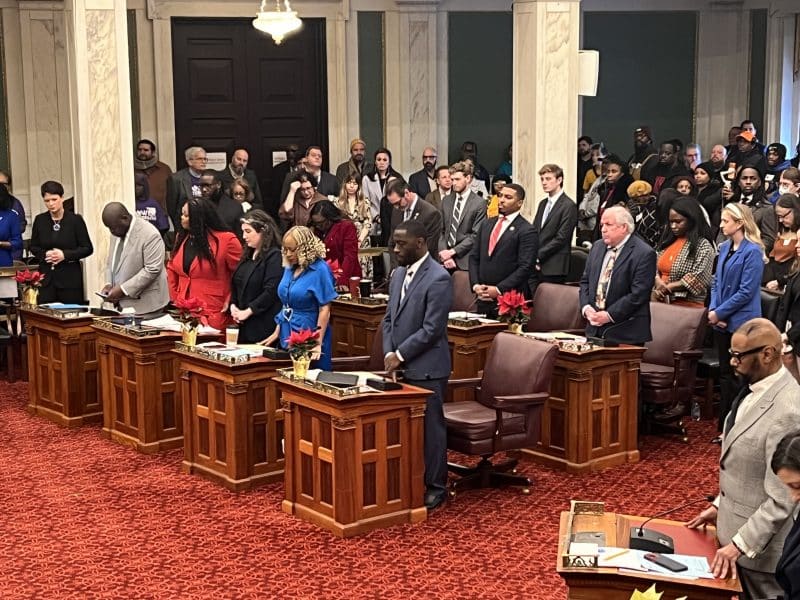
City Council’s Spring session was certainly busy and consequential. From the shocking announcement the Chinatown arena would not be built, to the $800 million HOME initiative, City Council and the Administration made decisions (or had decisions made for them) that will have ramifications for years to come. Here’s a look at the most important stories from the first half of 2025:
From January 15th, 2025- Scratch Baking
This was collaboration between Hall Monitor Reporters Lance Haver, Denise Clay-Murray, and Vanessa Maria Graber on the fate of the Chinatown Arena proposal
When the news hit on Sunday that the Philadelphia 76ers decided — with a little help from Comcast and the NBA — to become a part of Comcast’s partnership with the Philadelphia Eagles, Flyers and Phillies on a Wrigleyville-style project, reactions varied.
City council news and consumer survival tips.
Your Philadelphia monitor.
Residents of Chinatown, Washington Square West and the Gayborhood were praising the news, although they believed that the city never should have wasted the time considering the project.
People looking forward to coming downtown to catch a basketball game were a little confused.
And City officials? Their reactions ranged from Councilmember Jimmy Harrity, who was the first person to come out in support of the project and was angered by being used as “a pawn” to Councilmember Mark Squilla, who introduced the legislation creating 76 Place and didn’t seem to mind being called a pawn, saying the change was the “best-case scenario” to Mayor Cherelle Parker, who used a Monday morning news conference to try and put a positive face on what she called a “curve ball”.
During the news conference, Parker and Council President Kenyatta Johnson joined David Adelman and Josh Harris, owners of the Sixers, Comcast president Brian Roberts, NBA Commissioner Adam Silver and any other person that could be used to distract from the fact that in the end, the only thing that could stop a group of billionaires from doing something is a larger group of billionaires.
(Although Media-based comedian Wanda Sykes waxing eloquently about her love of the WNBA and why she’d like to see a franchise in Philadelphia did break up some of the tension.)
We at Hall Monitor have been following the 76 Place issue from months now. Co-hosts Larry McGlynn and Denise Clay-Murray were at Monday’s news conference. Consumer Reporter Lance Haver has been following how this would impact consumers. And Correspondent Vanessa Maria Graber has been focused on the community’s reaction to the news.
Here is what Lance and Vanessa had to say.
The Power Of Money
The announcement that the owners of the 76ers would not build an arena adjacent to Center City’s Chinatown but instead build a shared arena with the owners of the Flyers in South Philadelphia was a “curve ball,” according to Mayor Parker. But for almost everyone else, it was a bait and switch that created animosity between some minority groups, labor unions and their longtime supporters, those championing Center City and those hoping to save small independent businesses.
For over two years, David Adelman and Josh Harris, owners of the Sixers, and the Mayor have said the arena is needed to rebuild Market Street East and revitalize that part of the City. Without the new arena, the “Fashion District” would fail, and the City would suffer. Now, we are being told we don’t need an arena there; other types of development will do.
Our elected officials and the heads of some of our unions are saying keeping the arena in South Philadelphia is a big win for the City. We now will have two developments. Of course, if this is true, it makes most wonder why those same people didn’t advocate for this big win first before giving the owners of the 76ers tax breaks and land gifts and limiting the City’s victories.
The answer is not very complicated. The explanation comes from the movie “Wall Street.” “The main thing about money, Bud, is that it makes you do things you don’t want to do.” Because the billionaire team owners had money, the Mayor, City Council leaders, and some union leaders “did things they didn’t want to do” support a plan that now they are saying wasn’t as good as keeping the arena in South Philadelphia.
Sadly, little truth has been told. Neither the Mayor nor Council President Kenyatta Johnson have said they were misled into supporting the arena. Even Council Members and others who opposed it are prevaricating, saying it was the opposition that stopped it.
It wasn’t. It was just a fight between billionaires, which ended when they found a way to make even more by working together rather than fighting each other.
What will happen to Center City? The Mayor has said the stadium will have to start from scratch and create a new community benefit and payment in lieu of taxes (PILOT) agreements.
The Mayor has not said what happened to the lease agreement that was given to the team’s owners and can be assigned to other corporations. Will the City and the unelected members of PAID, — the Pennsylvania Authority for Industrial Development —, be allowed to transfer the terms to the” new undisclosed project”? Will the corporations get not one but two deals from the City that will enable them to escape tax liabilities?
Section 8.1 (b) of the lease agreement, which the Council passed and the Mayor signed into law, gives the team owners the right to transfer the lease agreement to another party. “The City shall have the right to approve such Transfer, which approval shall not be unreasonably withheld. “
No one at the press conference disclosed what would happen to the lease agreement. Most of the time was spent on self-congratulations, covering up how badly our elected officials had been misled.
When will our elected officials decide that Philadelphians, not billionaires, have the legal right to chart our City’sfuture? When will they learn that no matter what business people say, the first rule is to make a profit, not to help the City? After all, if the goal of the 76ers’ owners were first and foremost to create jobs and help Philadelphia, they would move their headquarters here, buy locally, and donate the stock in the company to the people of Philadelphia, much like the Green Bay Packers have done with their football team.
–Lance Haver
Community Reaction to the New Arena Plan Ranges from Celebratory to Frustration
The community reaction to the announcement of a new arena plan ranged from a sense of relief to feelings of frustration about the time and energy the city wasted deliberating the plan. Opponents of the arena from the Save Chinatown Coalition spent countless hours organizing community meetings, rallies, protests, and public testimony at city council hearings which included the arrests of activists advocating against the legislation. Many were angered that the decision to move the location of the proposed arena from Chinatown to south Philadelphia was not made by elected officials empathetic to their cause, but instead by four billionaires from the Sixers, Comcast, the NBA, and the NFL looking to create a better financial deal for their respective organizations.
In a statement, the Save Chinatown Coalition said, “This sham of a process laid bare what Philadelphians have long known: Decisions about the future of neighborhoods are not being made by the people who live there or have their best interests in mind, but by a select few who care only about their bank accounts, and a City Hall that’s bought and paid for. The nightmare of a Center City Sixers arena will not haunt our city anymore. To every Philadelphian who called, marched, testified, and warned City Hall that this was a raw deal: This win belongs to you, and the lesson for politicians is to trust the people.”
Some activists were concerned about the process leading up to the legislation, wanting more transparency and accountability for the money and time that was expended to get approval for the proposed arena. “It is clear that today’s press conference by Mayor Parker, city officials, and the 76ers owners was a clumsy attempt to save face after such an embarrassing change,” said Asantewaa Nkrumah-Ture, a member of PTU. “We now hope Mayor Parker will respond honestly and eagerly to all previous Right To Know requests made since she became mayor, “ she continued.
Even though the new plan is to keep the arena in South Philly and out of Chinatown, opponents of the arena plan are still looking for answers to how the new plan, the lease agreement, and the proposed community benefits agreement are going to impact Philadelphia residents. Members of the Black Philly 4 Chinatown coalition said, “This news is glaring evidence of the obscene failure of leadership from Mayor Cherelle Parker and our City Council. The people of Philadelphia will never forget how their so-called leaders fell over themselves to bend to the will of billionaires who don’t care about our communities and ignored the will of the people who make these communities thrive. We are waiting for more details of how this new deal will impact our city; in the meantime, our hearts are breathing a sigh of relief, and we are still deeply committed to the work of making this city a place where people come before profits.”
Despite continued skepticism about the new plan, organizers are still finding reasons to celebrate. A Save Chinatown Coalition party will be held tonight in Chinatown for what they are calling a “victory” celebration.
-Vanessa Maria Graber
A Matter of Trust
Sitting in the Mayor’s reception room on Monday and watching Mayor Cherelle Parker preside over a news conference announcing the Sixers decision to stay in South Philadelphia reminded me of when I was covering the Mayoral primary that led to former City Councilman Michael Nutter becoming the city’s mayor.
I went to a pool party at Sid Booker’s house. Booker, for those of you who don’t know, is the owner of the Stinger LaPointe bar on North Broad Street. In addition to décor that would be more at home in a 70s Blacksploitation film, the bar, the take-out joint attached to it and the food trucks parked nearby are known for churning out mountains of fried shrimp.
One of the food trucks was parked in the driveway of Booker’s house as politicos including several of the people who lost to Nutter in the primary were there to celebrate his victory. I found myself sitting next to a political operative by the pool, watching as people who really didn’t want to be there paid homage.
The political operative told me to take a good look at the crowd and to tell him what I saw. I said, I saw a bunch of politicians.
He said, “I see a conquered army.”
If you looked really closely, you saw the same thing yesterday. I know that I did.
From Josh Harris and David Adelman looking like they’d rather be just about anywhere else, to Councilmembers Quetcy Lozada and Isaiah Thomas who tried not to appear as angry as they probably were, a lot of people looked like the wind had been knocked out of their sails.
Even Mayor Parker and Council President Johnson looked like they had been blindsided. They were, but that’s not here or there.
While there were a lot of questions asked, none of them seemed to focus on the most obvious thing: the betrayal. While a reporter from CBS-3 asked Parker if she could trust the men around her to not do what the Sixers did to her again, Council will be the ones asked to pass any plan that any of these people put forward.
Will Council trust them again? Has Johnson lost the trust of his members? Budget season is coming up and trust is a big part of that. Will the arena debacle have an impact on that?
I guess we’ll find out soon enough.
Mayor Parker’s first year in office has been interesting. While it has had some definite ups, there have also been some prodigious drops.
If she wants a second term, she’s got three years to rebuild her political capital and, most importantly, to repair her relationships with Council and the public.
Good luck with that.
From May 13th, 2025: SEPTA Cuts Would Have Broad Consequences Across the Region
The Southeastern Pennsylvania Transportation Authority, better known as SEPTA, is facing a crisis. It projects a $213 million deficit for the next fiscal year, which will lead the Authority to raise fares by 21.5% and cut service by 45%. unless it gets some help. The danger is that SEPTA will enter an economic death spiral where service cuts and fare increases lead to riders limiting trips, which will cause another deficit and more service cuts in years to come.
The SEPTA Board and its acting General Manager, Scott Sauer, month after month, have told the public that unless the State Legislature supports Governor Shapiro’s plan to fund public transit across the state, SEPTA will be forced to do so.
SEPTA is threatening riders with fare increases, including raising the Key Card fare from $2.50 to $2.90, eliminating 55 bus lines, reducing the frequency of other lines, discontinuing five regional rail lines, and stopping all service on the rail lines after 9 pm, making it impossible for sports fans and concert goers to use. After each public threat, someone from SEPTA will say, “We don’t want to do this, but we have to.”
SEPTA has threatened similar fare hikes and service cuts in the last few years. In past years, at the last minute, the Governor has “flexed” highway dollars to keep public transit funded throughout the state. The flex came after SEPTA raised fares and signed a contract with its union.
How honest is SEPTA being? There are two answers. When it comes to the devastation the fare hikes and service cuts will lead to, they present an accurate picture.
This year, it is unlikely that the Governor will be able to flex any money. Unlike in past years, SEPTA is now publicly seeking support. SEPTA’s web page lists what SEPTA does for our region and what the fare hike and cuts will mean for our economy.
There will be job losses, not only layoffs at SEPTA, but also layoffs at many companies with which SEPTA does business. Because it will be harder for people to get to jobs, some companies will move, and others will be forced to close. The estimates are 76,700 lost jobs and $6.0 billion in lost earnings.
The longer wait times will make it harder for parents to be involved in their children’s schooling. Dinners together will be fewer, and all too often, the meals served will not be home-cooked.
Property values will go down. Study after studyhas shown that living near a public transit line increases property value.
For those who drive to work, the proposed service cuts and fare increases will make the roads more crowded and the commutes much longer. The Delaware Valley Regional Planning Commission projects another 275,000 cars on the road if SEPTA implements the doomsday budget.
The average commute time in Chester County on US Route 202 would increase by 40%. The added congestion will hurt the region’s chances of becoming a warehouse and distribution hub by making it harder for companies to get products from the ports and airports to consumers.
The damage to the air quality and our health has not been projected. It should, however, not go unnoticed that more cars, more air pollution, more cases of asthma, and more trips to the hospitals and health centers.
The second part of SEPTA’s statement, that it has no choice, isn’t genuine. Last year, SEPTA passed a budget with the expectation of getting more state dollars, and it did. This year, it wants to pass a budget that doesn’t require additional state funding, so the money from the state isn’t needed.
By being willing to harm its riders, SEPTA takes the pressure off the Governor and the State Legislature to find the money every public transit agency in the Commonwealth needs. It also gives those in Harrisburg who dislike public transit exactly what they want: the demise of a public transit system and opening the door to privatization.
SEPTA has the resources it needs to stand up for its riders and refuse to begin dismantling the system. As of last year, it had over half a billiondollars in its fare stabilization fund. Based on what SEPTA did last year, which included raising fares, increasing revenue from every county, charging for parking, leaving positions unfilled, reducing bus service, and receiving flex dollars from the Governor, the stabilization fund should not have been touched.
On WHYY April 30th, 2025, acting General Manager Scott Sauer explained that cutting the City Transit division, the buses, Subway, El, and Subway Surface cars, doesn’t save much money. “20% cuts save only $ 50 million,” less than 25% of the deficit. Further fare increases above the proposed $ 2.90 will drive riders off the system, as the fare was $2.00 last year.
And of course, SEPTA can cancel its “Key Card 2” $211 million contract and use the money to keep the system operating. SEPTA can refuse to dismantle the system if it wants.
The SEPTA board should not harm its riders or begin dismantling the system so the Republicans don’t have to take ownership of the crisis. Instead, they should heed the words of the late John Lewis: “Get in the way and cause good trouble.”
Public hearings on SEPTA’s Fiscal Year 2026 Operating and Capital Budgets — including the proposed fare increases and service reductions — are scheduled for:
- Monday, May 19, 2025: 11 am & 5 pm (Operating Budget, Fare Increases & Service Reductions)
- Tuesday, May 20, 2025: 10 am & 4 pm (Operating Budget, Fare Increases & Service Reductions)
- Wednesday, May 21, 2025: 10 am & 4 pm (Capital Budget)
All hearings will be held at:
SEPTA Headquart
From June 8th, 2025: Philadelphia City Council Committee Approves Budget, HOME Bills
The Committee of the Whole, which convened Wednesday morning at 9:00 to formally release the budget bills so they could be heard by the full council, finally did so more than 24 hours later, on Thursday afternoon. The bills needed to be brought before the entire council before the end of the week so they could be passed on June 12th, the last day of the spring legislative session. Had the legislation not been passed in a timely fashion, another session day would have been added to the council calendar.
It is not uncommon for budget bills to require longer to finalize than other types of legislation. Often, the passage of budget bills can come down to the proverbial “last minute,” with negotiations sometimes dragging out behind closed doors.
That was the case this year, as Council and the Mayor had not must budget, but the HOME plan, which looks to add 30,000 units of affordable housing or preserved housing to the city.
The final budget passed out of committee has approximately $98 million in additional spending compared to the document introduced last March. The funds will mostly come from the city’s fund balance, or tax money leftover after the city meets it’s obligations.
Major funding increases were allocated for the following departments (all from the city’s General Fund)
Office of Arts, Culture, and the Creative Economy
Proposed Appropriation: $5.4 million
Final Appropriation: $9.7 million
The Defenders Association
Proposed Appropriation: $67.5 million
Final Appropriation: $69 million
The Fire Department
Proposed Appropriation: $431.7 million
Final Appropriation: $444.2 million
Parks and Recreation
Proposed Appropriation: $83.5 million
Final Appropriation: $87.3 million
Department of Finance
Proposed Appropriation: $83.3 million
Final Appropriation: $115.9 million
Economic Stimulus (Commerce Department)
Proposed Appropriation: $78.5 million
Final Appropriation: $101.4 million
The Law Department
Proposed Appropriation: $16.6 million
Final Appropriation: $18.4 million
The District Attorney’s Office
Proposed Appropriation: $58.4 million
Final Appropriation: $59.3 million
Department of Planning and Development
Proposed Appropriation: $17.6 million
Final Appropriation: $27.4 million
Office of Prison Oversight
Proposed Appropriation: $1 million
Final Appropriation: $1.3 million
There was also a significant increase in the FY 2026 Capital Budget, which rose from $6.435 billion to $6.551 billion.
Another significant piece of legislation tied to the Budget bills is the proposed change to the Business and Receipts Tax (BIRT). In addition to elimination of a tax exemption on the first $100,000 dollars on income, the BIRT rate in FY 2026 will be 5.65%, down from FY 2025’s 5.71%. Below are the scheduled BIRT reductions through 2038:
| 2022 | 1.415 mills | 5.99% |
| 2023 [and thereafter] | 1.415 mills | 5.81% |
| 2024 | 1.415 mills | 5.81% |
| 2025 | 1.410 mills | 5.71% |
| 2026 | 1.395 mills | 5.65 % |
| 2027 | 1.390 mills | 5.60% |
| 2028 | 1.385 mills | 5.55% |
| 2029 | 1.380 mills | 5.50% |
| 2030 | 1.255 mills | 5.45% |
| 2031 | 1.130 mills | 5.30% |
| 2032 | 0.955 mills | 4.95% |
| 2033 | 0.780 mills | 4.60% |
| 2034 | 0.605 mills | 4.25% |
| 2035 | 0.430 mills | 3.90% |
| 2036 | 0.255 mills | 3.55% |
| 2037 | 0.080 mills | 3.20% |
| 2038 and thereafter | 0 mills | 2.80% |
Additionally, the city Wage and Net Profits Tax is scheduled to be reduced in FY 2026 from 2.24% to 2.235% for those who live in the city, and from 3.43% to 3.425% for non-residents. Further reductions are scheduled to continue until 2029.
Mayor Parker’s key 2025 initiative, the H.O.M.E plan, was also passed out of committee and had its first reading in Council last Thursday. Passage is expected on June 12th.
The plan would include an $800 million dollar bond issuance; $400 million this year and a second $400 million in 2027. Last week, we reported on the City Council amendment providing oversight to the legislation; a further layer was added prior to the bill being moved from committee that will include the City Controller in oversight of the spending.
Each piece of legislation will have a final vote on June 12th, 2025.
Committee Hearings
The following committees of Philadelphia City Council met last week to hear testimony on the following legislation:
The Committee on Public Safety
Amending Chapter 9-600 of The Philadelphia Code, entitled “Service and Other Businesses, to add a new Section 9-640, entitled “Mandatory Posting of Warning of Unlawful Transfer of Firearm,” to require licensed firearms dealers to post signs warning that purchasing firearms for another is criminally punishable; all under certain terms and conditions.
Amending Chapter 9-3500 of Title 9 of The Philadelphia Code, entitled “Fair Criminal Record Screening Standards,” to amend definitions, add clarifications, and enhance remedies, all under certain terms and conditions.
The Housing Committee heard testimony on the following legislation:
Bill No. 250329 (Did Not Advance)
Amending Chapter 9-3900 of The Philadelphia Code, entitled “Property Licenses and Owner Accountability,” to clarify licensing requirements, authorize the Department to create a Proactive Inspection program, require public reporting related to Code compliance, and establish remedies, damages, and protections for tenants, all under certain terms and conditions.
Bill No. 250330 (Did Not Advance)
Amending Chapter 9-800 of The Philadelphia Code, entitled “Landlord and Tenant,” to modify the requirements related to good cause for ending a tenancy, add protections against retaliation and harassment for tenants and tenant organizations, specify tenants’ rights related to the implied warranty of habitability and provide a legal presumption related to breaches of the implied warranty of habitability, create a tenant right to organize, specify deadlines for asserting claims, and establish and enhance enforcement mechanisms, remedies, damages, and protections, all under certain terms and conditions.
Amending Chapter 9-800 of The Philadelphia Code, entitled “Landlord and Tenant,” to hereby authorize the creation of an Anti-Displacement Fund, to establish violations for displacement, and to authorize the Department of Planning and Development to administer the Anti-Displacement Fund; and amending Section A-505, entitled “Cease Operations Order” to add notice requirements, all under certain terms and conditions.
The Committee on Finance heard testimony on the following legislation:
Amending Chapter 19-200 of The Philadelphia Code, entitled “City Funds – Deposits, Investments, Disbursements,” by amending Section 19-201, entitled “City Depositories,” to remove Citibank, N.A. and Republic First Bank as authorized financial institutions in which the City Treasurer may deposit funds, all under certain terms and conditions.
Authorizing the Procurement Commissioner, on behalf of the City of Philadelphia, to enter into an agreement with the Philadelphia Energy Authority for coordination of a guaranteed energy savings contract for implementation and evaluation of energy conservation measures designed to reduce energy, water, wastewater, or other consumption or operating costs at specified City properties, all under certain terms and conditions.
Amending Chapter 19-4600 of Title 19 of The Philadelphia Code, entitled “Low-Income Tax Provisions,” by extending the deadline for low-income taxpayers to apply for a refund or forgiveness of Real Estate Taxes, under certain terms and conditions.
Amending subsection 19-2604(6) of The Philadelphia Code, entitled “Credit for Contributions to Community Development Corporations, Nonprofit Organizations Engaged in Developing and Implementing Healthy Food Initiatives and Nonprofit Intermediaries,” under which businesses may enter into agreements to make contributions to community development corporations and certain other organizations to receive tax credits, by expanding eligibility for recipients of such funds and the uses to which such funds may be used; and which taxes that are used for this tax credit program, and increasing the number of businesses to which the credit shall be made available; and providing the option for a commensurate grant program; all under certain terms and conditions.
Amending Chapter 19-3200 of The Philadelphia Code, entitled “Keystone Opportunity Zone, Economic Development District, and Strategic Development Area,” to provide for additional extensions of certain benefits, under certain terms and conditions.
Approving the Fiscal Year 2026 Capital Budget providing for expenditures for the capital purposes of the Philadelphia Gas Works, including the supplying of funds in connection therewith, and acknowledging receipt of the Revised Forecast of Capital Budgets for Fiscal Years 2027 through 2031, all under certain terms and conditions.
Approving the amendment of the Fiscal Year 2025 Capital Budget providing for expenditures for the capital purposes of the Philadelphia Gas Works (including the supplying of funds in connection therewith) subject to certain constraints and conditions and acknowledging the receipt of the Revised Forecast of Capital Budgets for Fiscal Years 2026 through 2030, as amended.
Authorizing an increase in the non-electoral indebtedness of the City within the Pennsylvania constitutional limit; authorizing the Bond Committee to sell bonds at public or private negotiated sale, to provide funds toward various capital municipal purposes; providing for appropriations to the Sinking Fund Commission for the payment of such bonds; and authorizing agreements to provide credit or payment or liquidity sources for the bonds in connection with issuance of the bonds, and certain other actions.
Authorizing the Director of Planning and Development, on behalf of the City, to file applications with the United States Department of Housing and Urban Development for a Community Development Block Grant; to file applications to participate in the HOME Investment Partnership program and the Emergency Solutions Grant program; and to apply for a Housing Opportunities for Persons with AIDS grant; and to file applications with the Commonwealth to obtain grants under the Act of April 12, 1956, P.L. 1449, Section 4, as amended, to prevent and eliminate blight; authorizing the Director of Planning and Development and the Director of Commerce to file applications to obtain other grants from the Commonwealth; authorizing the Director of Commerce to use the Section 108 Loan Guarantee Program; and authorizing the Director of Planning and Development and the Director of Commerce to enter into all understandings and assurances contained in such applications and take all necessary action to accept ..
Constituting the Twenty-Eighth Supplemental Ordinance to the Restated General Water and Wastewater Revenue Bond Ordinance of 1989, as supplemented; authorizing the Bond Committee to issue and sell one or more series or subseries of tax-exempt or taxable water and wastewater revenue bonds and revenue refunding bonds; authorizing agreements to provide credit enhancement or payment or liquidity sources (or any combination of the foregoing) for such Bonds; providing that such Bonds shall bear interest at fixed or variable rates; determining the sufficiency of pledged Project Revenues; authorizing the Director of Finance to take certain actions with regard to the sale of such Bonds, the investment of proceeds thereof and the City’s continuing disclosure obligations with respect to such Bonds; setting forth the use of proceeds of such Bonds; covenanting the payment of interest and principal; supplementing the Restated General Water and Wastewater Revenue Bond Ordinance of 1989; and specifyin…
Authorizing and approving the execution and delivery of a Service Agreement between The City of Philadelphia and the Philadelphia Redevelopment Authority relating to the financing of a Housing Opportunities Made Easy (H.O.M.E.) Plan which includes housing production and preservation, home affordability, home owner and renter assistance, related contractor training and support, blight and vacant property reduction, urban beautification, neighborhood infrastructure, and other related programs; approving the issuance by the Authority of bonds, notes or other evidences of indebtedness (including reimbursement obligations related to lines or letters of credit) in one or more series to finance or refinance such plan and authorizing and approving the obligation of The City of Philadelphia to pay in full when due the Service Fee and other amounts payable under the Service Agreement; authorizing certain City officers to take certain actions required to issue such bonds, notes or other evidences…
Authorizing various encroachments in the vicinity of 2654 S 10th St, Philadelphia, PA 19148, under certain terms and conditions.
Authorizing encroachments in the nature of a sidewalk caf? in the vicinity of 2101 E York St, Philadelphia, PA 19125, under certain terms and conditions.
Amending Chapter 17-1400 of The Philadelphia Code, entitled “Non-Competitively Bid Contracts; Financial Assistance,” to modify exceptions and provide for reporting and recordkeeping in connection with invocation of such exceptions, all under certain terms and conditions.
Our reporters sit through hours of city council meetings, dig through piles of documents, and ask tough questions other media overlook. Because we’re committed to addressing Philadelphia’s poverty crisis — and challenging those who sustain it. If you think this work is important too, please support our journalism.
We’re counting on readers like you.