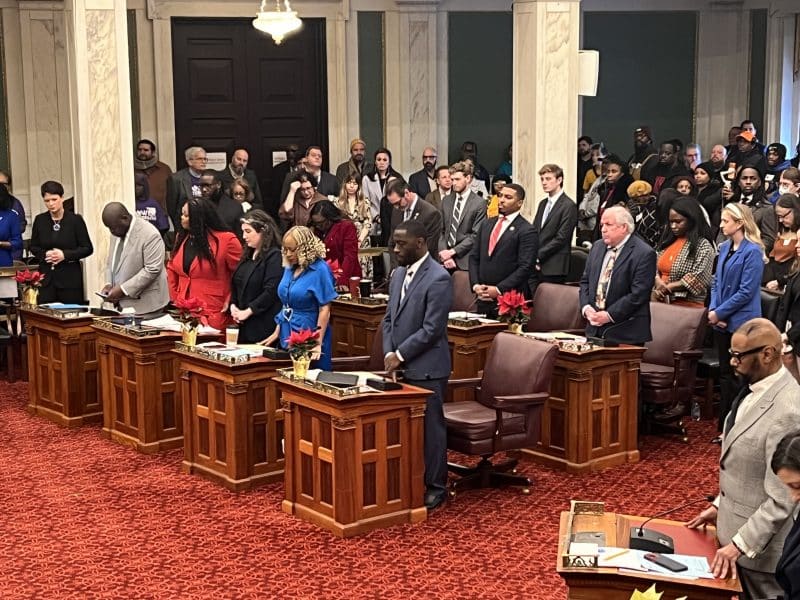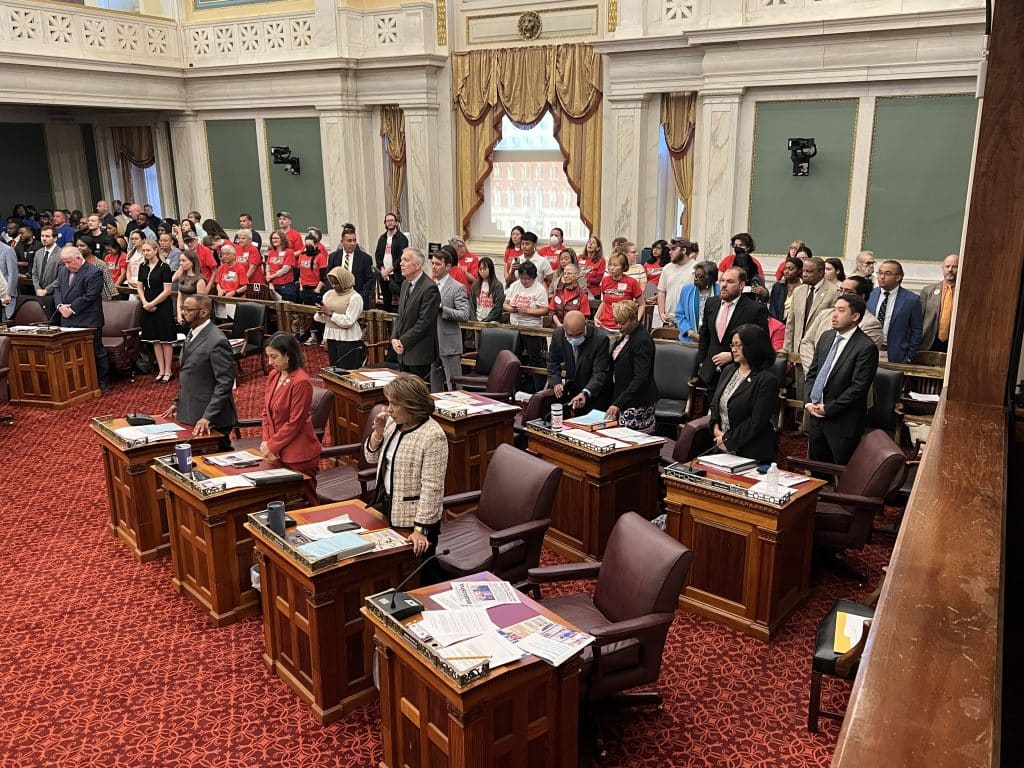
Once again, the proposed 76ers arena dominated Philadelphia City Council’s stated meeting. Two pieces of arena-related legislation, Resolutions Nos. 240999 and 241000 were on the Final Passage Calendar, which meant anti-arena advocates could speak during the public comment section of the meeting.
Debbie Wei, a leader of the arena opposition who was removed from last week’s City Council meeting, spoke passionately about her experience.
“Last week, I was dragged out of City Council and violently thrown out of City Hall for merely holding up a sign and chanting,” Wei said. “I was enraged to hear Council President Johnson claim there are channels through which you can be heard; for more than two years, we in Chinatown have begged to be heard.”
Wei said that over the two years, arena opponents have not been granted the public process promised and that Council President Johnson has not returned Wei’s calls. Wei also said that despite her standing in the community and the fact that the city council had honored her the year before, she felt like a target.
“Within a minute of me standing up, Sheriff’s deputies yanked me out of my chair, causing me to fall, and told me, ‘It’s time for you to go,'” Wei said. “(In the elevator) they said to me ‘now are you going to behave?’ Do you know how it feels to be a woman of color in a closed, isolated space, hearing men with power tell you that you need to behave?”
The legislation was approved but did not receive unanimous votes, as traditionally customary in the collegial city council. Councilmembers Gauthier, Landau, Young, Brooks, and O’Rourke broke ranks to oppose the legislation. Both Gauthier and Landau said they remained undecided on the project but felt the process was moving too fast and required greater scrutiny.
The first public hearing on the project will be November 12th.
This Week’s Committee Hearings
The Committee on Streets and Services heard testimony on Bill No. 240931, “An Ordinance authorizing and directing the changing of the name of Taney Street to LeCount Street, from West Toronto Street to West Somerset Street; from Ridge Avenue to Cecil B. Moore Avenue; from Master Street to Aspen Street; from Pine Street to Bainbridge Street; from Catharine Street to Christian Street; from Dickinson Street to Morris Street; and authorizing and directing the changing of the name of Taney Terrace, from Point Breeze Avenue to Jackson Street, to LeCount Terrace, all under certain terms and conditions.”
The Committee on Legislative Oversight heard testimony on Resolution No. 240544, “authorizing the Committee on Legislative Oversight to hold hearings examining disparities experienced by the LGBTQ+ community and exploring solutions to achieving equity for LGBTQ+ Philadelphians.”
Read More
The Committee on Legislative Oversight heard testimony on Resolution No. 240544, authorizing the committee to hold hearings examining disparities faced by the LGBTQ community in Philadelphia and exploring actionable solutions for achieving equity.
Councilmember Rue Landau, the sponsor of the hearing resolution, said nearly half of LGTBQ individuals in Pennsylvania report experiencing workplace discrimination, and 40% of homeless youth identified as LGBTQ.
“These numbers reflect a deeper, pervasive issue that demands our attention and action,” Landau said. “We know LGTBQ individuals are more likely to experience food insecurity, with 26% reporting challenges affording necessities. This is not an economic issue but a matter of human dignity.”
Jasper Liem, Executive Director of the Attic Youth Center, reiterated that LGBTQ youth in Philadelphia are disproportionately affected by homelessness, mental health crises, discrimination, and bullying.
“Mental health is another critical concern. LGTBQ youth experience anxiety, depression, and suicidal ideation at alarmingly higher rates than their peers,” Liem said. “As someone who grew up just outside the Philadelphia city limits, I struggled with mental health myself. I’m a survivor of suicidal ideation, and it’s incredibly dark to be in that space.”
The Committee on Housing, Neighborhood Development, and the Homeless heard testimony on Resolution No. 240288, “authorizing the Joint Committees on Housing, Neighborhood Development, and the Homeless and Public Property and Public Works to hold hearings on the ten-year performance of the Philadelphia Land Bank; what barriers exist to effective application review, process efficiency, and transparent communication; and how these can be solved to maximize this unique opportunity to create genuinely affordable housing and community-stewarded green spaces for neighborhoods that need them the most.”
Read More
Councilmember Jamie Gauthier, who sponsored the legislation authorizing the hearing, explained the 13-year history of the Landbank as a collaboration between Community Development Corporations, grassroots activists, and Philadelphia City Council as an organization to “promote long-term affordability and socioeconomic diversity through the equitable development and deliberate and sustained public discussion.”
Having set an early goal of distributing 2700 of the 8000 city-owned parcels within five years, Gauthier said the city had made little progress towards the Landbank’s stated goals and mission.
“Land dispositions for genuinely affordable rental housing have declined yearly since 2017,” Gauthier said. And two years ago, land for community green space has stopped. The same groups that fought for the Landbank in the first place routinely received unfriendly and restrictive service from the agency.”
Gauthier highlighted the complaints of city non-profits looking to use space for community gardens and other public space projects, who have been subjected to significant delays and issues when applying for parcels of land. Gauthier also decried the Landbank’s need for an updated strategic plan, the last of which was completed in 2017.
Rick Sauer, Executive Director of the Philadelphia Association of Community Development Corporations and a former member of the Landbank Board, said since its creation, the Landbank had failed to live up to expectations and offered six recommendations for improvement:
The creation of a strategic plan
The further development of a Landbank dashboard with reports evaluating how the Landbank is fulfilling its mission
Creating a disposition policy that benefits the community
The development of an acquisition policy that is both affordable and efficient
Greater transparency, as frustration has grown over the lack of information regarding in-progress applications, etc
Addressing customer service is also a key need-including increased staffing
The Committee on Law and Government heard testimony on the following bills and resolutions:
Bill No. 240004: An Ordinance amending Title 11 (“Streets”) and Title 21 (“Miscellaneous”) of The Philadelphia Code to amend requirements concerning publication of notices in newspapers, all under certain terms and conditions.
Bill No. 240817: An Ordinance providing for the submission to the qualified electors of the City of Philadelphia of the proposal set forth in a Resolution approved by Council proposing an amendment to The Philadelphia Home Rule Charter relating to the creation of the Philadelphia Prison Community Oversight Board; and authorizing the appropriate officers to publish notice and to make arrangements for the special election; all under certain terms and conditions.
Resolution No. 240834: Resolution proposing an amendment to the Philadelphia Home Rule Charter to provide for the creation of the Philadelphia Prison Community Oversight Board and the Office of Prison Oversight and providing for the submission of the amendment to the electors of Philadelphia.
Read More
The charter change is supported by most council members and advocates, but administration officials were not sure of its necessity.
Prisons Commissioner Michael R. Resnick said that while he “respected the motivation for this measure,” he believed the proposal was unnecessary because of previous legislation that created similar oversight. This new charter change would be duplicitous.
“There are already several layers of oversight for the PDP, and it will not be helpful to add another layer potentially creating conflict and confusion,” Resnick said.
Councilmember Nicholas O’Rourke, a sponsor of the legislation, asked Resnick how many times per year the PDP referred use-of-force of PDP personnel cases to the District Attorney’s Office for investigation.
Due to Resnick only accepting the position last April, data for this tenure was incomplete, but Resnick said, on average, he believed such referrals were made between 5 and 15 times per year. Currently, two cases are being prosecuted.
Numerous community members and stakeholders, including Tom Innes, the Director of Prison Advocacy at the Defender Association of Philadelphia, supported the legislation.
Innes discussed the fraught recent history of the Philadelphia Prison System, including numerous lawsuits over the last few decades, a severe lack of transparency, and little oversight. In just the previous 18 months, Innes said there have been over 20 deaths in city prisons, and an average of 106 people per month (over 3 per day) have been taken from the State Road facility to emergency rooms.
The Philadelphia Prison System’s current population is 4529 inmates, 23 certified juveniles, and 330 females. The PDP employs around 900 guards, with a class of 50 nearing graduation and another class of 50 entering training.
Our reporters sit through hours of city council meetings, dig through piles of documents, and ask tough questions other media overlook. Because we’re committed to addressing Philadelphia’s poverty crisis — and challenging those who sustain it. If you think this work is important too, please support our journalism.
We’re counting on readers like you.