As the Hall Monitor reported, Congress has been unable to pass a budget that continues the enhanced subsidies for the Affordable Care Act (ACA) health insurance policies. Those subsidies, passed in 2021, increased the amount of financial assistance and made it available to more middle-class families than ever before.
Families purchasing ACA, often called ‘Obamacare’ health insurance, across the country more than doubled, enabling the number of people covered to grow from 11 million to over 24 million.
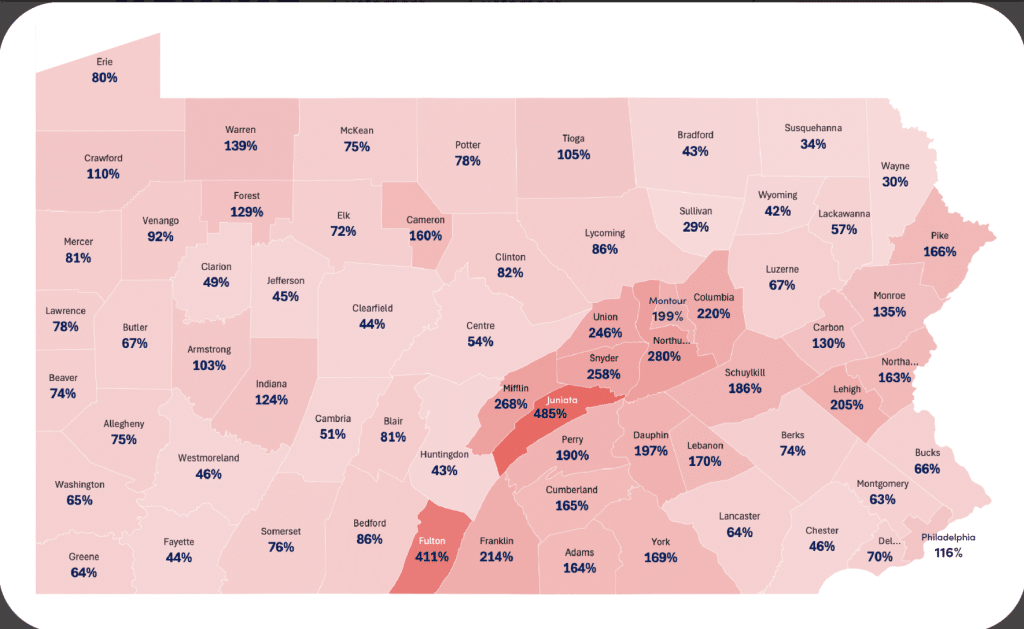
Currently, more Pennsylvanians than ever before have health insurance. However, this is likely to change; almost 500,000 Pennsylvanians are facing a doubling of their health insurance premiums.
Who are these people? Pennie, PA’s official health insurance “marketplace” that lists the ACA plans and prices, says “those who use Pennie services are individuals without access to employer-based coverage, like small business owners, farmers, or early retirees.”
The largest increases are in rural counties, which President Trump won by double digits. PA’s 10th Congressional District, which has seen ACA enrollment increase by 86% since 2021, is facing the largest proposed increase, if the subsidies are not renewed — an unbelievable 170%. This district is represented by one of President Trump’s most loyal members of Congress, Scott Perry. The Congressman who tried to have PA’s vote for President Biden overturned based on outright lies.
The increase falls most heavily on the state’s aging population — older workers, many of whom were “downsized,” but are still too young for Medicare.
A married couple (60 years old) making around $82,000 annually
• With the enhanced premium tax credits, their monthly premium is capped at 8.5%, or $581/month.
• Without the enhanced premium tax credits, their monthly premium jumps to $2,934/month, 43% of their monthly income.
• Expiration of the tax credits results in a 405% increase in this couple’s net premium.
Congressman Perry opposes continuing the subsidies. He called extending the subsidies “a colossal mistake.” The Congressman makes the point that the subsidies could lead to further national debt, without mentioning the medical debt his constituents will endure if they become ill without health insurance.
Even with the expanded subsidies, the American Bankruptcy Institute says the number one cause of bankruptcy in the United States is becoming sick. Sixty-two percent of the 2 million personal bankruptcies filed each year are the result of medical debt.
The projected ACA premium increases are lower than the actual increases will be. As health insurance companies project fewer policies sold, premiums will increase. The increased premiums and the loss of subsidies in PA will result in an average increase of 102%.
The suffering for those who were receiving enhanced subsidies is easy to understand — higher rates, fewer subsidies mean fewer dollars for household needs. Less for the mortgage or rent, for food or utilities, less money to fix the car, buy school supplies, and presents for holidays.
It is harder to understand just how devastating the cuts will be to people who have health insurance through work or even Medicare. The current administration’s “Big Beautiful Bill” cuts Medicaid. Many hospitals are already losing money. Without Medicaid and with fewer patients having health insurance, hospitals will lose revenues. Some will close. Dr. Valerie A. Arkoosh, MD, MPH, PA’s Secretary of Human Services, says in under-resourced communities, these funds can be the difference between a clinic staying open or shutting down.
“When hospitals begin to see patients who don’t have health insurance, they will have no choice but to shift the cost of care that they are providing to people who do have health insurance to the people who can pay.” she says. “That translates to higher insurance premiums and deductibles for private and employer-based plans.”
The Hospital industry agrees. “Pennsylvania’s healthcare system is facing a period of escalating instability, marked by a troubling combination of hospital closures, financially driven service reductions. The cumulative impact is limiting access to care, particularly in underserved areas, and raising urgent questions about the long-term sustainability of healthcare delivery in the state.”
Over the past five years, six rural hospitals in Pennsylvania have closed, and an additional 18 are at risk. Of those, 10 are considered to be in imminent danger of shutting their doors. Pennsylvania’s population – about 3.4 million people – live in rural communities, with 48 of the total 67 counties deemed rural.
“Pennsylvania has the unfortunate distinction of having one of the highest percentages of rural hospital closures,” Nicole Stallings, president and CEO of the Hospital Association of PA, said during an episode of the “Becker’s Healthcare Podcast.” “In the northwest part of the state, there’s now an area the size of Connecticut without a birthing hospital.”
Two questions remain: Given these facts, will the Republicans in Washington save the enhanced subsidies, and if not, who will the people losing health insurance and hospitals blame at the ballot box? Will Congresspeople like Scott Perry be held responsible for their actions?
Our reporters sit through hours of city council meetings, dig through piles of documents, and ask tough questions other media overlook. Because we’re committed to addressing Philadelphia’s poverty crisis — and challenging those who sustain it. If you think this work is important too, please support our journalism.
We’re counting on readers like you.