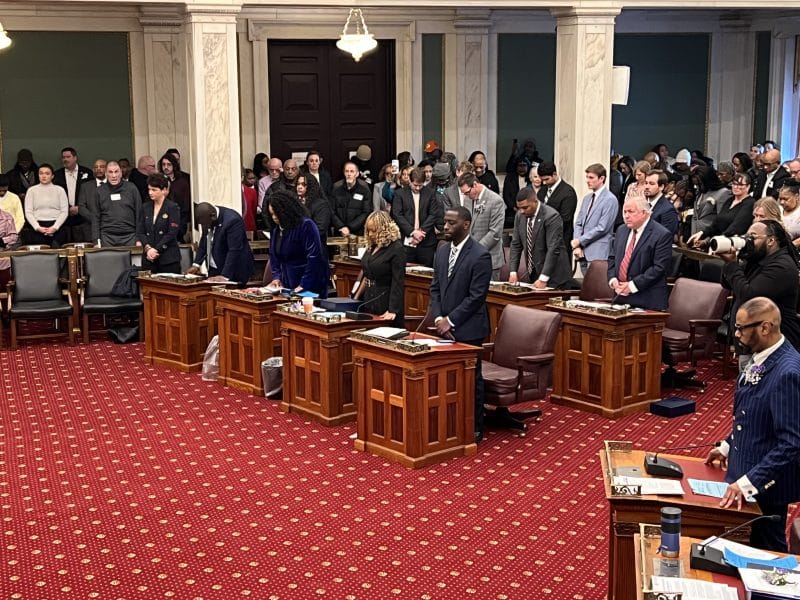
Councilmember Isiaiah Thomas introduced two resolutions related to the city’s 2026 festivities. Thomas has been de facto point person on preparedness for the upcoming events.
The first resolution “authorizes the Committee on Legislative Oversight to hold hearings to determine the current state of planning and readiness for the traffic flows caused by events and visitors during the historic 250th Anniversary celebration of the United States and the many events coming to town.”
With traffic already a concern in many parts of the city, an influx of drivers and pedestrians could make a difficult situation more challenging. According to the resolution, Philadelphians lose over 1000 hours per year to traffic congestion.
In concert with the first, the second resolution “authorizes the Philadelphia City Council Committee on Legislative Oversight to hold hearings considering how Philadelphia will handle over half a million extra visitors during 2026 and the feasibility of allowing short term rental rule holidays as other cities have done around large scale events.”
The city expects to see an influx of 550,000 in the summer of 2026 alone, when the World Cup, Semquinncentenial, and MLB All-Star game occur.
One of the goals of resolution is to determine how Philadelphians can benefit economically from the events and keeping visitors in the city despite sluggish growth in the building of new hotels.
Landau Introduces LGBTQ Resolutions
Councilmember Rue Landau introduced a trio of resolutions recognizing the LGBTQ community.
The first “recognizes October 19, 2025 as National LGBTQ Center Awareness Day in the City of Philadelphia and highlighting the vital role of LGBTQ+ community centers in serving as crucial lifelines and hubs for LGBTQ+ communities, fostering a sense of belonging and community, and advocating for equal rights.”
Several LGBTQ centers call Philadelphia home, including GALAEI, Attic Youth Center, Mazzoni Center, Valley Youth House, COLOURS, William Way LGBT Community Center, Covenant House, Bebashi, and Philadelphia FIGHT. LGBTQ+.
Landau also introduced a resolution “recognizing October 2025 as LGBTQ+ History Month in the City of Philadelphia and honoring the movement for LGBTQ+ rights, providing visibility for an often-erased history, and raising awareness for the ongoing fight for civil rights and equality.”
Philadelphia boasts one of the earliest LGBTQ+ PRide events, which was held every July 4th from 1965 to 1969. The first Gay Pride March held in Philadelphia in June of 1972.
The third resolution “recognizes, congratulates, and celebrates Valley Youth House on the distinguished occasion of its 20th anniversary in Philadelphia, passionately serving young individuals to help them achieve their full potential by providing essential services like counseling, housing support, community connections, and life training skills.”
The Valley Youth House provides a number of services, including bridge programs for young adults aged 18-24, life-skills classes, mentoring, homelessness outreach, and supervised independent living.
Lozada Introduces Land Bills
Councilmember Quetcy Lozada introduced a pair of bills related to land disposition. The first requires a special exemption for retailers selling pharmaceuticals and for convenience sales.
The second requires the Philadelphia Land Bank to submit an annual report to City Council that includes the following: the name of the party or parties who acquired the property. If the property was acquired by someone other than an individual, the report shall include the principal(s) of any entity other than an individual; the purpose of the disposition; the date the application was submitted; the date the Board approved the disposition; the date Council approved the disposition; and the date the land was disposed of (closing date).
Driscoll Calls for Hearing on Regional Rail Trains
Councilmember Mike Driscoll introduced a resolution “authorizing the Committee on Transportation and Public Utilities to hold hearings to investigate SEPTA Regional Rail’s Silverliner IV fleet.”
Following a National Transportation Safety Board (NTSB) report that recommended older train cars be removed from service, the Federal Railroad Commission issued an emergency order requiring SEPTA to address electrical fires on its Silverline IV fleet.
According to the resolution, the Sliverline IVs are 57 percent of SEPTA’s Regional Rail fleet, and are used on every Regional Rail route.
O’Rourke Introduces Consumer Legislation
Councilmember Nicholas O’Rourke introduced multiple pieces of legislation, including a bill guaranteeing public ownership of the city’s water supply, and an ordinance providing real estate tax refunds for certain low income Philadelphians.
The latter directs the Department of Revenue to develop procedures, guidelines, and forms so eligible taxpayers can obtain refunds for overpaid real estate taxes.
Currently, Pennsylvania’s Property Tax/Rent Rebate program provides assistance to renters, but does not necessarily provide relief for the 20 percent of property taxes allowed to be passed through by landlords onto tenants.
Councilmember O’Rourke will appear on The Hall Monitor Radio/Television Program next week to discuss these programs in greater detail.
L&I Hears Testimony on Voter Registation Bill
The Philadelphia City Council on Licenses and Inspections heard testimony on Bill No. 250774, an ordinance that would provide voter registration information to all tenants.
The new legislation requires the owner of a rental property to include, along with other rental-related documentation, “a link to the ‘How to Register’ page on the City Commissioner’s website.”
Councilmember Nina Ahmad, the sponsor of the bill, spoke at the hearing, explaining the bill’s goal was to make voter registration information easier for renters to access.
“This is a non-partisan, easy lift, high impact step,” Ahmad said. “L&I has confirmed it can incorporate this link directly into the “Partners in Good Housing” handbook already given to tenants.”
Vice Chair of the City Commissioners Lisa Deeley said it is difficulty to provide such information to renters due to canvassers and other officials not having access to apartment complexes.
“They’re like fortresses,” Deeley said. “So this (legislation) really helps get through that barrier, and it gives people the information they need to find out how to register to vote.”
The bill was recommended unanimously and passed out of the committee where it will have it’s first reading at the next session of council. The earliest the bill can be passed is October 16th.
Disabilities Committee Prepares for 2026
The Philadelphia City Council Committee on People with Disabilities and Special Needs held a hearing regarding the city’s “ progress preparing to accommodate individuals with disabilities for the historic programming taking place in 2026 in the City of Philadelphia.”
Councilmember Kendra Brooks, chair of the committee and sponsor of the hearing resolution, said she had spent decades working professionally with the disabled community, and related the difficulties faced in people with disabilities attending certain events.
“Accessibility in our public spaces is often an afterthought, if considered at all,” Brooks said. “I see discrimination against people with disabilities continues to be widely accepted in city government. We would never tolerate a public space that said ‘no women allowed,’ or ‘no Black people allowed. And yet we frequently tolerate public spaces that are impossible for people with disabilities to access.”
Michael Newmuis, director of the city’s 2026 festivities, said there over 280,000 people in Philadelphia who identify as having a disability.
“We’re talking about our friends and neighbors, our brothers and sisters, and our seniors,” Newmuis said. “They are intrinsic and valued members of our communities, essential to the fabric of our city.”
Generally speaking, the city makes compliance with the Americans with Disabilities Act (ADA) mandatory at all city events, which includes ensuring vendors are following necessary protocols. Permitting and compliance are handled by the Office of Special Events, who were not made available by the Administration for the hearing.
This article is a part of Every Voice, Every Vote, a collaborative project managed by The Lenfest Institute for Journalism. The William Penn Foundation provides lead support for Every Voice, Every Vote in 2024 and 2025 with additional funding from The Lenfest Institute for Journalism, Comcast NBC Universal, The John S. and James L. Knight Foundation, Henry L. Kimelman Family Foundation, Judy and Peter Leone, Arctos Foundation, Wyncote Foundation, 25th Century Foundation, Dolfinger-McMahon Foundation, and Philadelphia Health Partnership. To learn more about the project and view a full list of supporters, visit www.everyvoice-everyvote.org. Editorial content is created independently of the project’s donors.
Our reporters sit through hours of city council meetings, dig through piles of documents, and ask tough questions other media overlook. Because we’re committed to addressing Philadelphia’s poverty crisis — and challenging those who sustain it. If you think this work is important too, please support our journalism.
We’re counting on readers like you.