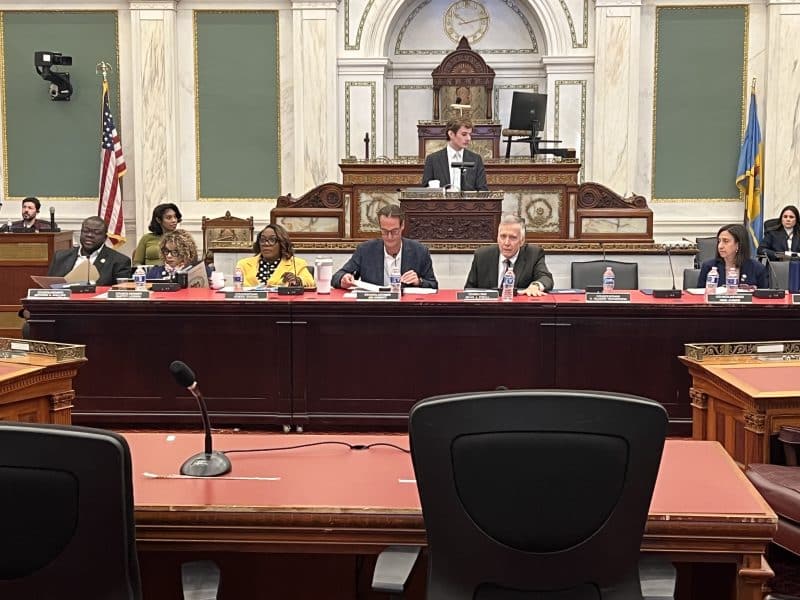
The Philadelphia City Council Committee on Technology heard testimony on the city’s use of artificial intelligence (AI) in city governance, as well as the possible advantages and pitfalls of this burgeoning technology.
Kristin Bray, the Chief Legal Council to Mayor Cherelle Parker, said utilizing the potential of AI requires careful planning.
“That’s why we’re building a framework for how we will use emerging technology, like article intelligence, guided by three principles; human-centered judgement, public trust and accountability, and using smart tools responsibly,” Bray said.
Bray also acknowledged the potential risks of of AI technology, warning of the potential for bias.
“Automated systems can make mistakes that affect people’s lives,” Bray said. “That’s why the second principle that guides our framework is rooted in transparency, fairness, and accountability, ensuring every use of artificial intelligence is responsible, explainable, ethical, and within constitutional and other legal parameters.”
Dr. Sorelle Friedler, Professor of Computer Science and former official in the White House Office of Science and Technology, said the one thing she hoped the committee took from her testimony is that AI is not designed to work all the time.
“The guarantees we make about AI as computer scientists are statistical,” Friedler said. “We might say ‘this system achieves 98% accuracy.’ 98% sounds good, but it also means we got it wrong 2% of the time. A lot of AI governance is about making sure there are systems in place to handle that 2%.”
“Given our city’s population,” Friedler continued. “If an AI system with a 2% error rate makes a decision about everyone in the city, that’s more than 31,000 people who will get the wrong result. We need plans in place to determine who will suffer from these errors and staffing to help people fix them.”
Friedler said for the city to have control and make sure AI systems used by the administration actually do the job, the following would be required: testing requirements, human review processes, and transparency as to how AI is being used in the city.
Transportation Committee Hears Testimony on Silverliner Trains
The Philadelphia City Council Committee on Transportation and Public Utilities heard testimony regarding SEPTA’s Regional Rail Silverliner IV fleet which has experienced five emergency situations, including fires, in the last year.
On October 1st of this year, the National Transportation Safety Board issued a report, followed by an emergency order by the Federal Railroad Administration (FRA) requiring SEPTA to “take certain immediate actions to abate the risk of additional fires and other thermal incidents and implement steps to ensure the safe operation of its passenger trains consistent with Federal railroad safety requirements…”
Scott Sauer, the General Manager of SEPTA, outlined the steps the FRA are requiring of SEPTA, including further training for staff, installation of new thermal detectors, and daily inspections. To date, 52 cars have received the thorough inspections reuqired by the FRA.
However, the new requirements are leading to disruptions in service.
“I recognize that our customers are feeling the strain,” Sauer said. “SEPTA has been advising customers of possible Regional Rail trip delays, cancellations, and overcrowded conditions during their commutes as Silverliner rails cars are rotated from service for enhanced inspections, testing, and important safety upgrades.”
Regarding the purchase of new rail cars, Sauer said SEPTA was, at best, four years away from seeing the first pilot car of a new fleet due to the extensive ordering and building practices of manufacturers. Sauer said SEPTA would expect to qualify for the Department of Transportation’s Transportation Infrastructure Finance and Innovation Act (TIFIA) program, which provides low interest loans and flexible terms.
However, SEPTA has yet to begin this process, leading to criticism from advocates who testified at the hearing.
Lance Haver, Hall Monitor’s consumer reporter who was speaking as an independent citizen, inquired as to why the committee hadn’t asked why SEPTA has not applied for the TIFIA program already.
“Nobody said to him, ‘this is a 50 year problem…why didn’t SEPTA borrow the money to buy new rail cars,” Haver asked. “Why did SEPTA wait for them to catch on fire and (only) then say something?”
Members of the committee agreed to send staffers to the next SEPTA board meeting to monitor developments.
Thomas Offers Hearing Resolutions, Restaurant App Bill
Councilmember Isaiah Thomas introduced a resolution “authorizing the Philadelphia City Council Committee of the Whole to hold hearings to discuss the current state of Philadelphia school facilities, how the School District evaluates those facilities and what the educational facilities needs are for the school district today and in the future.”
According to the resolution, the School District of Philadelphia manages 300 buildings spread over 140 square miles with an average age of 73 years. In recent hearings, the district said their total capital liability was nearly $7 billion, and grew by $200 million per year.
Thomas also offered a resolution “authorizing the Committee on Legislative Oversight and the Committee on Transportation and Public Utilities to hold joint hearings to investigate the rising costs of energy bills, what is driving those increases, and what the city can and can’t do to address why our energy bills are so high.”
The resolution makes mention of the 11% hike in energy bills, despite a drop in usage. Commonly cited causes for the increase in prices is a burgeoning scarcity created by the rise of energy-gobbling data centers and structural stress brought about by climate change.
Looking to curb predatory behavior aimed at local restaurants, Thomas introduced a bill banning third-party reservations services, such as web applications, from “listing, advertising, promoting, or selling reservations of a food service establishment without a prior written authorization the food service establishment.”
The penalty for each violation of the ordinance will be $1000; the Department of Licenses and Inspections will be charged with enforcment.
Young Seeks Reform of Later Water Penalties
Councilmember Jay Young introduced a bill exempting “certain residential customers from penalties and interest for late payment of water and sewer rent charges.”
The legislation changes a section of the city code adopted in 1960 which prescribed the various fees and penalties related to delinquent water bills. The original section of the code stipulated that the fees apply beginning January 1st, 1960.
The amendment to the code no longer applies to water and swerve charges to residential customers which accrue on or after July 1st, 2026.
Our reporters sit through hours of city council meetings, dig through piles of documents, and ask tough questions other media overlook. Because we’re committed to addressing Philadelphia’s poverty crisis — and challenging those who sustain it. If you think this work is important too, please support our journalism.
We’re counting on readers like you.