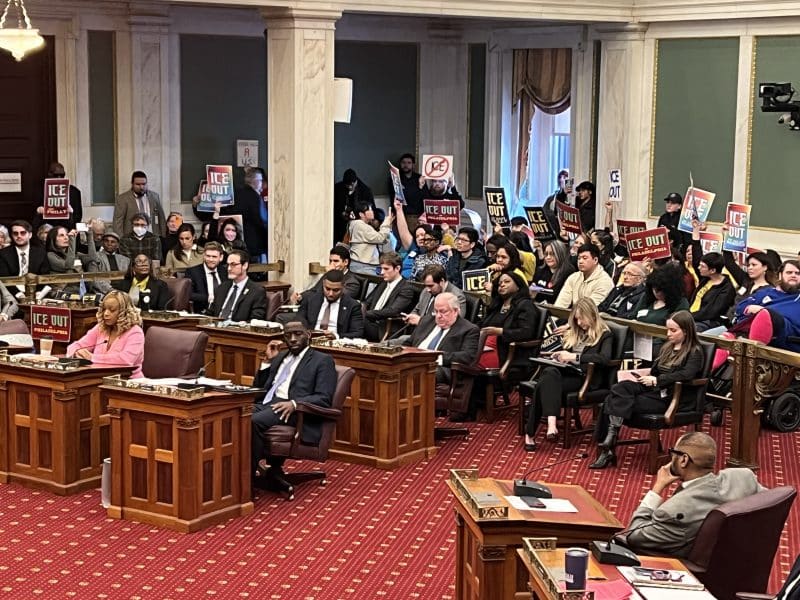
Councilmember Jimmy Harrity introduced a resolution “authorizing the Committee on Labor and Civil Service and the Committee on Transportation to hold joint hearings regarding the arrival of driverless rideshare vehicles in the City of Philadelphia and its impact on labor, the local economy, and public safety.”
According to the resolution, 60,000 Philadelphians depend on income earned through rideshare employment. An influx of self-driving vehicles could harm the ability of current rideshare drivers to earn that income, many of whom are first-generation Americans who rely on the service as their primary means of support. Part-time drivers looking to supplement their income would also surely be affected. This could also harm the city’s tax base.
Safety issues are a major concern as well, as the city’s smaller streets could pose a problem for driverless vehicles. According to the National Highway Traffic Safety Administration, over 1400 driverless vehicles have been in accidents, some resulting in major injuries and fatalities, since July of 2021.
Harrity also introduced a companion resolution “calling on the General Assembly of Pennsylvania to establish a comprehensive regulatory framework and conduct a formal safety and labor impact review of driverless rideshare vehicles operation in Philadelphia and throughout Pennsylvania.”
This subsequent resolution raises several concerns mentioned in the first, except the acknowledgment that Pennsylvania has no regulatory framework in place regarding driverless vehicles.
Bass’s Dog Breeding Bill Advances
In this week’s Rules Committee Hearing, Councilmember Cindy Bass’ legislation placing a moratorium on the breeding and transfer of puppies in Philadelphia received a favorable recommendation and had its first reading in City Council on Thursday.
The unregulated breeding of puppies in the city has led to an influx of dogs being surrendered to the city’s Animal Control Agency (ACCT Philly). Consumers also suffer when purchasing puppies from unlicensed breeders, as there is a greater risk of serious illness and less accountability for the dog’s health.
The moratorium adds the following text to the city code:
Any person who keeps, harbors, or has custody or control of a female dog within the
City of Philadelphia shall take reasonable measures, including but not limited to spay
surgery, supervision, confinement, and/or separation from intact male dogs, to
prevent the birth of a litter of puppies, unless expressly exempted under this Chapter.
The birth of a litter of puppies shall constitute prima facie evidence of a violation of
this section.
No person, business or entity shall transfer, offer for transfer or advertise for transfer
any dog under seven (7) months of age (“puppy”), except as provided in subsection
(2). A person shall not conduct or arrange a hand-off outside the City for the
purpose, or with the effect, of evading this Subsection. Any such transaction shall be
deemed to occur within the City.
This article is a part of Every Voice, Every Vote, a collaborative project managed by The Lenfest Institute for Journalism. The William Penn Foundation provides lead support for Every Voice, Every Vote in 2024 and 2025 with additional funding from The Lenfest Institute for Journalism, Comcast NBC Universal, The John S. and James L. Knight Foundation, Henry L. Kimelman Family Foundation, Judy and Peter Leone, Arctos Foundation, Wyncote Foundation, 25th Century Foundation, Dolfinger-McMahon Foundation, and Philadelphia Health Partnership. To learn more about the project and view a full list of supporters, visit www.everyvoice-everyvote.org. Editorial content is created independently of the project’s donors.
Our reporters sit through hours of city council meetings, dig through piles of documents, and ask tough questions other media overlook. Because we’re committed to addressing Philadelphia’s poverty crisis — and challenging those who sustain it. If you think this work is important too, please support our journalism.
We’re counting on readers like you.