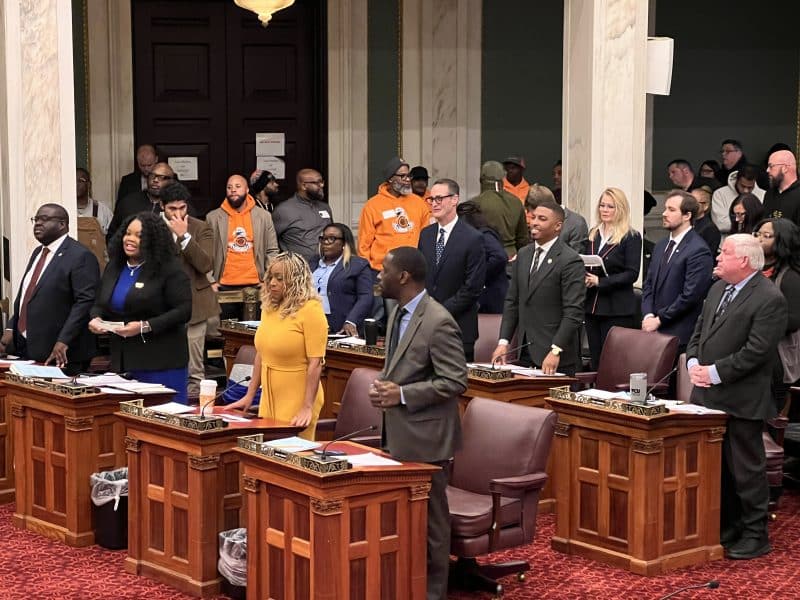
The Philadelphia City Council Committee on Labor and Civil Service heard testimony on Resolution No. 250028, “authorizing the Committee on Labor to hold hearings exploring the Sugar-Sweetened Beverage Tax and its impact on Philadelphia businesses, trades, and Consumers.”
The tax, which was implemented in 2016, generated $67 million in revenue in Fiscal Year 2025 dedicated to PHLPreK (a pre-kindergarten program) and, indirectly, the Rebuild program. In 2025, the tax funded 5250 pre-k seats at an average cost of $10,000 per seat.
Held at the behest of Councilmember Jim Harrity because of concerns raised to him by city residents and labor unions who attribute job loss to the tax, opinion amongst witnesses regarding the future of the tax were mixed. Harrity also questioned the tax’s suitability to continue financing these projects, as revenues have declined each year since inception.
Rob Dubow, the city Finance Director, acknowledged the diminishing returns in his testimony, but suggested they were expected and built into the city’s Five-Year Plan.
“The tax is estimated to have generated $68.2 million in FY25 and is projected to generate $64.4 million in FY 26,” Dubow said. “This trend aligns with nation patterns of reduced consumption of sweetened beverages.”
Dubow said without the tax, the PHLPreK seats and Rebuild projects would not have been possible.
However, the soda and grocery industries claimed the tax unfairly affected distributors and retailers, pointing to price increases and job-loss statistics.
John O’Rourke, Vice President of Teamsters Local Union 380, said his union had felt the unintended effects of the tax more than anyone else in the beverage industry.
“When the brunt of the tax was first felt and beverage sales bottomed out, approximately 1000 Local 830 members were laid off reluctantly or quit the union altogether due to a lack of beverage sales,” O’Rourke said. “The average annual salary of those 1000 lost Local 830 members was $55,000, meaning Teamsters Local 830 lost a total of $55,000,000 in members’ salaries.”
Christina Roberto, the Mitchell J. Blutt and Margo Krody Blutt Presidential Professor of Health Policy and Director of the Center for Food and Nutritional Policy at the University of Pennsylvania, testimony praised the health benefits of the tax, citing 8 years of studies regarding the impact of the tax on health outcomes.
“This research shows that the tax has improved health, particularly for the lowest income Philadelphians,” Roberto said.
She also addressed beverage industry claims the tax had caused job losses and forced grocery stores to close.
“We studied unemployment claim filings in Philadelphia compared to those in other untaxed Pennsylvania counties on year before and after the tax,” Roberto said. “We saw no change in unemployment claims overall or in industries affected by the tax, such as supermarkets and soda companies.”
While no action was taken in relation to this hearing, it is likely this subject will be raised again in the near future.
Water Infrastructure Hearing Exposes Issues in System
The Joint Committees on Streets & Services and Transportation & Public Utilities heard testimony on a resolution “examining water main breaks and sinkholes occurring in District 7 evaluating the underlying causes of these issues, and identifying solutions to prevent and mitigate their frequency.”
Councilmember Quetcy Lozada, the sponsor of the resolution, opened the hearing decrying the state of water infrastructure in her district, the response of the Water Department, and how non-city actors responsible for damaging public water lines are held to account.
Councilmembers Anthony Phillips and Jay Young, both committee members, shared similar concerns, as both of their districts have seen water-related issues in the past few weeks. Phillips in particular has been extremely critical of the Water Department’s response to issues in the Ninth District.
Benjamin Jewell, the newly installed Commissioner of the Philadelphia Water Department, explained the vastness and complexity of the water main and sewer system that runs throughout the city, which includes 3057 miles of water mains, of which 328 miles are in the 7th District, and 3729 miles of sewers, of which 270 miles are in Lozada’s district.
Jewell said certain maintenance costs had increased by 75%, leading to reductions in the amount of water mains and sewer lines that can be repaired annually.
Community members shared harrowing tales of flooding in their homes, having to pay out-of-pocket for repairs they believed were covered by additional insurance they had purchased, and lackluster customer service from the department.
Maria Orona, a resident of the 7th District, detailed the numerous problems she’s had, ranging from flooding leading to mold and other serious issues to irresponsible contractors and developers.
“My life has been a living nightmare,” Orona said. “There is no reason why the city of Philadelphia has allowed this to go this far.”
Orona later said her bills related to the constant unresolved issues reached nearly $40,000.
The hearing was more of an attempt to hear resident concerns and discuss Water Department procedures and operations than reach any immediate conclusions. An upcoming hearing on rising utility rates, which has yet to be scheduled, could provide more insight into this issue, in addition to shedding light on the shocking increases in utility bills over the last few years.
Committees Hear Concerns Regarding GPS Monitors
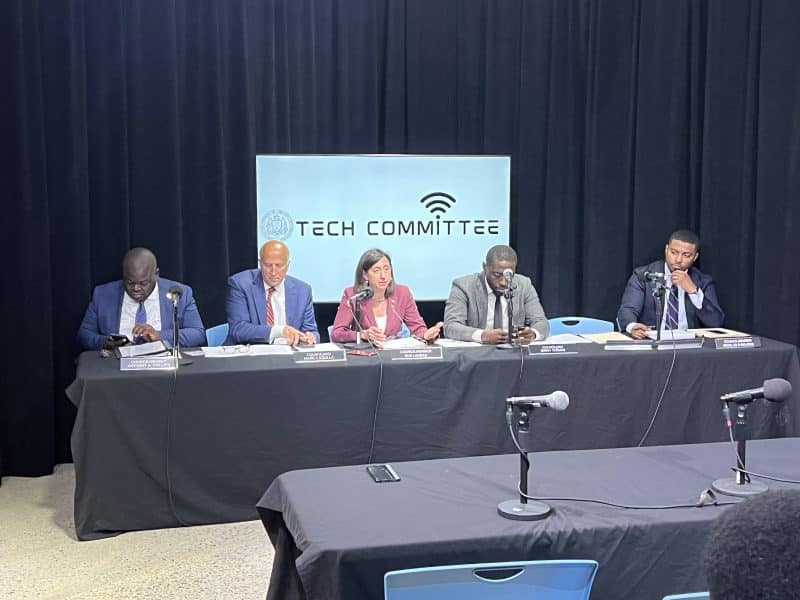
The Joint Committees on Children & Youth and Technology & Information Services heard testimony on “the use of electronic monitoring or Global Positioning Systems (GPS) for youth involved with Philadelphia’s Juvenile Justice System.”
Who is placed on a GPS monitor is determined by a judge prior to trial.
Philadelphia maintains a complement of 350 ankle-bracelet GPS monitors, which are used by nearly 1900 youth annually. The monitors are purchased by a third-party vendor who is also the custodian of information gathered by the devices. However, it can only be accessed by the Juvenile Branch of the city’s Family Court division.
Councilmember Rue Landau, chair of the Technology Committee, raised specific questions about the sharing of data related to federal government inquiries, most notably Immigration and Customs Enforcement, known as ICE.
Faustino Castro-Jimenez, Chief of Probation for the Juvenile Branch of Family Court, was unsure about specific language regarding the sharing of sensitive data with other law enforcement entities. However, Castro-Jimenez did say Family Court did sometimes share data.
“We do share, sometimes, data based upon requests (from other offices), Castro-Jimenez said. “(We do so) for public safety reasons and when there is a crime…to protect the citizens of Philadelphia and the children we have under our supervision.”
While Castro-Jimenez later clarified his department had never shared information with ICE, Landau emphasized, based on the uncertainty of Castro-Jimenez’s answer, that it is possible requests from federal agencies could be accommodated.
“Let me be clear,” Landau said. “Chrildren will not be safe in their own homes if the First Judicial District shares this information with ICE.”
Data from the GPS devices is held for seven years, long after cases are adjudicated.
Joshua Levan, a 19 year-old from West Philadelphia, shared his experiences with GPS monitoring, explaining the negative effects the device had on his life.
“I was on GPS for two years (before trial),” Levan said. “It took a toll on my life because I was confined to the house and couldn’t go anywhere. I was very depressed and anxious.”
Levan said he was eventually placed in jail because of an unstable housing situation, which exacerbated an already bad situation.
“Even my family was looking at me in a different way, because they had doubts about me (turning) my life around,” Levan said.
Kate Weisburd, a Professor of Law at the University of California, testified that electronic monitoring is not a harmless alternative to incarceration, as the practice “restricts a young person’s liberty, limits privacy, harms youth with disabilities, disrupts family relationships, and jeopardizes positive educational and employment outcomes.”
Weisburd also said there was “no reliable empirical evidence that electronic monitoring furthers the rehabilitative goals of the juvenile court.”
“To the contrary,” Weisburd said. “Adolescent brain development research suggests that subjecting youth to long-term electronic surveillance is harmful to their development during the critical period of adolescence.”
Updated HOME Resolution Sees Revisions
The resolution detailing the the expenditures for the first disbursements of Mayor Cherelle Parker’s signature HOME initiative was formally introduced in City Council. The changes to the first nearly $200 million of the overall $800 million plan are as follows:
| Program | Original Allocation | Updated Allocation |
| Adaptive Modifications Program | $8,500,000 | $8,500,000 |
| Affordable Housing Preservation Funds | $37,500,000 | $29,627,500 |
| Affordable Housing Production Funds | $19,420,833 | $24,343,333 |
| Basic Systems Repair Program | $34,775,000 | $34,775,000 |
| Built to Last | $8,250,000 | $8,250,000 |
| Comprehensive Land and Property Acquisition Program | $4,000,000 | $4,000,000 |
| Curbside Appeal Program | $1,000,000 | $1,000,000 |
| Employer-Assisted Housing | $500,000 | $500,000 |
| Facade Improvement Program | $1,000,000 | $1,000,000 |
| Homeless Prevention | $3,800,000 | $3,800,000 |
| Housing Counseling and Foreclosure/Eviction Program | $2,850,000 | $ |
| Housing Plus Rental Assistance (PHL Housing Plus) | $1,800,000 | $1,800,000 |
| Neighborhood Infrastructure Improvement Programs | $2,000,000 | $2,000,000 |
| One Philly Mortgage Program | $25,000,000 | $25,000,000 |
| Philadelphia Accelerator Fund (Multi-family) | $5,000,000 | $1,500,000 |
| Philadelphia Accelerator Fund (Turn the Key) | $1,500,000 | $1,500,000 |
| Philly First Home | $8,666,6667 | $10,666,667 |
| Purchase Bank Liens | $600,000 | $600,000 |
| Remove Vacant or Blighted Housing through Demolition | $3,000,000 | $3,000,000 |
| Rent and Moving Assistance Program (Fresh Start PHL) | $1,000,000 | $1,000,000 |
| Rental Improvement Fund (RIF) | $4,500,000 | $4,500,000 |
| Shallow Rent Assistance, Property Based | $434,783 | $434,783 |
| Shallow Rent Program, Tenant-Based | $2,000,000 | $2,000,000 |
| Tangled Title Prevention and Resolution Program | $1,250,000 | $2,200,000 |
| Wills Program | $1,250,000 | $1,250,000 |
| Eviction Diversion/Targeted Financial Assistance | $15,000,000 | $15,000,000 |
Legislation Passed on October 30th, 2025
Resolution No. 250930
INTRODUCED BY: Councilmember Young
Resolution also naming Oxford Street between Broad Street and 15th Street as “Jake and Sarah
Adams Avenue.”
Bill No. 250572
INTRODUCED BY: Councilmember Gilmore Richardson for Council President Johnson
An Ordinance amending Section 2-112 of The Philadelphia Code, entitled “City Commissioners,” by
removing the powers and duties of the Department of Licenses and Inspections over matters relating
to weights and measures; amending Title 9, entitled “Regulation of Businesses, Trades and
Professions,” by removing provisions relating to amusement devices, and weights and measures and
making related technical changes; and amending Title 19, entitled “Finance, Taxes and Collections,”
by eliminating provisions related to amusement licenses and weights and measures registration; all
under certain conditions.
Bill No. 250577
INTRODUCED BY: Councilmember Squilla
An Ordinance repealing in its entirety the following Ordinance, approved December 23, 2024: Bill
No. 240964-A02 (authorizing the City of Philadelphia to organize an authority to be known as The
Arena Services District Authority, pursuant to the terms of the Pennsylvania Municipality Authorities
Act, all under certain terms and conditions).
Bill No. 250772
INTRODUCED BY: Councilmember O’Neill
An Ordinance adding a new Chapter 21-3500 of The Philadelphia Code, entitled “Public Utility
Meters,” to prohibit provision of a second utility meter by a public utility at a residential property
without evidence of a valid housing rental license for the property, under certain terms and conditions.
Bill No. 250767
INTRODUCED BY: Councilmember Gilmore Richardson for Council President Johnson
An Ordinance repealing in its entirety Bill No. 240415 (approved July 19, 2024), entitled “An
Ordinance to amend the Philadelphia Zoning Maps by changing the zoning designations of certain
areas of land located within an area bounded by Island Avenue, the Delaware Expressway, and
Bartram Avenue.”
Bill No. 250773
INTRODUCED BY: Councilmember Squilla
An Ordinance amending Chapter 9-4900 of The Philadelphia Code, entitled “Prohibition on Use of
Certain Bags by Retail Establishments,” to modify certain definitions, require retail establishments to
charge a fee for the provision of a bag to customers, and require signage, all under certain terms and
conditions.
Bill No. 250800
INTRODUCED BY: Councilmember Phillips
An Ordinance amending Title 14-602, entitled “Use Tables,” by prohibiting drug paraphernalia sales
in certain industrial districts, all under certain terms and conditions.
Bill No. 250802
INTRODUCED BY: Councilmember Jones
An Ordinance amending Title 14 of The Philadelphia Code, entitled “Zoning and Planning” by revising
and clarifying certain provisions and making technical changes to text that has expired, all under
certain terms and conditions.
Bill No. 250803
INTRODUCED BY: Councilmember Jones
An Ordinance amending Section 14-524 of The Philadelphia Code, entitled “/FDO Fourth District
Overlay District” by clarifying allowed uses, all under certain terms and conditions.
Bill No. 250808
INTRODUCED BY: Councilmember Squilla
An Ordinance amending Title 14 of The Philadelphia Code, entitled “Zoning and Planning” by revising
and clarifying certain provisions and making technical changes to text that has expired, all under
certain terms and conditions.
Bill No. 250810
INTRODUCED BY: Councilmember Bass for Council President Johnson
An Ordinance amending Title 14 of The Philadelphia Code, entitled “Zoning and Planning” by
clarifying certain provisions related to mixed income housing, revising the quality standards for
affordable units within mixed income developments and making related technical changes, all under
certain terms and conditions.
Bill No. 250811
INTRODUCED BY: Councilmember Bass
An Ordinance to amend the Philadelphia Zoning Maps by changing the zoning designations of certain areas of land located within an area bounded by Ardleigh Street, East Sedgwick Street, the SEPTA Chestnut Hill East Line and East Gorgas Lane.
Our reporters sit through hours of city council meetings, dig through piles of documents, and ask tough questions other media overlook. Because we’re committed to addressing Philadelphia’s poverty crisis — and challenging those who sustain it. If you think this work is important too, please support our journalism.
We’re counting on readers like you.