The Philadelphia City Council Committee on Commerce heard legislation on Bill No. 240582, which would amend previous legislation defining “serious nuisance businesses.” The current definition of a critical nuisance business is “a business with respect to which a business owner has been issued a notice concerning serious violent behavior or obstruction of an investigation of serious violent behavior.” The amendment adds the language “on more than one occasion during any twelve (12) month period.”
Councilmember Jay Young, the legislation’s sponsor, said the change was needed because one incident may be too strict, citing the case of an octogenarian business owner in the 5th District.
“There was an incident where a property owner who is a business owner, who has been a lawful business owner for a number of years was deemed to be critically nuisance after one incident for the past 20 something years outside of this business,” Young said, describing the difficulty the owner encountered in reopening the business, and the effect the closure had on employees.
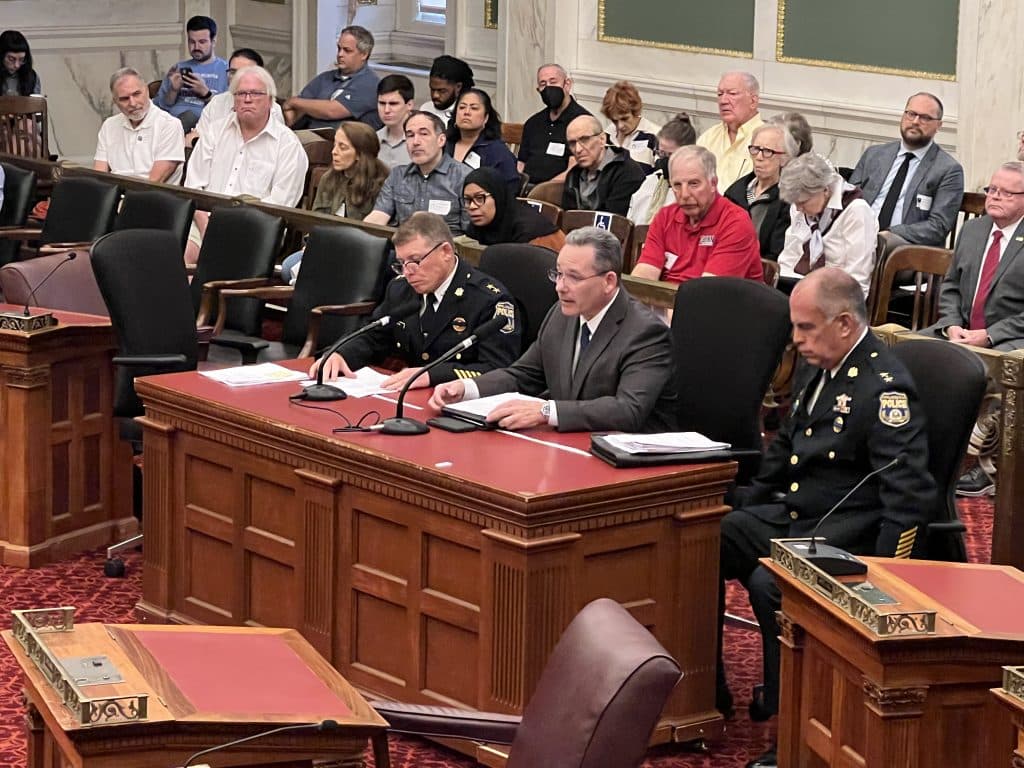
Francis Healy, the Deputy Commissioner of the Office of Professional Responsibility and Legal Affairs for the Philadelphia Police Department, however, took issue with the amendment, raising concerns that its passage would interfere with the department’s ability to respond to violent encounters at businesses.
“If there is no nexus (connection) between the business and the violence that occurs, the business owners have nothing to fear,” Healy said. “There is absolutely no need to allow a second violent incident to occur before the police department can take action.”
Healy said the proposed amendment would contradict the work put into the 2023 legislation.
OPA Provides Testimony on Office Building Values
Also heard in the Commerce Committee was testimony regarding the valuation of commercial office buildings in Center City.
James Aros, the Chief Assessment Officer for Office of Property Assessment (OPA), testified that the total value of the office buildings in Center City is currently $8.78 billion, which is down from the 2021 assessment, which valued the buildings at $9.82 billion.
According to Aros, the $ 1 billion decline can be attributed to “higher vacancy rates and higher capitalization rates, which is a real estate metric that estimates the rate of return on an investment property.”
Prema Gupta, CEO of the Center City District, testified that Center City has about 40 million square feet of office space, a static number compared to 30 years ago, but available suburban office space has increased exponentially over the same period.
“In the last thirty years, the supply of suburban office space in our region has grown from 25 million square feet to 60 million square feet,” Gupta said.
The vacancy rate for Center City office buildings is 19%, up from 9% before the pandemic.
Joint Committee Hears Testimony on ATV, Car Meetups
The Joint Committees on Public Safety and Streets & Services met to hear testimony on the increase in car meetups and ATV usage in the city.
Francis Healy, Deputy Commissioner of the Office of Professional Responsibility and Legal Affairs for the Philadelphia Police Department, said a citywide police task force had been created to address the car meetups. The task force is most active during weekend hours.
A separate detail of PPD dirt bike-trained officers has also been created to combat illegal ATV riding. According to Healy, hundreds of ATVs have been seized.
Recent legislation allows police to issue $2000 fines for those who drive vehicles illegally.
Deputy Commissioner Michael Cram, head of patrol operations, said 99% of car meetups break into small groups and flee when police arrive, usually at high rates of speed. Police do not pursue the vehicles due to safety concerns.
“You get about the 1% of the time where they’ll have 50 to 100 cars, and they’ll take over an intersection,” Cram said. “As soon as an officer arrives, they’ll wait a couple of minutes and do their thing. They want the backdrop of the officer being in the photo.”
Cram said some of the meetups are well-organized and include professional videographers.
The special squads will continue to monitor hotspots throughout the city as the situation continues.
Our reporters sit through hours of city council meetings, dig through piles of documents, and ask tough questions other media overlook. Because we’re committed to addressing Philadelphia’s poverty crisis — and challenging those who sustain it. If you think this work is important too, please support our journalism.
We’re counting on readers like you.