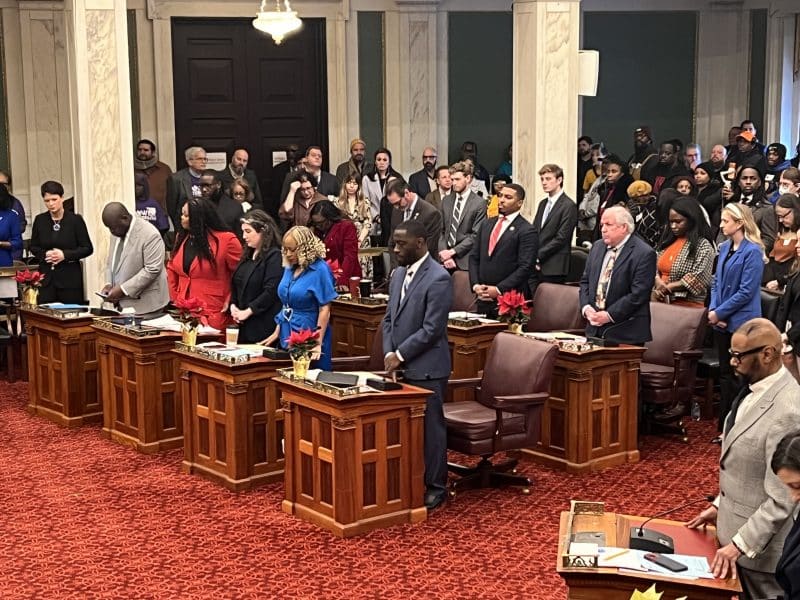
The Philadelphia City Council Committee on the Environment heard testimony on Bill No. 250768, which would prohibit the City from entering into waste disposal contracts that dispose of garbage by use of an incinerator.
Currently, the city sends roughly 30% of its garbage to the Reworld incinerator in Chester, Pennsylvania, which is the largest trash incinerator in the United States. The effects of the incinerator on Chester are manifold; higher childhood asthma rates, concerns over cancer-causing particulates in the air, a lack of meaningful development along the incinerator site, and several other pressing concerns.
Councilmember Jaime Gauthier, the sponsor of the legislation, said the effects of the incinerator not only harm Chester, but Philadelphia also.
“One in five of our young people have asthma, earring us the unfortunate designation as a 2025 asthma capital,” Gauthier said. “The city’s priority is making Philly safer, cleaner, and greener, but we cannot do this at the expense of our neighbors, who are left sicker, dirtier, and less safe because of the trash we send into their air.”
Stefan Roots, mayor of Chester, said that while Delaware County had committed to ending it’s own practice of using the incinerator, New York City still maintained a long-term contract with Reworld. Roots said he had addressed the issue via letter with Philadelphia Mayor Cherelle Parker.
“In my very first communication with her, I pleaded with her to divert Philadelphia’s trash away from the incinerator in Chester,” Roots said. “I haven’t yet received a reply.”
Kristin Ball Motley, health commissioner for the City of Chester, said the air that is polluted with toxic emissions from the incinerator in Chester does not stop at the city’s border.
“These toxic emissions further exacerbates (Philadelphia’s) high rates of infant deaths (40% higher than the national average), cancer deaths (30% higher than the national average), and pediatric asthma (3 times worse than the national average),” Motley said.
However, despite the information provided by the leadership team from Chester, Philadelphia officials seemed wary of moving away from incinerating the city’s garbage.
In additional to the Chester incinerator, Philadelphia also sends garbage to landfills, with 430,000 tons, or 70%, going to facilities in Bucks County.
Carlton Williams, the city’s Director of Clean and Green initiatives, said more data was needed to determine if the environmental effects of the incinerator were significantly worse than landfills.
“There are pros and cons to to both waster disposal processes,” Williams said. “Waste-to-energy reduces volume by about 90%, produces energy, and can reduce greenhouse gases compared to landfills. However, waste-to-energy facilities can be a source of air pollution, and generate ash that needs proper disposal.”
Williams cited a 2016 Environmental Protection Agency study that stated “waste-to-energy is viewed as more sustainable than traditional landfills.”
Williams asked that the legislation be held in committee until the contracting process was complete and “all options to manage and dispose of the City’s waste” were considered.
Not surprisingly, representatives from Reworld, the owners of the incinerator, claimed the facility operated well within accepted regulatory standards. Brian Stormwind, an air quality services manager at AECOM, a Texas-based civil engineering firm, said “comprehensive studies” had been undertaken.
“Ultimately, the results of the analysis were evaluated relative to EPA thresholds that they deem acceptable for facilities such as this,” Stormwind said. “The results of the health risk assessment show that the facilities were below the thresholds for cancer, acceptable cancer rates, and particulate matter.”
However, Councilmember Nina Ahmad, a trained scientist, quickly disputed AECOM’s findings, forcing Stormwind to admit the details of the report were hypothetical as they did not include studies on actual residents of Chester, despite Stormwind’s assertion that the studies followed EPA guidelines.
“I’m saying it’s not acceptable,” Ahmed said. “With all the profits (Reworld) is making, you (have the perfect opportunity) to have a really detailed study on the real people of Chester. We don’t have that.”
The bill was favorably recommended by the committee by a vote of 5-1, with Councilmember Mike Driscoll the lone dissenting vote.
Gauthier Introduces “Just Water” Package
Councilmember Jaime Gauthier introduced a package of legislation aimed at making water bills more affordable for Philadelphians.
Dubbed the “Just Water” package, the two bills and one resolution do the following:
- Expand eligibility for the Tiered Assistance Program (TAP) to 200% of the Federal Poverty Level (FPL). Households earning up to 300% of the FPL would qualify for structured payment plans.
- Require the City to share responsibility for long-term (12+ months) water meter failures that result in runaway water bills.
- Investigate solutions for tenants who are at risk of losing access to water or are ineligible for water assistance programs because, unlike other utility bills, PWD doesn’t allow renters to put water bills in their name.
As Hall Monitor has reported, water rates have been increasing each year, essentially adding an additional tax burden on Philadelphia residents. In 2025, rates increased by 9.4%, with another 5.5% increase scheduled for 2026.
Driscoll Calls for Certain BIRT Tax Reductions
Councilmember Mike Driscoll introduced a bill “to exempt sole proprietorships and single-member limited liability companies from some or all of the Business Income and Receipts Tax.”
The city eliminated the BIRT exemption that excused businesses that earned under $100,000 from the tax due to a legal challenge. The city’s refusal to take the matter to a higher court was seen by many small business owners as a tax increase.
Driscoll’s legislation makes the following change to the BIRT law:
For tax year 2026 and thereafter, any business conducted by an entity owned and operated as a sole proprietorship by an individual or by a single-member limited liability company whose sole member is an individual.
Our reporters sit through hours of city council meetings, dig through piles of documents, and ask tough questions other media overlook. Because we’re committed to addressing Philadelphia’s poverty crisis — and challenging those who sustain it. If you think this work is important too, please support our journalism.
We’re counting on readers like you.