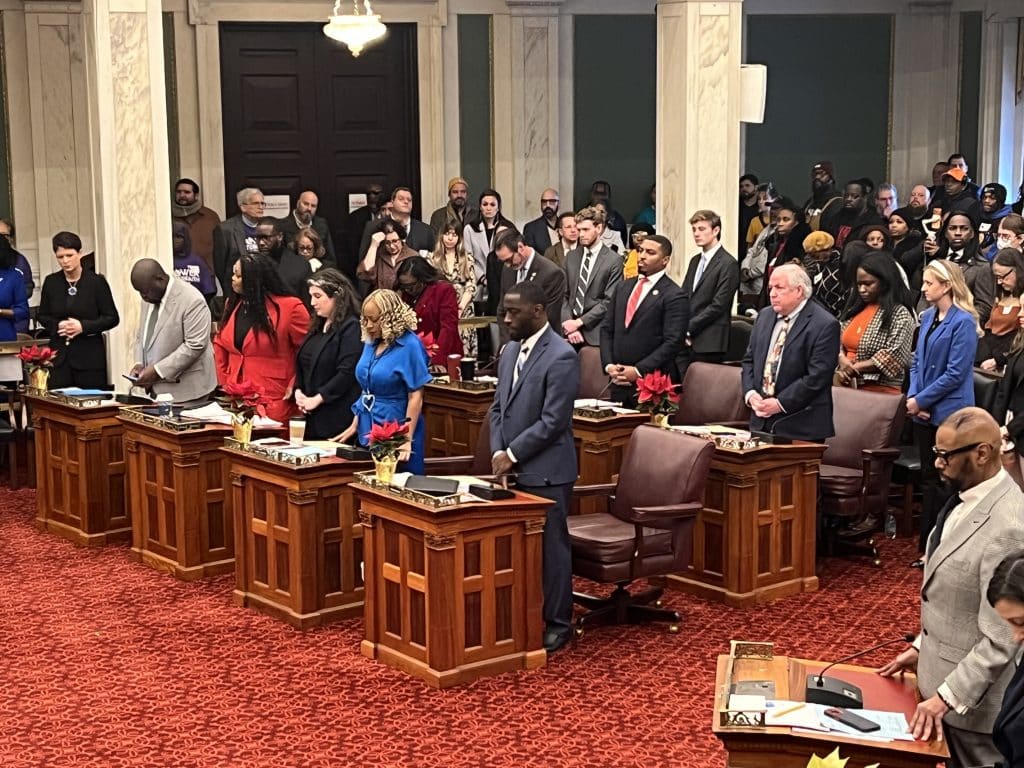
The Philadelphia City Council Committee on Intergovernmental Cooperation heard testimony on amendments to Bill No. 251065, which amended Bill No. 250568, the legislation authorizing the financing of Mayor Parker’s $800 million HOME Plan.
Over the course of the previous week, tensions around the execution and final form of the first bond issuance had reached a fever pitch between City Council and the Mayor’s office, with dueling press releases claiming the other side was misrepresenting the facts around the program. This dispute culminated with Mayor Parker embarking on a short tour of churches to campaign for her version of the program, and privately lobbying councilmembers and ward leaders.
Councilmember Jaime Gauthier, chair of the Housing Committee, opened the hearing by lamenting “the misinformation spread about City Council’s amendments to the HOME program.”
“I appreciate the opportunity to correct the record about the bond ordinance and the amended Year One HOME Program unanimously approved by the Committee of the Whole last week,” Gauthier said. “We expanded eligibility for the City of Philadelphia’s two most in-demand housing repair programs, Basic System Repair and Adaptive Modification for the first time ever so that higher income earners can take advantage of these popular services.”
Gauthier went on to say City Council had doubled the number of eligible households that are now eligible to participate in these programs.
“So to hear people claim this body is pitting higher income folks against working families, it’s really hard to tell if this is a misreading of the facts, or a deliberate attempt to misinform,” Gaiuther said.
On behalf of the Administration, Mayor Parker’s Chief of Staff, Tiffany Thurman, asserted the Administration had negotiated in good faith throughout the process, and called for what she deemed a necessary change to the amended legislation.
“There is one sentence in Bill No. 251065 that the Parker Administration does not support in its current form,” Thurman said. “If this sentence is not amended, then we cannot and will not support this ordinance in its entirety.”
The objectionable sentence reads in part: Budget counsel has the authority to establish a maximum area media income qualification for any program or sub-program. The established AMI qualification can apply to all of the funding allocated to such program or percentage of funding allocated to such program.
Essentially, the Administration would like the programs to be freed from requirements mandating percentages of the funding go to those living in poverty. Instead, the Administration would like anyone who qualifies to be able to access the program regardless of socioeconomic status.
The Administration attempted to introduce an amendment that would allocate 60% of the funding for those who are at 60% of AMI. The amendment was not introduced.
After the hearing, Chief of Staff Tiffany Thurman issued the following statement:
“We thank City Council for its vote today affirming the first year of spending on Mayor Cherelle L. Parker’s historic $2 billion H.O.M.E. Initiative to build, restore and repair 30,000 units of housing. There is a housing crisis in Philadelphia and we need action urgently on H.O.M.E., for existing homeowners, renters, and first-time homebuyers as well. We look forward to continuing conversations with Council President Kenyatta Johnson and members of City Council in the weeks ahead, and to fulfilling Mayor Parker’s strong vision to save Philadelphia’s rowhomes.”
The City Council version of the bill was recommended favorably from the committee.
Public Safety Committee Holds Hearing on Domestic Violence
The Philadelphia City Council Committee on Public Safety heard testimony on Resolution No. 250927, which authorized the committee to examine the City of Philadelphia’s strategies, laws, and policies for protecting victims of abuse and domestic violence within the justice system, including the Courts, the Sheriff’s Office, the District Attorney’s Office, and the Philadelphia Police Department.
While initiated due to the tragic death of Kada Scott, the hearing took a deeper and broader look at the processes of various city agencies, including the District Attorney’s Office.
Regarding domestic violence cases that come before the courts, Krasner presented a 23 month report that tracked all cases and their outcomes. Krasner said there is a high rate of dismissal at the preliminarily level.
“Cases do not go forward sometimes due to a failure on the part of the government,” Krasner said. “Sometimes the reason is we’re not right with our relocation or with our (treatment) of people who are suffering from trauma.”
Kranser also said a general distrust of the justice system and a fear of retaliation from the abusive partner also contribute to the high rate of dismissed cases. Over the last 23 months, Karsner said 272 felony abuse cases were dismissed, 96 resulted in a guilty verdict, and there were 561 no-contest pleas.
The implications of the city’s cash bail system were also discussed, as Scott’s murderer was able to secure his release by posting 10% of his $200,000 bail. The municipal court created a rule in 2019 requiring only 10% of the bail to be paid in order to be released.
The city utilizes bail commissioners, appointed by the Municipal Court, to determine the amount required for someone accused of a crime to be released. These commissioners rely on charts listing certain crimes and the prescribed level of bail.
In order to appeal a bail decision, the DAO can petition the courts by contacting an emergency judge, but Krasner had previously said this process can backfire, as some judges object to being contacted, sometimes in the middle of the night, and will actually reduce bail when an increase was requested, largely out of spite.
“There’s a track record for which emergency judges are just going to keep saying no,” Krasner said. “There’s a track record for which ones are going to lower the bail. It happens.”
In the Kada Scott case, however, the DAO did contact the emergency judge, but they also believed the $200,000 bail was appropriate, given the circumstances.
Krasner said the best way to combat domestic violence was to provide funding to groups who work with people who have experienced domestic violence, and he made a pitch to council for more DAO funding to hire between 5 and ten attorneys who would augment his office’s domestic violence operations.
Council Holds Hearing on Human Trafficking
The Philadelphia City Council Committee on Public Health and Human Services heard testimony on Bill No. 250990, legislation that would add protections for victims of human trafficking to the city’s employment discrimination statutes.
Councilmember Nina Ahmed, chair of the committee and sponsor of the legislation, said the bill was intended to give survivors or human trafficking a chance to rebuild.
“Nationally, more than one in three women experience physical or sexual violence or stalking in their lifetime,” Ahmed said. “What’s even more difficult is that most survivors never see justice in the traditional sense. It’s because the system is profoundly hard for survivors to navigate.”
District Attorney Larry Krasner said the legislation would have a positive impact for victims.
“If (a victim of human trafficking) has been (victimized), historically, they haven’t been able to pick up the phone and call the police because the expectation was they would be arrested, they would be prosecuted, they would (then have) a criminal record that would disqualify them from every job that would get them out of the life they were trying to escape,” Krasner said.
The legislation was passed with a favorable recommendation.
This article is a part of Every Voice, Every Vote, a collaborative project managed by The Lenfest Institute for Journalism. The William Penn Foundation provides lead support for Every Voice, Every Vote in 2024 and 2025 with additional funding from The Lenfest Institute for Journalism, Comcast NBC Universal, The John S. and James L. Knight Foundation, Henry L. Kimelman Family Foundation, Judy and Peter Leone, Arctos Foundation, Wyncote Foundation, 25th Century Foundation, Dolfinger-McMahon Foundation, and Philadelphia Health Partnership. To learn more about the project and view a full list of supporters, visit www.everyvoice-everyvote.org. Editorial content is created independently of the project’s donors.
Our reporters sit through hours of city council meetings, dig through piles of documents, and ask tough questions other media overlook. Because we’re committed to addressing Philadelphia’s poverty crisis — and challenging those who sustain it. If you think this work is important too, please support our journalism.
We’re counting on readers like you.